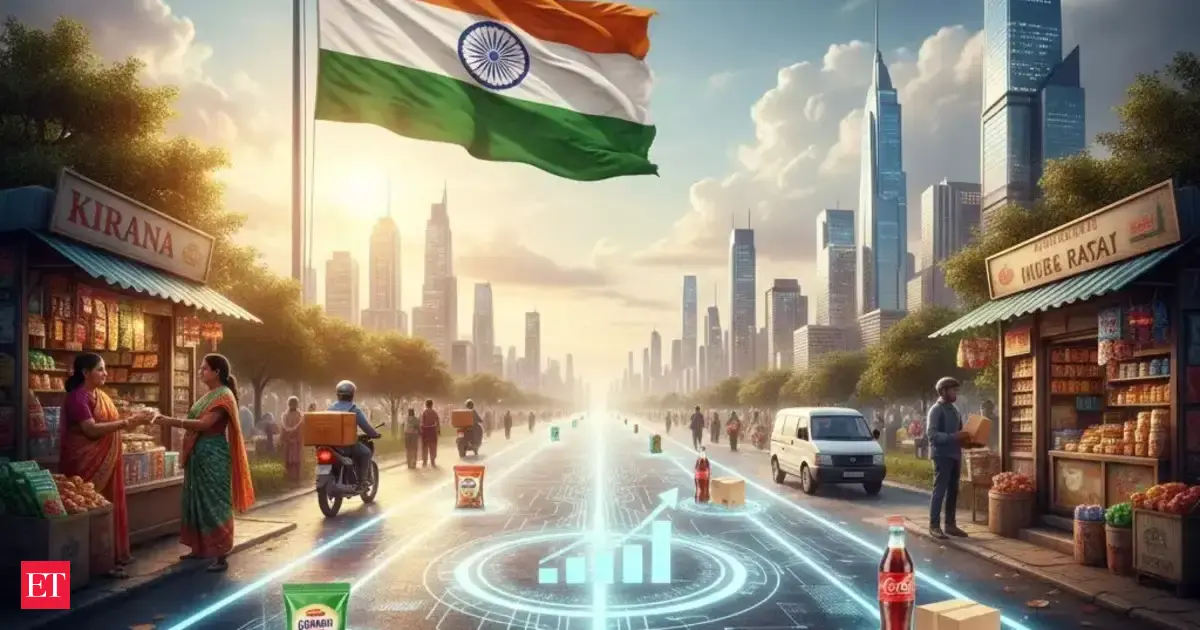
World’s biggest brands are testing their tricks in India first
हिंदी में सुनें
Listen to this article in Hindi
India's dynamic e-commerce and retail sectors are driving global innovation. Companies like Amazon and Walmart are replicating successful India-born models, from rapid delivery and kirana store partnerships to affordability-focused packaging and rural distribution networks, in markets worldwide. This strategic testing ground refines business strategies for diverse global landscapes.
Synopsis
India's dynamic e-commerce and retail sectors are driving global innovation. Companies like Amazon and Walmart are replicating successful India-born models, from rapid delivery and kirana store partnerships to affordability-focused packaging and rural distribution networks, in markets worldwide. This strategic testing ground refines business strategies for diverse global landscapes.
India’s e-commerce landscape has compelled global giants to innovate rapidly around delivery, logistics and digital inclusion, and then replicate these ideas in other countries. Amazon is taking its 10-minute delivery model in India to other parts of the world. It has even found a parallel of Indian kirana stores in Spain and implemented its India delivery model there.
"We have launched Amazon Now in UAE, Egypt and Saudi Arabia. We have launched it in Mexico and the US," Udit Madan, a senior vice president of global operations at Amazon, has told TOI in an interview. "Two cities in the US can now experience 30-minute delivery. It is a slightly different construct, but it is still, for that geography, very fast. That is an example of business and consumer innovation and lessons we are learning here. The formula that is working here, we are taking that and applying it everywhere else."
Madan said other local innovations that have been taken global from India, include cash-on-delivery, Amazon Hub Points programme where it ties up with local kirana stores for dropping packages. "What we found was that the idea sparked in India, but then a team in Spain found that in rural parts of Spain you had the exact same need: A lot of variability and a lot of businesses that were idle during the middle portion of the day... We have seen the exact same formula work in many parts of the US. So, now this programme that started in India, that serves customers in Mumbai, is exactly the same programme that serves customers in downtown Manhattan in New York," he said.
India is now becoming a laboratory where some of the world’s largest retailers as well as FMCG companies refine new product formats, distribution mechanisms, business models and pricing innovations. What was once considered merely a fast-growing emerging market has gradually evolved into a strategic testing ground whose outcomes influence decisions in Latin America, Africa, Southeast Asia and even parts of the developed world.
How Indian experiments have reshaped global FMCG and retail
Live Events
After Walmart acquired Flipkart in 2018, the partnership created a unique opportunity for Walmart to test India-specific e-commerce models elsewhere. Flipkart pioneered an initiative in which neighborhood kirana stores acted as delivery hubs, return points and assisted-buying agents. The success of this blended offline-online network helped Walmart shape similar small-store partnership programs in Mexico, Chile and parts of Central America, where informal retail dominates. Flipkart’s early hyperlocal beta programmes in big cities became benchmarks that shaped Walmart’s approach to speed-based delivery in Canada, Mexico and Chile, where last-mile density challenges are similar.
Unilever’s sachet revolution began in India. Hindustan Unilever observed that a large share of Indian consumers could not afford full-size shampoo bottles. This led to the introduction of extremely low-cost, single-use shampoo sachets, initially tested in southern India around in the 80s before spreading to the rest of the country. The model redefined consumption patterns by converting non-users into regular users at an accessible price point. The success of these sachets fundamentally changed Unilever’s strategy globally. The concept migrated to Indonesia, the Philippines, Vietnam, Kenya, Nigeria and other price-sensitive markets.
In the early 2000s, Hindustan Unilever once again turned India into a proving ground with Project Shakti, a rural distribution model built around women micro-entrepreneurs. It created an alternative distribution network in villages where traditional retail infrastructure was weak or nonexistent. Women were trained to function as small-scale distributors for last-mile logistics for HUL. This model was replicated in several other countries.
PepsiCo’s India arm created Kurkure in 1999 as a snack tailored specifically for Indian palates, using locally preferred flavors and a texture profile distinct from Western extruded snacks. Its popularity made PepsiCo to distribute it in Pakistan and Bangladesh, and eventually to introduce versions of it in Canada and the US for South Asian diaspora consumers.
Coca-Cola has frequently used India as a testing ground for affordability-led packaging strategies. The company tested 200ml and 250ml affordable PET bottle formats in India. The success of these smaller bottles influenced Coca-Cola’s rollout of similar affordable PET formats across several African and Latin American markets.
Why India functions as the perfect test lab
India’s suitability as a test market stems from several factors. Its sheer scale offers companies a chance to pilot innovations in micro-markets before scaling them nationwide. Across regions, income levels and cultural practices vary dramatically, turning the country into a model of multiple emerging markets compressed into one geography. Companies can test premium positioning in affluent urban neighborhoods, mass-market products in smaller cities and affordability-driven innovations in rural districts.
The presence of both modern, organised retail formats and millions of traditional kirana stores adds further complexity. This duality compels companies to design solutions that work in highly diverse retail environments, from app-driven digital supply chains to cash-based, relationship-driven distribution channels. Innovations that survive such complexity tend to be robust enough for replication elsewhere.
India’s consumers are among the most price-conscious and brand-aware in the world. This combination forces multinationals to innovate constantly on packaging, pricing, flavor, distribution and communication. When innovations succeed in India, they signal a product’s ability to perform in challenging, competitive and value-driven environments. Also, India’s rapid digital adoption in the 2010s and early 2020s created a unique ecosystem in which traditional trade and advanced digital commerce coexist. This makes India a rare market that simultaneously mirrors the future of emerging economies and the constraints of older retail structures.
For many global retail and FMCG companies, India is a market they adapt to as well as learn from. Its unique capacity to generate scalable, value-driven and versatile innovations ensures India remains central to global retail and FMCG experimentation.
(You can now subscribe to our Economic Times WhatsApp channel)
How Escorts plans a comeback after Kubota takeover slowed it
How push for AI-led productivity is raising risks for Indian IT cos
India’s newest airline is quietly prepping for IPO. Can it pull it off?
Is RBI taking a leaf out of Fed, BoJ to manage bond yields?
Stock Radar: Breakout from Ascending Triangle pattern makes Infosys an attractive buy check target & stop loss
Chaos at airports is also a reflection of … : 11 stocks from the tourism & hospitality space with upside potential of up to 33%
1
2
3