Wish To Travel Around The Moon? NASA Is Issuing Boarding Passes And You Can Grab One
NASA is handing out boarding passes to the moon. Have you grabbed yours?
NASA's Artemis II will carry four astronauts to explore the moon and you can join too!
The National Aeronautics and Space Administration (NASA) is returning to the moon with a crewed mission, and it has invited humanity to join for a joyride around our rocky satellite. The Artemis II mission, scheduled for 2026, is not solely focused on the Moon. It also serves as a critical stepping stone, testing the systems and procedures needed for future crewed missions to Mars.
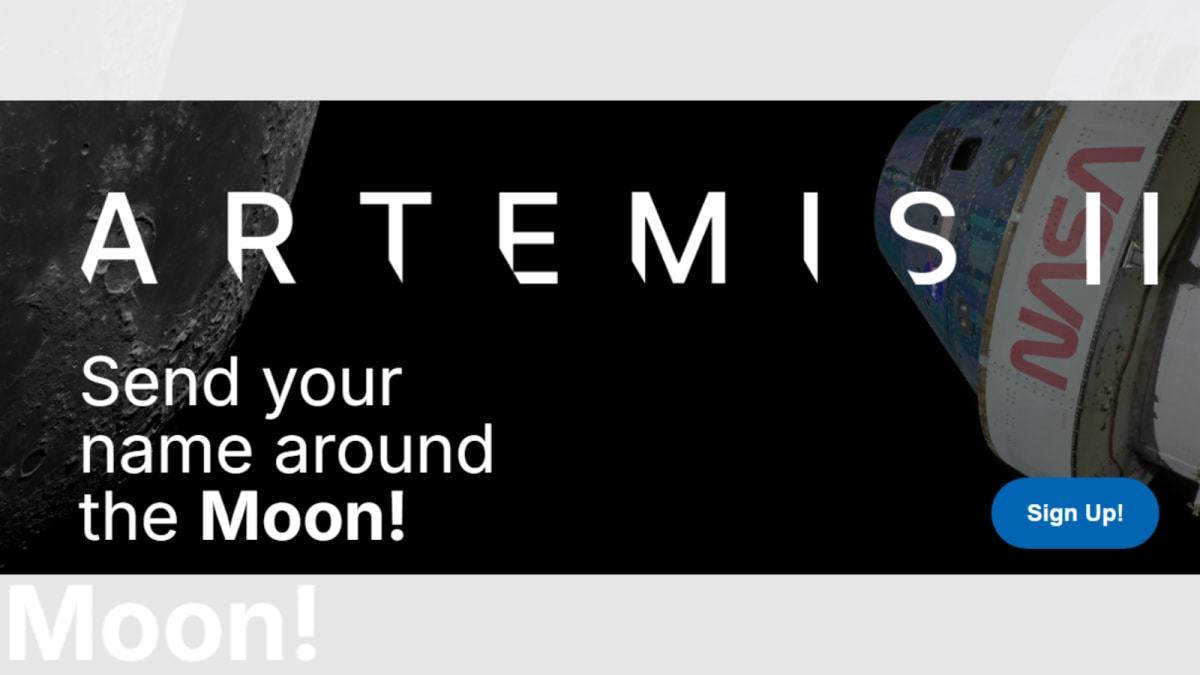
But before we get to Mars and aim for the stars, NASA wants to take you aboard Artemis II and around the moon, and it has already begun accepting submissions from the public.
Artemis II
Artemis II, a 10-day mission, will carry four astronauts who will launch from Earth in April 2026 aboard NASA’s SLS rocket and Orion spacecraft, the first crewed flight of this combination. This mission primarily aims to gain insight into and the nuances of deep space as NASA prepares for a landing on the lunar surface under the Artemis III mission slated for mid-2027.
“NASA is sending astronauts to explore the Moon for scientific discovery, economic benefits, and to build the foundation for the first crewed missions to Mars," an excerpt on NASA’s website reads.
Also Read: What Is Point Nemo And Why Is Instagram Obsessed With It?
The Learning
Through Artemis II, NASA aims to deepen its understanding of space radiation’s effects on human health and behaviour, test long-distance communications, and gather critical data to shape future deep-space exploration missions.
“Orion’s service module will provide the push needed to break free from Earth orbit and set course for the Moon. This translunar injection burn will send astronauts on a four-day outbound journey around the far side of the Moon in a figure eight pattern extending more than 230,000 miles from Earth," NASA noted.
Upon the mission conclusion, Orion will make a splash in the Pacific Ocean off the coast of San Diego. Here, both the crew and the spacecraft will be retrieved.
Crew
NASA Astronauts:
Reid Wiseman (Commander)
Victor Glover (Pilot)
Christina Koch (Mission Specialist)
CSA (Canadian Space Agency) astronaut:
Jeremy Hansen (Mission Specialist)
Boarding Pass
Why should astronauts have all the fun?
“When Artemis II lifts off next year, more than 900,000 names will be aboard—and yours (or your friend’s, or your pet’s…) could be one of them," NASA wrote in a post on X.
On its website, NASA further stated that the submitted names would be loaded on an SD card and carried inside Orion, which will travel around the moon in 2026.
“Submitted names will be included on an SD card that will fly inside Orion when the Artemis II mission launches in 2026."
Also Read: Elon Musk Wants To Ship Humans To Mars. Is The Science On Rocketman’s Side?
How To Sign Up?
1) Click on this link.
2) Enter your First Name.
3) Enter your Last Name.
4) Add a Pin Code (4-7 digits)
Your boarding pass should look something like this:
(X Screengrab)
NASA also politely informed not to forget the PIN code, as it would not be able to retrieve it.
With Artemis missions, the moon will serve as the perfect launchpad to send astronauts to Mars.