India's Manufacturing Renaissance: The Path Towards Sustainable Growth
हिंदी में सुनें
Listen to this article in Hindi
Analyzing India's manufacturing sector's potential growth trajectory and its implications for market dynamics in 2026.
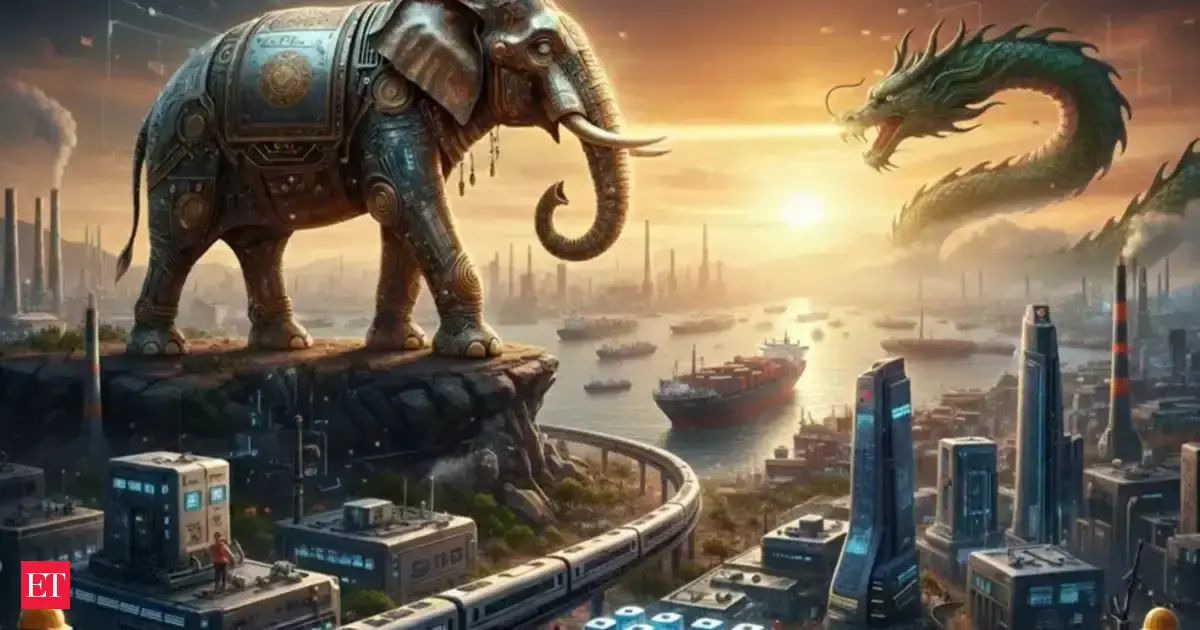
As India approaches a pivotal moment in its manufacturing journey, the landscape is poised for transformative change. Recent developments in key sectors such as electronics, semiconductors, batteries, and rare earths signal a potential renaissance that could elevate India's position in the global supply chain. The question that looms large is not merely whether India can replicate China's manufacturing boom, but rather how it will carve out its unique path towards sustainable industrial growth.
At the heart of this shift is the global imperative to diversify supply chains away from China. Companies worldwide are re-evaluating their production strategies, and India stands at the forefront of this transition. With the Indian government actively pursuing trade agreements and policy frameworks aimed at bolstering manufacturing, the potential for a robust industrial base is becoming increasingly tangible. The rapid expansion of Apple’s manufacturing capabilities in India serves as a powerful indicator, showcasing not only the country’s rise as a secondary production base but also its growing attractiveness to global suppliers.
The electronics sector, particularly the localisation of components, is pivotal in determining whether India can move beyond mere assembly to deeper value addition. The introduction of the Production-Linked Incentive (PLI) scheme has already begun to yield results, but the true test will be in 2026. If India can successfully cultivate a domestic ecosystem for critical components—such as printed circuit boards and camera modules—manufacturing could emerge as a significant contributor to economic growth, akin to China’s early consumer electronics sector.
That said, the reality is a bit more complicated. this evolution is not without its challenges. The semiconductor industry represents both an ambitious goal and a daunting task for India. While the establishment of fabrication and packaging facilities is a strategic move towards self-sufficiency, the reality is that chip production involves immense capital investment and a highly competitive global landscape. The success of India’s semiconductor push will depend not just on individual facilities but on the formation of a comprehensive ecosystem that integrates talent, technology, and supply chains. The potential for collaboration among chip designers, material suppliers, and electronics manufacturers will be crucial in fostering a credible semiconductor industry.
Battery manufacturing and rare-earth processing are arguably the more transformative elements of India’s industrial strategy. As global demand for energy storage solutions surges, India’s domestic market presents a significant opportunity. In 2026, if India can transition from initial pilot projects to commercially viable operations in these sectors, it may well lay the foundation for a new industrial core. This move would not only reduce dependence on foreign suppliers but also anchor advanced manufacturing capabilities within the country.
The implications of this industrial strategy extend beyond mere economic metrics. India’s workforce, characterized by its youthful demographic, presents both an opportunity and a challenge. The country’s labour market dynamics differ fundamentally from those of China, with varying skill levels and rigidities in formal employment. For the manufacturing sector to flourish, there will need to be a concerted effort to align vocational training with industry needs. The effectiveness of recent policy initiatives, such as the apprenticeship scheme, will be critical in determining whether India can absorb large numbers of workers into its factories, moving beyond reliance on contract labour.
In this context, the geopolitical landscape plays a significant role in shaping India’s manufacturing narrative. The ongoing trade tensions among major global powers and the search for stable production bases create a unique opportunity for India. That said, the reality is a bit more complicated. this window of opportunity is not permanent; other countries are actively vying for the same investments. India’s advantages, including its scale and political stability, must be leveraged effectively to attract and retain foreign investment in its manufacturing sectors.
Ultimately, India's path towards a manufacturing renaissance will not mirror the rapid ascent of China. Instead, 2026 may mark the beginning of a more measured but resilient growth trajectory. The convergence of electronics, semiconductors, batteries, and rare earths into a coherent industrial strategy, coupled with favorable domestic demand and a shifting global supply chain, could yield a sustainable manufacturing ecosystem. This evolution has the potential to foster a new era of economic growth, characterized by increased employment opportunities and a diversification of India's economic base.
As this narrative unfolds, India’s manufacturing sector will be closely watched by investors and policymakers alike. The sentiment within the markets will likely reflect the progress made in these sectors, influencing liquidity and volatility as the country strives to establish itself as a manufacturing powerhouse in an increasingly competitive global landscape.
Editor's note: This article was independently written by the Scoopliner Editorial Team using publicly available information.