What did Putin and Modi get out of Delhi meeting?
BBC editors explain what lies behind the high-optics visit of Russian President Vladimir Putin to Delhi.
What Putin and Modi got out of Delhi meeting
1 hour ago
Steve Rosenberg ,Russia editor, in Delhiand
Vikas Pandey ,India editor
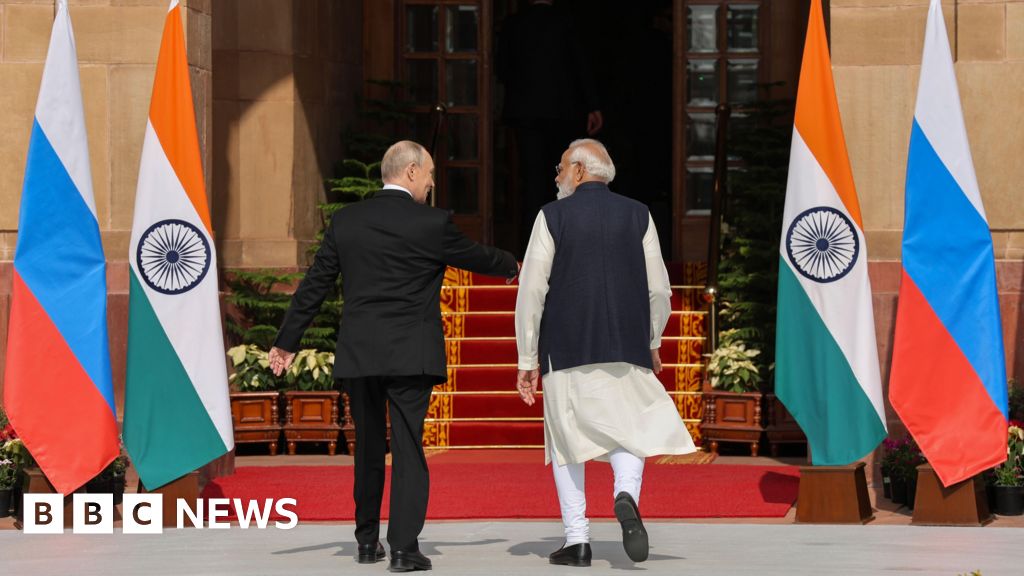
Russian President Vladimir Putin will wind up a packed day in India at the place where he began his official engagements - with a banquet at the president's house, where he received a guard of honour in the morning.
In between, he held talks with Prime Minister Narendra Modi, attended a business forum and announced the launch of Russia Today, a Kremlin-funded state-controlled TV network.
The Russian leader has faced diplomatic isolation since the Ukraine war began in 2022 and the red carpet laid down by Delhi would have sent a strong message to the West.
But what exactly did Delhi and Moscow get out of the visit? Here's our take:
Plenty of pomp, but few concrete announcements
By Steve Rosenberg
First, about the welcome Vladimir Putin received.
The Russians loved it.
"A cavalcade, volleys of cannons and a marble throne room," wrote the ultra pro-Kremlin news site Komsomolskaya Pravda on Friday. "How Vladimir Putin was greeted in an Indian palace with 340 rooms."
So much for Western efforts to turn President Putin into a pariah for his full-scale invasion of Ukraine.
When it comes to deals done, there are fewer of those than rooms in the palace.
But still enough for Russia and India to be able to trumpet their "special and privileged strategic partnership" and for President Putin to hail efforts to expand cooperation.
Agreements like the Russia-India economic cooperation programme.
An agreement involving critical minerals and supply chains.
Pharmaceuticals, too. A Russian-Indian pharmaceutical factory will be built in Russia's Kaluga region.
But what about the most talked about - and sensitive - issues?
First, oil.
India has been buying large volumes of Russian oil. These purchases have been a major support for Russia's sanctioned economy.
Much to the annoyance of America. It accuses India of helping to finance the Kremlin's war chest. So, through heavy tariffs on Indian goods, the Trump administration has been exerting pressure on Delhi to stop purchasing Russian energy.
On Friday, Putin emphasised that Moscow is ready to ensure uninterrupted oil supplies to India.
But no details have been announced. It feels like the ball is in India's court to decide what comes next.
Then there's the question of Russian weapons and defence systems.
Ahead of Putin's visit, there was much speculation: Is India about to purchase state-of-the-art Russian fighter jets and air defence systems?
No defence deal was announced.
That may be a sign of the balancing act India has to perform - between its relationship with Moscow and ties with Washington.
On Friday, all eyes were on the pomp and ceremony (and palaces) and deals done and announced.
But I'd love to know what was discussed last night in what the Russians are calling the "informal dinner" between President Putin and Prime Minister Modi.
According to Putin's foreign policy aide Yuri Ushakov, that was "one of the key points of the visit".
Ushakov told the Russian government paper Rossiyskaya Gazeta that "during such confidential face-to-face contacts, the most urgent, most sensitive and most important issues of both bilateral relations and the international situation are discussed".
"Politics is made at these kind of meetings."
Trade was at the centre of this visit
By Vikas Pandey
The visit was high on optics - it all started with the famous Modi hug at the airport. It's not usual for the Indian prime minister to receive global leaders at the airport but he did that for Putin.
That shows how much Modi values India's time-tested partnership with Russia, as well as his bonhomie with Putin.
But the pomp and show of big ceremonies didn't result in big deals. There was no major defence deal, or an agreement to enable India to continue importing discounted Russian crude.
After the ceremonies, it was time for the leaders to give their remarks.
As they read out their statements, what stood out first was the conspicuous display of mutual respect. The second was the absence of any blockbuster announcement.
But what became clearer from their remarks was that trade was at the epicentre of this visit.
Russia is reeling under Western sanctions and India is facing 50% tariffs from Washington.
They both need alternative markets to boost their economies. Both countries see each other as big markets and there also seems to be an understanding that their economic partnership has underperformed for decades.
Their current trade volume of $68.72bn, up from $8.1bn in 2020, has hugely relied on India's purchase of discounted Russian oil.
Russia would like this to continue but when Putin said that Moscow was ready to continue "uninterrupted shipments" of fuel, it was a gentle nudge to Modi and India to not give into the White House's demands.
India is under pressure from Trump to stop buying oil from Russia. Now it will be interesting to see how Modi manages to achieve the impossible - that is to continue buying oil from Russia and get a trade deal with Trump at the same time.
But beyond defence and oil, the two countries announced many deals in other sectors.
Deals and memorandums have been signed in shipbuilding, training of Indian seafarers to operate in polar waters, investments in new shipping lanes, civil nuclear energy, visa-free travel and critical minerals.
Modi stressed a lot on boosting business ties between the two countries which reflects India's quest to find newer markets.
He also mentioned the progress made in concluding India's potential free trade agreement with the Eurasian Economic Union (EAEU), which includes Russia, Armenia, Belarus, Kazakhstan and Kyrgyzstan.
When concluded, the deal will enable Russia, India and other members to explore each other's markets.
The leaders also spoke about a five-year economic framework that will enable the two countries to reach their target of $100bn in bilateral trade.
It's an ambitious target, especially if discounted oil is taken out of the equation. And that could be the reason why there was so much stress on boosting bilateral trade in many different areas.
And finally, the absence of a big-ticket defence deal doesn't limit Russia's role in Indian armed forces. Moscow will continue to be the most important player for India's defence needs, as it has been for decades.
What is worth noting is that India hasn't said much publicly about its intention to buy the Su-57 fifth-generation fighter aircraft, which it needs to fill critical gaps in its air force.
What India might have demanded is the timely delivery of its defence orders. The delivery of the remaining units of its current order of the S-400 air defence system is running late.
But that's something Russia might find hard to promise, given that vast amounts of its defence resources are being spent in Ukraine at the moment.
That, however, doesn't mean that their negotiations about the jet or other major defence deals are not continuing in the background.
It's just that this visit seems to be all about trade.