Unveiling Mars: The Discovery of Unusual Caves in Hebrus Valles
हिंदी में सुनें
Listen to this article in Hindi
Researchers discover unusual cave-like structures on Mars, revealing potential geological processes involving water.
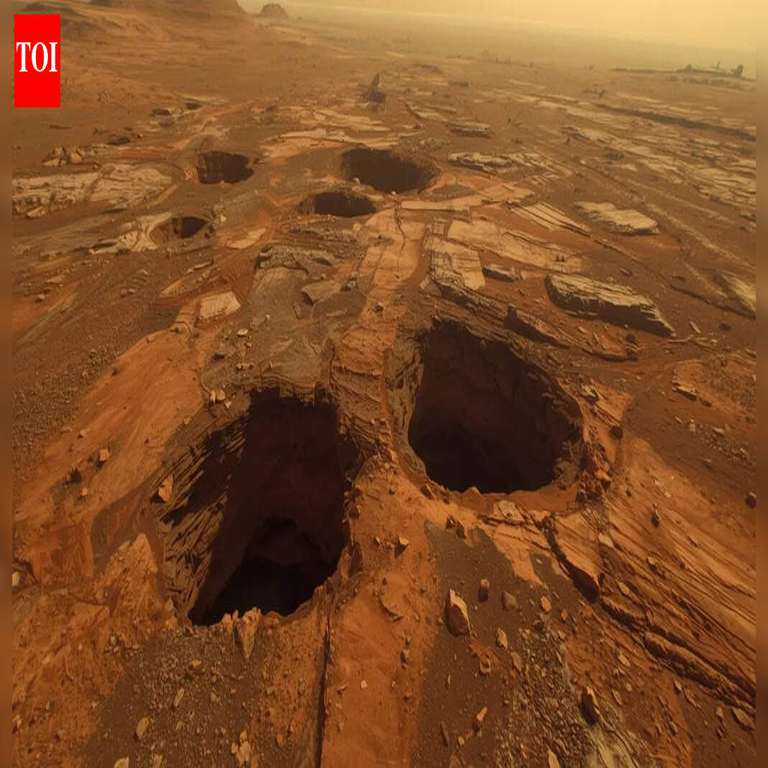
Recently, researchers have identified a series of unusual cave-like structures on Mars, located in the region known as Hebrus Valles. These formations, described as skylights, represent deep openings in the Martian surface that starkly contrast with other geological features typically found on the planet. Unlike impact craters or volcanic pits, these pits are nearly circular and lack the expected signs of debris or raised rims, suggesting they were formed by processes distinct from those commonly recognized on Mars.
The presence of these pits raises several important questions about Mars' geological history. Researchers suggest that these openings may indicate the existence of ancient underground cavities, potentially shaped by the slow erosion of rock by water over extended periods. This is particularly significant as it could imply that Mars was once more geologically active and possibly had liquid water present beneath its surface.
The discovery is further bolstered by the presence of minerals such as carbonates and sulphates nearby. On Earth, these minerals typically form in the presence of water and are often associated with karst landscapes, which are characterized by sinkholes and caves created through chemical erosion. Until now, such a landscape had not been clearly recognized on Mars, making this finding noteworthy in the context of Martian geology.
That said, the reality is a bit more complicated. it is crucial to clarify what this finding does not mean. While the presence of these pits and associated minerals suggests a history of water activity, it does not confirm that liquid water currently exists on Mars or that it has sustained any form of life. The geological processes that formed these structures remain largely speculative, and further study is needed to understand their full significance.
Additionally, researchers have pointed out that these caves, or skylights, could serve as areas of interest for future Mars exploration. They might provide insights into the planet's subsurface environment and geological processes, as well as potential resources for future missions.
The implications of this research highlight the ongoing evolution of our understanding of Mars. Each new discovery challenges previous notions of a static, lifeless planet, suggesting instead a more dynamic history that could inform our search for life beyond Earth. That said, the reality is a bit more complicated. the findings also underscore the limitations of current knowledge, as many questions about the caves' formation and the specific geological processes involved remain unanswered.
In summary, the discovery of these unusual cave structures on Mars offers a new perspective on the planet's geological history and raises intriguing possibilities about the role of water in shaping its landscape. As scientists continue to investigate these formations, they may uncover further evidence that reshapes our understanding of Mars and its potential to support life.
Editor's note: This article was independently written by the Scoopliner Editorial Team using publicly available information.