Interstellar Hitchhiking: Could Rogue Objects Expedite Deep Space Exploration?
हिंदी में सुनें
Listen to this article in Hindi
The discovery of interstellar objects like 3I/ATLAS raises the intriguing possibility of using them as natural 'spacecraft' to accelerate interstellar exploration.
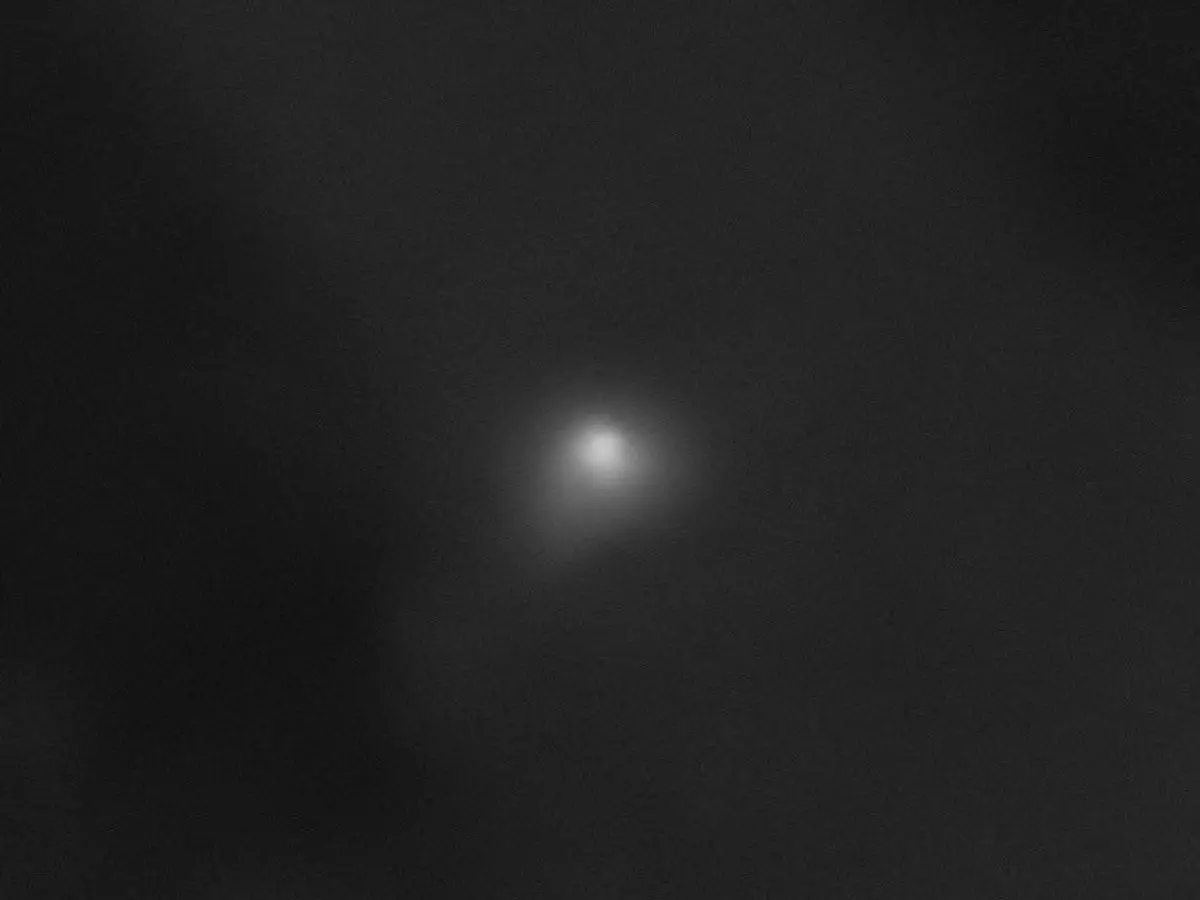
The recent close approach of interstellar object 3I/ATLAS has reignited discussions about the possibilities—and immense challenges—of interstellar travel. While initial hopes of a potential alien encounter have faded, a more pragmatic idea has emerged: could we use these fast-moving celestial wanderers as a springboard to reach the stars sooner than currently projected? The concept, championed by Harvard astronomer Avi Loeb, hinges on the immense speeds these objects possess, potentially shortening the journey to interstellar space by millennia.
To understand the appeal of this idea, consider the vast distances involved. Our current spacecraft, like the Voyager probes, are only now approaching the boundary of our solar system after nearly half a century of travel. Voyager 1, for example, launched in 1977, is expected to take another 28,000 years to reach the Oort Cloud, a theoretical sphere surrounding our solar system where objects are no longer gravitationally bound to the Sun. Crossing the Oort Cloud marks the entry into true interstellar space.
Interstellar objects, like 3I/ATLAS, offer a potential shortcut. 3I/ATLAS, observed making its closest approach to Earth in December, is traveling at an astonishing speed of 37 miles per second. Loeb argues that if we could somehow attach a spacecraft or a 'time capsule' containing messages and information about humanity to such an object, we could significantly reduce the time required to reach interstellar space. He estimates that "riding 3I/ATLAS" could allow us to reach interstellar space by the year 10,000 CE instead of 30,000 CE.
The idea is not without its challenges. The primary hurdle is the engineering feat of intercepting and attaching a payload to a fast-moving object like 3I/ATLAS. Loeb suggests using high-power lasers to engrave messages onto the object's surface or designing dedicated interceptor missions to physically attach a payload. Both options present significant technological and logistical difficulties. Precisely targeting and maneuvering a spacecraft to rendezvous with an object traveling at such immense speeds would require unprecedented precision and advanced propulsion systems. Furthermore, the harsh conditions of space, including extreme temperatures and radiation, would necessitate robust shielding and durable materials to protect the payload during its long journey.
Another consideration is the trajectory of these interstellar objects. While 3I/ATLAS will pass relatively close to Jupiter in 2026, offering a potential observation opportunity, its ultimate destination lies far beyond our solar system. We would need to ensure that the attached payload is capable of withstanding the journey through interstellar space and potentially surviving encounters with other celestial objects. Understanding the composition and behavior of interstellar objects is also crucial. [Science basics explainer: learning about these objects].
Despite the challenges, the concept of interstellar hitchhiking highlights the potential of leveraging naturally occurring phenomena for space exploration. As we continue to discover more interstellar objects, the possibility of utilizing them as vehicles for interstellar messages or even future exploratory missions becomes increasingly intriguing. [Related field context: advances in propulsion technology] are crucial to making this a reality. The discovery of 3I/ATLAS and similar objects has opened up a new avenue for considering how we might one day reach the stars. [Prior research background: the Voyager missions and their limitations].
While the dream of interstellar travel remains distant, the idea of hitching a ride on a cosmic wanderer provides a compelling vision for the future. It underscores the importance of continued research into interstellar objects, advanced propulsion systems, and the challenges of surviving the harsh environment of deep space. Whether or not we ultimately succeed in 'riding' an interstellar object, the pursuit of this goal will undoubtedly drive innovation and expand our understanding of the cosmos.
Editor’s note: This article was independently written by the Scoopliner Editorial Team using publicly available information.