'We are killing the sport': Manolo Marquez blasts AIFF with no end in sight to ISL crisis
हिंदी में सुनें
Listen to this article in Hindi
Marquez, FC Goa, and everyone else sit around awaiting solutions around the ISL that seem as far from arriving as at any point in the past few months.
Manolo Marquez sounds tired.
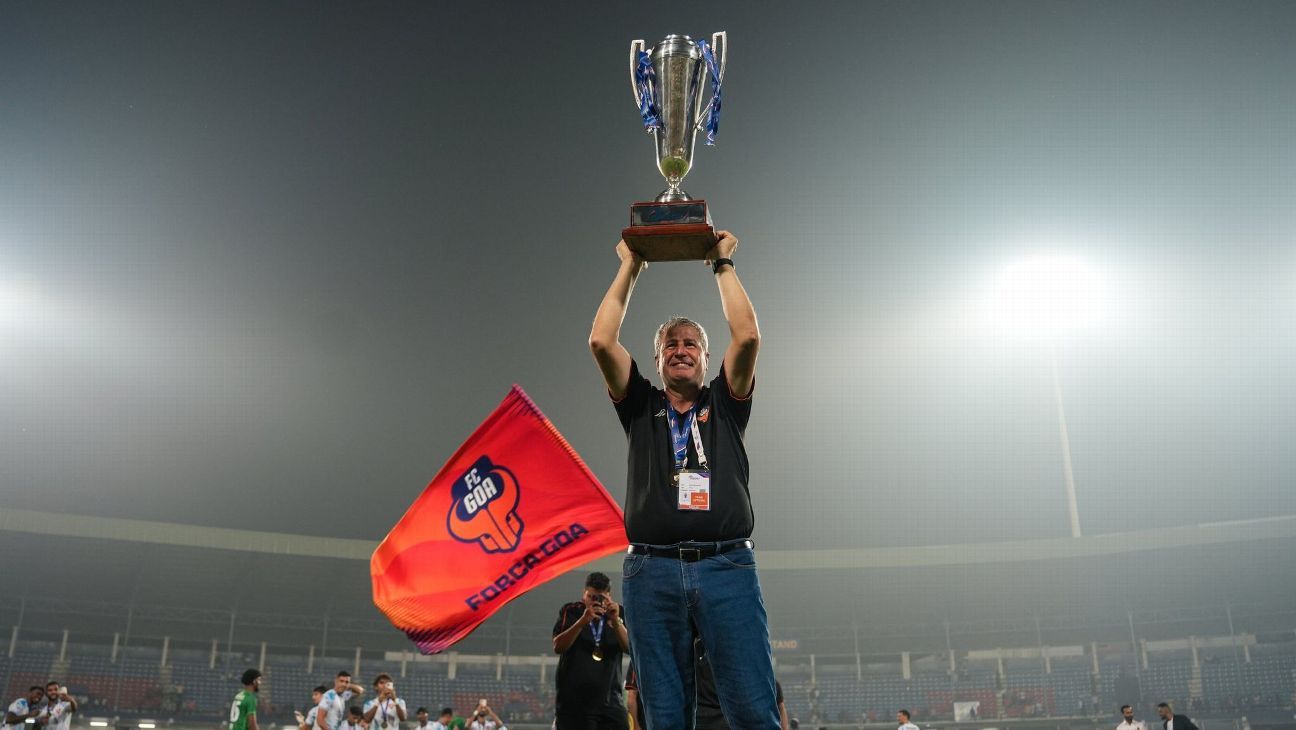
FC Goa's Super Cup winning coach should have been on a flight to Qatar, and from there on to his home in Barcelona, but he's chatting with ESPN from Goa as yet another casualty of Indigo's flight cancellation fiasco. "Now I am half Indian," he says with a laugh as he talks about how his schedule has gone for a toss, how much he loves this country that he's been managing football teams in since 2020 and how tough this year has been. You can understand why he's so exhausted -- in 2025, he's getting the full Indian experience.
He was India national team manager till July this year, where he oversaw a very poor run -- winning just one of eight matches and making AFC Asian Cup qualification tough (impossible, as it turned out). He then got reappointed as FC Goa boss and walked into a period of unprecedented turbulence: getting them into the AFC Champions League Two group stages and winning the AIFF Super Cup... all without any idea of when (and even if) the 2025-26 season of the ISL would start.
It's taken all the tools he's learned over 36 years of being in football management to keep things going, plus a new skill he's 'improved' since landing in India. "The best quality that I improve in my [five] years here is to improvise everything. Every country has different things, different traditions, different characteristics: [in] India [it is that] everything is in the last moment. It's a big problem... and this is the problem that we have in Indian football because finally it's a thing [the AIFF-FSDL deal expiring] that you could see long time ago. 'Be careful that this can happen, this can happen' and in the moment that happens, 'okay now we need to solve the situation', now it's very late."
This, Marquez says, is what makes it so tough when talking to his players. "It's difficult because it's a long time and you cannot change the speech every day. The conversations are very difficult because one day it looks like, if you remember they say, ISL will start in October. Very good. [Then] it was in November, then December, then January, now mid-January. I was very optimistic at the beginning of the season. Now I have doubts if it will be normal. For sure it won't be normal ISL but even I have doubts that [there] will be [a] competition this year."
"There is the positive part and the negative part," he says with a sigh as he talks about playing two competitions, while not having the domestic league. "The positive part is that you are playing strong games in Asia, and I feel that it was key to win the Super Cup because except in the final (and the semifinal second half against Mumbai City) ... we showed a [better] level, especially physically. I feel that we finished much better than East Bengal in extra time [in the final]."
This comes, of course, from being the only team in India who had high-level competitive games on this season (It would have two teams, if Mohun Bagan hadn't made the inexplicable decision of not travelled to Iran for their ACL2 tie). And there comes the negative. "This is our fifth month with training sessions, and we play 11 games. It means that we play [about] two games a month."
Even there, there's a catch: Five of those 11 games happened in a span of 14 days. "It's very difficult to motivate the players when they know that the next game will be after three weeks, four weeks," he says about the period before that 14-day rush.
He's happy that the club won the matches "that needed to be won" -- the qualifier into ACL2, two Super Cup league stage games and the Super Cup semi and final -- but he's not as delighted with the Super Cup win as he would have been normally. "[Goa have] an advantage [over} other teams. At least, we were playing football [for] five months. A lot of teams, they are at home, some of them play Durand Cup [which is] not very competitive. A lot of teams in the Super Cup play with different conditions -- one team without foreigners, another team without training sessions, another team with all the foreigners, another team like FC Goa playing Asian competition. Now we are the champions, but I continue telling you the same, I don't like competitions where the teams don't play in the same conditions."
He pauses as he reflects on how this will affect the average Indian footballer. "I can tell you that if you don't play football for one year then people cannot come to the player and say now you need to win. Obviously when [COVID-19] was there, this is not a normal situation, but it was practically in all the world. It was very difficult to manage the situation, but you understand [the larger implications] and that there will be six or seven months that you won't play."
"If the season doesn't happen, the only positive thing is that maybe India can put some rules for a lot of years," he says. "But it's very, very bad. This situation is terrible for Indian football. Even yesterday I was speaking with one player from another team, and he said, 'in some moments I don't know what to do, and now I'm trying to learn how to cook', but he's a football player, isn't he? I think that he's at home and okay, yes, you can do something but for one or two months, but not for six months!"
It's not just the players he says this is tough for... "but for everyone, for the masseurs, for the physios, for everyone, for the fans, of course. If you don't play football, it's the easier thing that people will forget this sport."
His conversations with FC Goa's management haven't been easy either. "I have a very good relationship with the management in FC Goa, especially with the CEO, Ravi Puskur, who for me is one of the persons who is trying to help Indian football. But obviously not everyone, I repeat, not every team is in the same direction, every team is interested in their things."
"My conversations with Ravi are practically every day. Then he speaks about what is the situation... but the reality is the situation changes after every meeting."
"It's very difficult. And then how many statements we [see] from the Federation, but there is no solution. Finally, we need to know that we are killing Indian football. Forget the foreigners, forget that. It's about India. We are killing the sport, the kids [wanting] to play football if this continues in this direction."
He doesn't like to speak about his stint with the national team -- "I was not the best coach for national team, I felt that was not my place, and that's all" -- but does go there, briefly, to highlight another issue: the extremes of Indian football. "One big problem in India is that if you win one game, it looks like, oh wow, everything is fantastic now, it's incredible. But if you lose the next game, then everything is a disaster. And this is not like this. There is something in the middle, and you need to, I don't know if the expression is correct, but to look further. Because finally, this is a long-term job. It will take time."
"Everyone speaks about under-23. Yes, under-23 is a good team, but the players who can play at the top level in this moment, in the national team, there are four or five, no more. When Khalid [Jamil] moves four or five players, we could see what happened with under-23 in Thailand [where they lost a friendly 0-4]. Not everything is magic. You need to work and do [long-term planning]. At least we need to go all together in the same direction."
And then he says something that sums up the current situation in Indian football to the T: "...in India everyone speaks, speaks, speaks, but there are no solutions."'
And so, Marquez, FC Goa, and everyone else sit around awaiting solutions that seem as far from arriving as at any point in the past few months, hoping that one is found and football in India can resume in some shape or form.