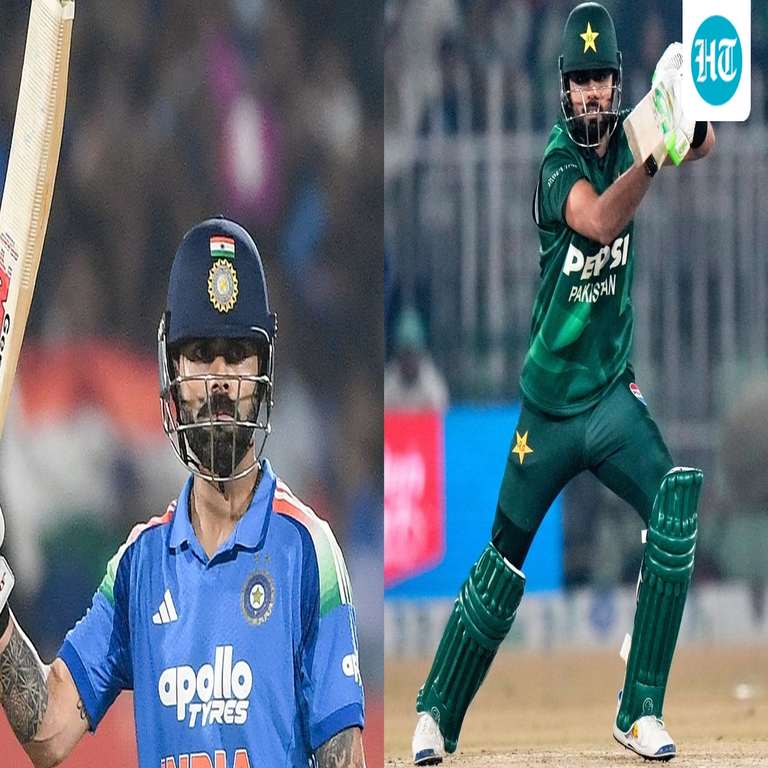
Kohli's ODI Supremacy Outshines Babar's Multi-Format Efforts in 2025
हिंदी में सुनें
Listen to this article in Hindi
A comparative analysis of Virat Kohli and Babar Azam's performances in 2025, focusing on quality versus quantity in their cricketing outputs.
In 2025, the performances of Virat Kohli and Babar Azam illustrate the contrasting demands placed on modern cricketers across different formats. Kohli, with a year primarily focused on ODIs, delivered a standout performance that highlighted his enduring dominance in the format, while Babar's contributions spanned all three formats, reflecting Pakistan's multi-format expectations.
Virat Kohli's statistics in ODIs for 2025 speak volumes. With 651 runs at an average of 65.10 and a strike rate of 96.20, he managed to score three centuries and four fifties in just 13 innings. This output not only illustrates his ability to convert starts into significant scores but also his knack for performing in crucial matches. Kohli's highest score of 135 showcases his capacity to anchor innings and play match-defining knocks, which is a critical aspect of ODI cricket.
In contrast, Babar Azam's performance across formats yielded a total of 1,065 international runs, outpacing Kohli's overall tally. That said, the reality is a bit more complicated. when looking at the context of his runs, Babar's average in ODIs was considerably lower at 34, with only one century to his name. His test performances were also subpar, averaging 31.50, indicating struggles in adapting to the longer format. While Babar's overall volume is noteworthy, the quality of the runs scored becomes a pivotal point of discussion.
The crux of the analysis lies in understanding that while Babar had a heavier workload, Kohli's ODI performances were not merely about the numbers but the impact behind them. Kohli's runs came in matches where he was pivotal to India's success, reinforcing the argument that match-defining contributions are crucial in evaluating a player's year.
Tactically, Kohli’s ability to maintain a higher strike rate while achieving a significant average indicates his effectiveness in modern ODI cricket, where scoring quickly without losing wickets is paramount. This aligns well with India’s strategy in the lead-up to critical tournaments like the World Cup. On the other hand, Babar's lower strike rates and averages in ODIs and Tests suggest that while he is a consistent performer, he may need to adapt his approach to enhance his impact in high-stakes situations.
Looking ahead, Kohli's retirement from Test cricket in May 2025 and T20I in June 2024 marks a transition phase in his career, allowing him to focus exclusively on ODIs. This shift could mean a resurgence in his ODI prowess, especially as major tournaments loom. For Babar, the expectation remains to elevate his game across formats to solidify his standing as one of the top players globally.
So where does that leave things? while Babar Azam's multi-format presence gives him a statistical edge in volume, it is Virat Kohli's quality of performance in ODIs that stands out in 2025. The discussion between these two players emphasizes the evolving nature of cricket, where impact and context often outweigh sheer numbers.
Editor's note: This article was independently written by the Scoopliner Editorial Team using publicly available information.