Uranus and Neptune might be rock giants
हिंदी में सुनें
Listen to this article in Hindi
A new study challenges the understanding of Uranus and Neptune's composition, suggesting they may have rocky cores instead of being primarily icy.
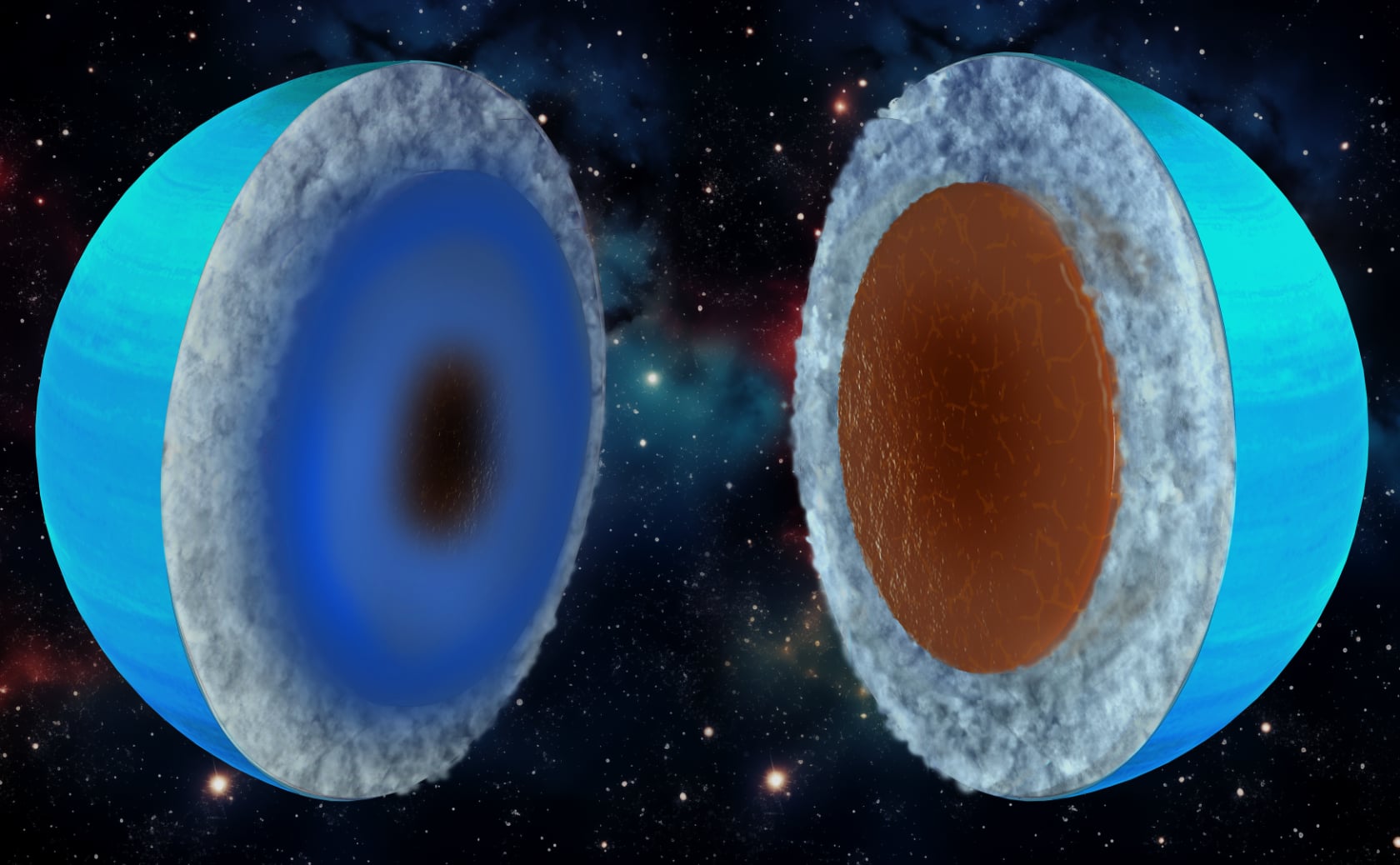
Uranus and Neptune, often called "ice giants" due to their high concentrations of methane, water, and other volatile substances, may be more rocky than previously believed. Unlike the larger gas giants Jupiter and Saturn, Uranus and Neptune contain substantial amounts of these elements, which solidify into "ices" under immense internal pressure. That said, the reality is a bit more complicated. new research from the University of Zurich (UZH) and the National Centre of Competence in Research (NCCR) PlanetS is causing scientists to rethink the makeup of these distant planets.
The research, published in *Astronomy & Astrophysics*, indicates that the cores of Uranus and Neptune might be predominantly rocky, challenging the traditional view of them as primarily icy. Furthermore, the study suggests the interiors of these planets may experience convection, a cyclical movement of materials similar to Earth's tectonic activity, rather than remaining static. These findings potentially explain some of the enigmatic characteristics observed on these "ice giants."
Traditionally, the planets in our solar system have been categorized into three groups based on their composition and distance from the sun: the inner, rocky terrestrial planets (Mercury, Venus, Earth, and Mars); the gas giants (Jupiter and Saturn); and the ice giants (Uranus and Neptune), located beyond the "Frost Line" where volatile materials freeze. The recent work by Luca Morf, a PhD student, and Professor Ravit Helled of UZH and the NCCR PlanetS, casts doubt on this long-standing classification.
Uranus and Neptune are the least explored planets in our solar system. The *Voyager 2* mission, which flew by Uranus in 1986 and Neptune in 1989, remains the only close-up study of these distant worlds. To better understand their composition, Morf and Helled developed a novel simulation process that considered a wider range of compositions than the traditional water-rich model. This involved creating random density profiles and calculating the corresponding planetary gravitational fields, repeating the process until results aligned with observational data.
Morf explained that the "ice giant" classification is too simplistic given our limited understanding of Uranus and Neptune. He added that their approach combined physics-based and empirical models to create unbiased and physically consistent models of the planets' interiors. The simulations revealed that a predominantly rocky composition fits the data better than an ice-dominated one. This aligns with data from the Hubble Space Telescope and the New Horizons mission, which suggest that Pluto is about 70% rock and metals and 30% water by mass.
The research also offers potential explanations for the unusual magnetic fields of Uranus and Neptune, which have more than two poles. Helled stated that the models feature "ionic water" layers that generate magnetic dynamos, explaining the observed non-dipolar magnetic fields. The study also indicated that Uranus's magnetic field originates deeper within the planet than Neptune's. She concluded that both Uranus and Neptune could be classified as either rock giants or ice giants, depending on the model assumptions. More data is needed from dedicated missions to these planets to determine their true nature.
While the models have uncertainties, they highlight the need for future missions to further explore these "ice giants." The new findings present alternative scenarios and challenge established assumptions about the internal composition of giant planets, potentially influencing future materials science research under extreme planetary conditions.