Ukraine's Strategic Shift: From Battlefield Gains to Negotiated Security
हिंदी में सुनें
Listen to this article in Hindi
Ukraine is signaling a readiness for negotiated settlement, reflecting a shift in war strategy amid ongoing attacks and evolving geopolitical realities.
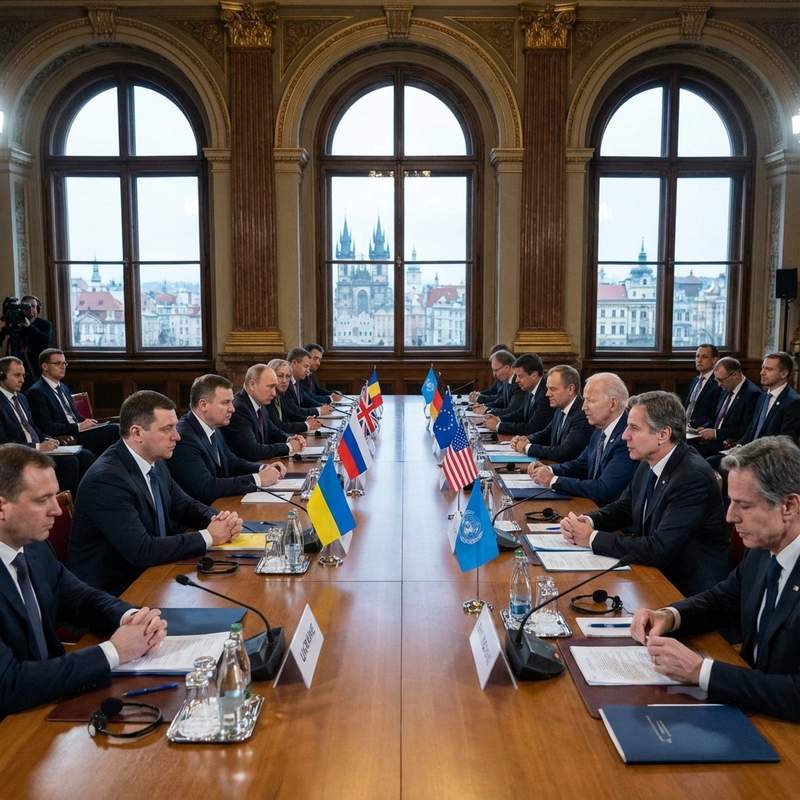
The ongoing conflict in Ukraine has entered a phase characterized by a complex interplay of battlefield actions and diplomatic maneuvering. While military operations continue, including drone strikes targeting both Moscow and Ukrainian territory, a discernible shift in Ukraine's strategic calculus is emerging. This evolution centers on a willingness to explore negotiated settlements, underpinned by the pursuit of robust security guarantees. This pivot reflects an understanding of the war's protracted nature and the need to secure long-term stability even amidst ongoing hostilities.
This strategic shift is less about abandoning military objectives and more about recalibrating them within a broader framework of geopolitical realities. Ukraine, despite its battlefield resilience, operates within a network of external dependencies. Military aid, economic support, and diplomatic backing from the United States and European partners are crucial for sustaining its war effort. The signals coming from Washington, suggesting a desire for a resolution, cannot be ignored. Ukraine's alignment with these signals is a pragmatic response to maintain vital international support. It also reflects the reality that decisive military victory, while desirable, may be unattainable in the short to medium term, making a negotiated settlement a viable alternative to a potentially indefinite conflict. The situation in Ukraine also has serious impacts on world affairs background, with rising energy prices for example.
The pursuit of security guarantees is central to Ukraine's negotiating position. The proposed framework, reportedly including security assurances from the U.S., NATO, and European partners, signifies a move beyond the current state of reliance on ad-hoc military aid. The intention is to establish a more formalized and enduring security architecture that would deter future aggression, even absent full NATO membership. This approach seeks to replicate the deterrent effect of Article 5, providing a credible commitment to Ukraine's defense without triggering a direct military confrontation between NATO and Russia. The emphasis on security guarantees is not merely about immediate protection; it's about creating a stable and predictable security environment that can underpin Ukraine's long-term economic development and political stability.
That said, the reality is a bit more complicated. significant uncertainties and constraints remain. The territorial question remains a major obstacle. Russia's annexation of Crimea and claims over other Ukrainian territories pose a formidable challenge to any negotiated settlement. Reconciling these territorial disputes with Ukraine's insistence on territorial integrity will require creative diplomatic solutions and potential compromises. The level of commitment from Western partners in providing credible and lasting security guarantees is also subject to change, influenced by domestic political considerations and evolving geopolitical priorities. Furthermore, the success of any agreement hinges on Russia's willingness to genuinely commit to a lasting peace and abide by its terms. Russia's India’s global position is also important to the Russia-Ukraine conflict.
The drone strikes, while seemingly contradictory to the pursuit of negotiations, serve as a crucial element of Ukraine's overall strategy. They demonstrate Ukraine's capacity to inflict pain on Russia, raising the costs of continued aggression. These attacks act as a form of coercive diplomacy, signaling that Russia will face consequences for its actions, even far beyond the immediate battlefield. The strikes targeting Moscow, in particular, carry a symbolic weight, challenging the perception of invulnerability within Russia and potentially influencing domestic public opinion. This combination of diplomatic signaling and demonstrated offensive capabilities aims to create a more conducive environment for negotiation, where Russia recognizes the limitations of its military approach and the potential benefits of a negotiated settlement.
Ultimately, the path towards a resolution in Ukraine remains fraught with challenges. That said, the reality is a bit more complicated. Ukraine's strategic shift towards exploring negotiated settlements, while simultaneously maintaining its defensive capabilities, represents a pragmatic and potentially viable approach to achieving long-term security and stability. The success of this strategy will depend on a complex interplay of factors, including the unwavering support of Western partners, the willingness of Russia to engage in genuine negotiations, and the ability of all parties to navigate the remaining uncertainties and constraints with foresight and determination. Topic basics for readers includes military aid, economic support, and diplomatic backing from the United States and European partners.
Editor’s note: This article was independently written by the Scoopliner Editorial Team using publicly available information.