JWST Reveals Nitrogen Enrichment in Early Galaxies, Rewriting Chemical Evolution Models
हिंदी में सुनें
Listen to this article in Hindi
JWST observations reveal elevated nitrogen levels in early galaxies, challenging existing models of galactic chemical evolution and star formation.
The James Webb Space Telescope (JWST) continues to reshape our understanding of the universe, this time by providing unprecedented insights into the chemical makeup of galaxies in the early cosmos. A recent study, utilizing JWST's powerful NIRSpec instrument, has revealed a surprising abundance of nitrogen in galaxies from a time when the universe was only a fraction of its current age. This discovery challenges existing models of galactic chemical evolution and highlights the complex processes that govern star formation and element distribution in the early universe.
The research focused on analyzing the nitrogen-to-oxygen (N/O) ratio in star-forming galaxies at redshifts between 1 and 6, corresponding to a period when the universe was roughly 1 to 6 billion years old. By examining the faint auroral emission lines – specific wavelengths of light emitted by ionized gases – in 76 distant galaxies, the team was able to directly measure the abundance of nitrogen and oxygen. These measurements were achieved through a method that uses electron temperatures, providing a more accurate assessment of elemental abundances than previous indirect methods.
The study established the first high-redshift calibrations of strong-line N/O diagnostics based on these direct abundance measurements. Strong-line diagnostics are relationships between the intensity of different emission lines that astronomers use to estimate the N/O ratio. The researchers found that the relationships between certain emission lines (specifically, [NII]6585/[OII]3727,3729 and [NII]6585/[SII]6717,6731) and the N/O ratio were similar to those observed in nearby galaxies, suggesting that these diagnostics can be reliably used even at high redshifts. This is an important step forward, allowing astronomers to estimate N/O ratios in a larger sample of 430 galaxies without needing to detect the faint auroral lines. For context, understanding the processes that create elements is a key area of study for [astrochemistry](internal_link).
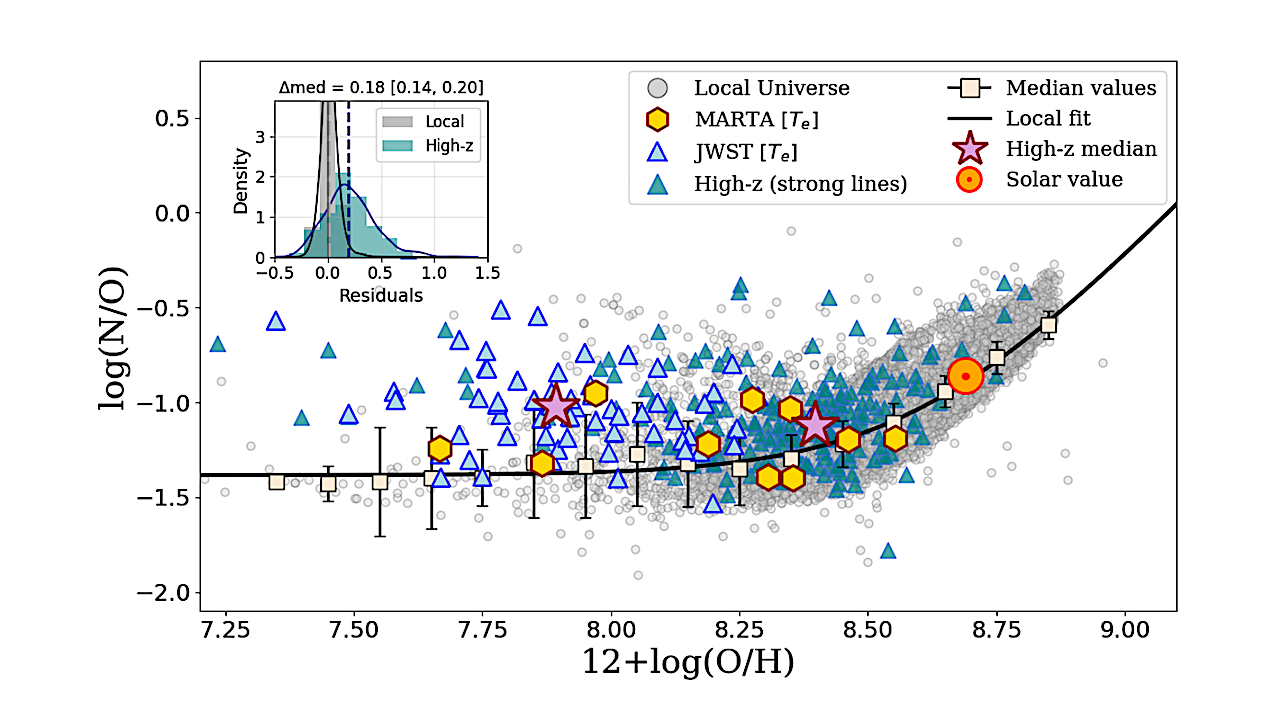
That said, the reality is a bit more complicated. when comparing the N/O ratio to the oxygen abundance (O/H, a proxy for overall metallicity) across cosmic time, the team uncovered a significant difference. Galaxies in the early universe (z>1) exhibited N/O ratios that were, on average, 0.18 dex (a logarithmic unit) higher than galaxies with similar metallicities in the local universe. This nitrogen enhancement was even more pronounced in galaxies with low metallicity, reaching up to 0.3-0.4 dex. This means that early galaxies contained significantly more nitrogen relative to other elements than expected based on current models.
This finding suggests that the processes responsible for nitrogen production were different in the early universe. One possibility is that early galaxies experienced more intense bursts of star formation, which could have led to a greater contribution from older, lower-mass stars that produce nitrogen. Another explanation involves the chemical signatures resembling those of first-generation globular clusters. These are dense clusters of stars formed very early in the universe. The elevated N/O ratios could reflect the late stages of a cluster-driven enrichment mode that dominated at earlier cosmic epochs.
While this study provides compelling evidence for elevated nitrogen in early galaxies, it also raises several unanswered questions. The relative contributions of different mechanisms, such as variations in star-formation history, the influence of older stellar populations, the impact of metal-loaded outflows (gas expelled from galaxies), and the inflow of pristine gas (gas that has not been enriched with heavy elements), remain uncertain. Further research is needed to disentangle these factors and develop a more complete picture of galactic chemical evolution.
Understanding the chemical evolution of galaxies is crucial for understanding the formation and evolution of the universe as a whole. These findings may necessitate refinements to existing models of [galaxy evolution](internal_link). The observed nitrogen enrichment could be a crucial piece of the puzzle, revealing new insights into the conditions that shaped the galaxies we see today. The JWST's ability to probe the distant universe is revolutionizing our understanding of these fundamental processes, providing a glimpse into the building blocks of the cosmos. Understanding these elemental ratios helps us understand [science basics](internal_link) in general.
Editor’s note: This article was independently written by the Scoopliner Editorial Team using publicly available information.