West Bank Settlement Expansion: A Litmus Test for International Law and Regional Stability
हिंदी में सुनें
Listen to this article in Hindi
The expansion of Israeli settlements in the West Bank challenges international law, strains diplomatic relations, and risks escalating regional instability. An analysis.
The ongoing Israeli-Palestinian conflict remains a central challenge to global security. Beyond the immediate human cost, the dispute's unresolved status acts as a persistent source of regional instability and a flashpoint for international tensions. The recent condemnation by thirteen European countries and Japan regarding Israel's approval of new West Bank settlements highlights a critical inflection point in the international community's approach to the conflict, and exposes the widening gap between international norms and on-the-ground realities.
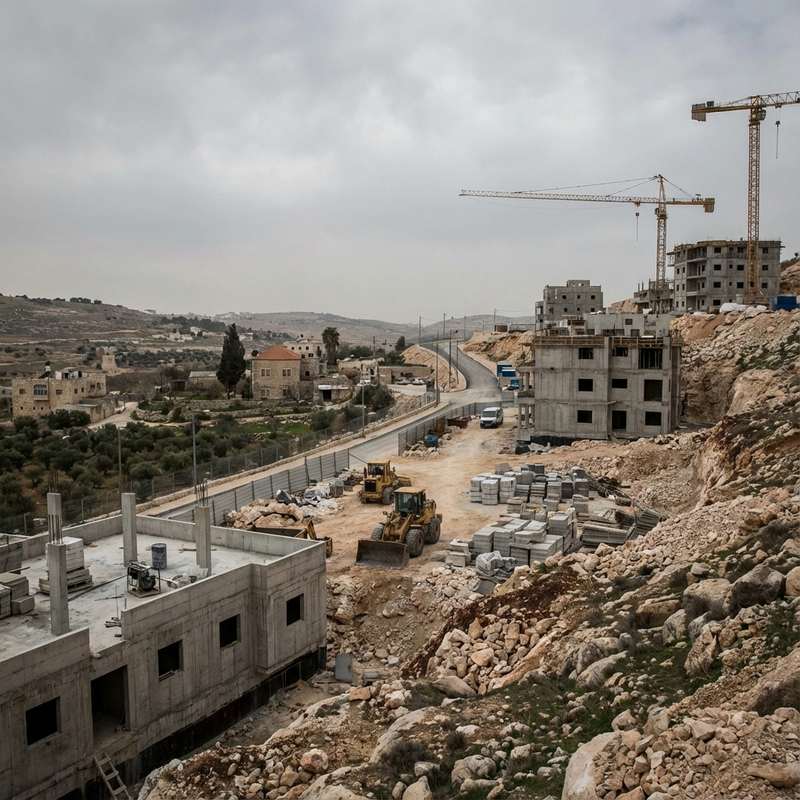
The expansion of Israeli settlements in the West Bank is not merely a localized issue; it has far-reaching implications for international law and diplomatic relations. The international consensus, enshrined in numerous UN Security Council resolutions, considers these settlements illegal under international law. The continued expansion, particularly by legitimizing previously unauthorized outposts, directly challenges this consensus and undermines the credibility of international legal frameworks. This erosion of international norms extends beyond the immediate context of the Israeli-Palestinian conflict, potentially emboldening other states to disregard international law in pursuit of their strategic objectives. The global implications are considerable, as a rules-based international order is increasingly challenged by unilateral actions and the selective application of international law. Examining other areas of world affairs background helps to understand the global impacts of violations of international law.
The dynamics within Israel itself are also critical to understanding the current situation. The increasingly prominent role of far-right political actors within the Israeli government, exemplified by Finance Minister Bezalel Smotrich, signals a hardening of positions and a decreased willingness to engage in meaningful negotiations towards a two-state solution. This shift in Israeli domestic politics directly impacts the prospects for peace and stability in the region, as the expansion of settlements is explicitly framed as an effort to prevent the establishment of a Palestinian state. This internal political dynamic also complicates the ability of international actors to exert influence, as the Israeli government appears increasingly resistant to external pressure. These actions can affect India's global position, as it navigates its relationship with both Israel and the Arab world.
The surge in settler violence against Palestinians in the West Bank further exacerbates the situation. The attacks, often carried out with impunity, contribute to a climate of fear and insecurity for Palestinian communities, increasing the risk of further escalation and potential displacement. The UN has documented a significant increase in these attacks, underscoring the urgent need for Israel, as the occupying power, to protect Palestinian civilians. The failure to do so not only violates international humanitarian law but also undermines any remaining trust between Israelis and Palestinians, making a future peace agreement even more elusive.
The path forward remains uncertain. While the condemnation from European countries and Japan signals a continued commitment to the two-state solution, the effectiveness of such diplomatic pressure is questionable in the face of Israel's current policies. The potential for further escalation of violence in the West Bank, coupled with the hardening of political positions on both sides, poses a significant threat to regional stability. The key challenge lies in finding a way to bridge the gap between international law and on-the-ground realities, and to create a political environment conducive to meaningful negotiations. Without a renewed commitment to dialogue and a willingness to address the underlying issues of the conflict, the prospect of a just and lasting peace remains distant. Understanding the topic basics for readers is crucial for navigating this complex issue.
Editor’s note: This article was independently written by the Scoopliner Editorial Team using publicly available information.