The rise and fall of Jimmy Lai, whose trajectory mirrored that of Hong Kong itself
हिंदी में सुनें
Listen to this article in Hindi
Jimmy Lai, Hong Kong media tycoon, was convicted of national security offenses, marking a pivotal moment for the city and its pro-democracy movement.
Jimmy Lai, the 78-year-old media tycoon and pro-democracy activist, was convicted of national security offenses in Hong Kong on Monday, marking the end of a significant trial for both the city and its beleaguered protest movement.
The verdict, which many anticipated, comes as no surprise. Lai, a long-time critic of Beijing, became a primary target in the crackdown on Hong Kong’s pro-democracy movement, with authorities portraying him as both a traitor and a criminal.
Lai's trial represents one of the last major national security prosecutions against high-profile activists involved in the 2019 protests. While hundreds of activists, lawyers, and politicians have faced imprisonment or exile, Lai's case has garnered global attention, largely because his life and career have mirrored Hong Kong’s own journey towards democracy and its subsequent decline.
According to Kevin Yam, an Australian-Hong Kong lawyer wanted by Hong Kong authorities for his pro-democracy activism, “The trajectory of his life reflects the history of Hong Kong itself.”
Hong Kong's government-appointed judges convicted Lai on all charges, including one count of conspiracy to publish seditious materials and two counts of conspiracy to foreign collusion, despite his not guilty plea. The judges stated that Lai “had harboured his hatred and resentment for the [People’s Republic of China] for many of his adult years” and sought to undermine the ruling Communist Party, “even though the ultimate cost was the sacrifice of the people of the PRC [People’s Republic of China] and HKSAR [Hong Kong Special Administrative Region].”
The trial, plagued by delays, legal challenges, and government intervention, lasted nearly two years. International rights groups have denounced the trial as a politically motivated sham and an assault on press freedom.
Lai has been in custody since 2020, either awaiting trial or serving multiple sentences totaling nearly 10 years for protest-related offenses, in addition to facing what his supporters describe as a fabricated fraud allegation. The recent convictions could result in a life sentence, raising concerns among his family that he may not live to be free. In the weeks leading up to the verdict, his children voiced serious concerns about his deteriorating health.
From Garment Worker to Media Mogul
Lai’s journey to becoming a billionaire began at age 12 when he left Maoist China for Hong Kong. There, he worked in garment factories before establishing a business empire that included the Giordano retail chain and later a media conglomerate that earned him the nickname the “Rupert Murdoch of Asia.”
At the time of his initial arrest in 2020, Lai's net worth was estimated at $1.2 billion, according to Mark Clifford, a long-time friend and biographer. Unlike many of Hong Kong's elite, Lai used his wealth and influence to support pro-democracy and anti-authoritarian causes.
Many of Lai’s business milestones are intertwined with key events in the ongoing struggle between Hong Kong and China over democracy. Although he wasn't always involved in politics, his son Sebastien notes that his early business decisions were driven primarily by ambition and boredom.
Sebastien recalls his father saying, “I always remember growing up he he talked about why he started Giordano, and he was like, look I just got bored.”
That said, the reality is a bit more complicated. the Tiananmen Square massacre in 1989 spurred Lai to become politically active, leading him to launch Next Magazine. Shortly before Hong Kong's handover from British to Chinese rule, he founded Apple Daily, which revolutionized the city’s media landscape with its bold investigations, tabloid-style reporting, and celebrity gossip.
Yam stated that “It kept Hong Kong honest in many ways… We kind of forget that Jimmy Lai and his media businesses played an important role in Hong Kong as an international financial centre because it kept the free flow of information going about Hong Kong’s corporate underbelly.”
Lai, along with Next Magazine and Apple Daily, became outspoken advocates for democracy, often challenging the authorities. Lai himself penned columns, famously calling China’s premier Li Peng, known as the “Butcher of Beijing,” “a bastard with zero IQ” in 1994, which resulted in political and financial repercussions from the Chinese government.
In 2003, both outlets supported protests against a proposed national security law for Hong Kong. In 2014, they backed the Occupy Central movement, with Lai participating in the protest camp. He was attacked with pig offal, and anti-corruption police raided his home and that of his top aide, Mark Simon, after leaked documents revealed his donations to activists.
During the 2019 protests against a proposed extradition bill, which later evolved into a broader pro-democracy movement, the papers once again offered their support. Apple Daily even published a cut-out letter addressed to then-US President Donald Trump, urging readers to send it to Washington to “help save Hong Kong.” This letter became a key piece of evidence in the national security case against Lai.
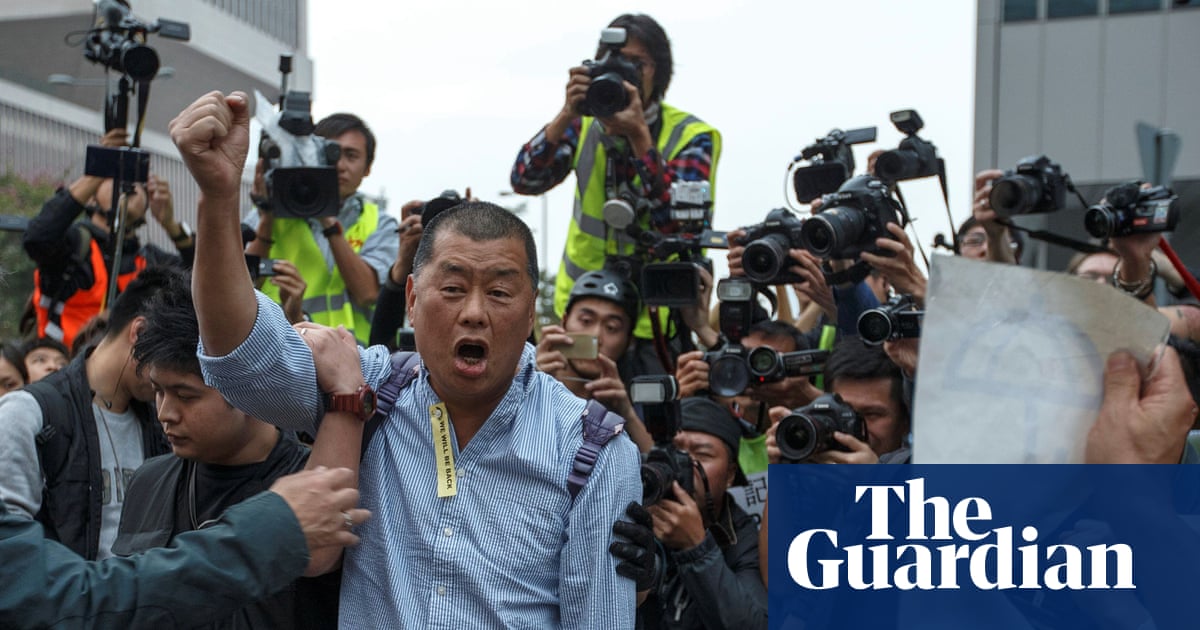
Lai also attended protest events in person, including a banned vigil for Tiananmen Square in June 2020, where he held a candle outside his car, resulting in a 13-month jail sentence.
'For them, I am a troublemaker’
Throughout his adult life, Lai faced constant monitoring, harassment, and intimidation in Hong Kong. His editorials about Li Peng led him to sell his stake in Giordano. His home and businesses were repeatedly firebombed, and his family was hounded by paparazzi. In 2008, he was the target of a failed assassination attempt.
“For them, I am a troublemaker,” he told Clifford. “It is hard for them not to clamp down on me and silence me.”
Lai's son, Sebastien, who now lives outside Hong Kong to advocate for his father’s release, said he was unaware of the threats when he was younger because his father never displayed any fear.
“I always had the knowledge that my dad was doing the right thing and not the easy thing,” Sebastien said.
He added, “You have someone who is, by all accounts, successful, but willing to give everything that he has for his beliefs. That in some sense would shame some people and therefore some people would not like him because of that… He always had the advantage that he came from nothing. He also had the advantage of knowing that even with nothing he’d be OK.”
Lai declined to hire a bodyguard, insisting he had done nothing wrong. He also believed a bodyguard would be ineffective against his greatest threat: arrest.
Following the 2019 protests, that threat became a reality. In August 2020, shortly after Beijing imposed the national security law (NSL), hundreds of police officers raided the offices of Apple Daily, arresting Lai and several of the paper's executives under the new law. His two eldest sons, Ian and Timothy, were also arrested. The company was ultimately forced to shut down the following year.
The closure of Apple Daily, considered another blow to democratic Hong Kong, made headlines worldwide. While the paper was a controversial tabloid known for its sensational stories and sometimes offensive opinions about mainland Chinese people, former employees testified against Lai as “accomplice witnesses,” alleging a work environment that was free but “within a bird cage,” under Lai's close management and control, with editorials that “had to follow the basic stance of the newspaper.”
That said, the reality is a bit more complicated. Sebastien argues, “in the end Apple is the only newspaper who stood up for democracy in Hong Kong, throughout the whole time, right?”
Despite Lai’s arrest and the paper’s closure, Hongkongers lined up to purchase an estimated one million copies of the final edition. China’s nationalistic Global Times newspaper celebrated the closure of the “secessionist tabloid.”
‘They haven’t bitten yet … so let’s see what happens’
Despite urgings from friends and advisors to take advantage of his UK citizenship, wealth, and foreign residences to flee the country, as many others had done, Lai refused. He insisted on staying to support his journalists and continue fighting for Hong Kong.
He told Clifford that he would rather go to jail than abandon the city that “gave me everything.”
While out on bail, he gave interviews and started a livestreamed political talk show. During an interview with The Guardian, Lai expressed cautious optimism, noting that the NSL had yet to be fully tested in Hong Kong’s court system, which was still internationally respected at the time.
“They just want to show the teeth of the national security law, but they haven’t bitten yet,” he said. “So let’s see what happens.”
But the law did bite. The result was over 200 NSL arrests, the mass prosecution of 47 politicians, activists, and civil society members who held an informal vote before city elections, appeals to Beijing when the courts didn’t align with the government, and laws rewritten to restrict bail rights and prevent foreign lawyers from representing Lai.
Lai was reportedly held in solitary confinement and denied communion as a devout Catholic. Authorities refuted these claims, citing logistical reasons or even a request from Lai himself. After an Associated Press photographer captured an image of Lai looking gaunt in shorts and sandals in the yard at Stanley Prison, the jail constructed a new roof covering. The photographer, Louise Delmotte, was later barred from working in Hong Kong when her visa renewal application was denied.
One fear that never materialized for Lai was the possibility of his case being transferred to mainland China for trial under a clause in the NSL. Many observers believed that if anyone were to face this fate, it would be Lai. He was already being treated as the city’s most dangerous criminal, transported to court in December 2023 by armored convoy, with security measures “one would expect for a president or a high-profile terrorist,” according to Clifford’s biography.
The Trump Connection
Lai’s business and political connections, particularly with US officials, were central to the prosecution's case.
Prosecutors presented a PowerPoint-style presentation of Lai’s “external political connections,” with whom he allegedly colluded. These connections included Trump, former Vice President Mike Pence, former Secretary of State Mike Pompeo, and veteran Democratic legislator Nancy Pelosi. All were known China hawks who, during Trump’s first term, had strengthened US policy towards China in a way that analysts said put real pressure on Beijing over human rights abuses.
Trump has repeatedly pledged to advocate for Lai’s release, and officials have stated that the media mogul’s case was raised during the meeting between Trump and Xi Jinping in South Korea in October. That said, the reality is a bit more complicated. Trump’s “America First” agenda has become more extreme in his second term, alienating allies and focusing more on “making a deal” with China.
Some speculate that Lai could become a bargaining chip in the US-China trade war.
Following the South Korea meeting, Sebastien publicly thanked the US president and praised him as the “Liberator in Chief,” a title conservatives had given Trump after the release of hostages from Gaza.
Sebastien’s appeal to Trump stems partly from what he perceives as the UK government’s insufficient efforts to secure the release of his father, a British citizen.
While the UK government has called for Lai’s release and deemed his prosecution politically motivated, it has not taken any economic action against Hong Kong. Bilateral trade between the two territories reached £27.2 billion in the year to July, a nearly 10% increase from the previous 12 months. Many of Lai’s supporters believe the UK has not done enough to secure the release of one of its most prominent citizens in its former colony.
Sebastien believes that if Jimmy Lai were released today, he would find Hong Kong drastically changed.
“It’s obviously no longer the sort of Hong Kong that had all these freedoms that you could associate with,” he says, adding that he is not there either and cannot return.
“Obviously, I think he’d be quite sad about what’s happened but look, at the end of the day this is someone who’s done everything he can, right? I don’t think anybody looking at his life would think: well, he could have done more.”