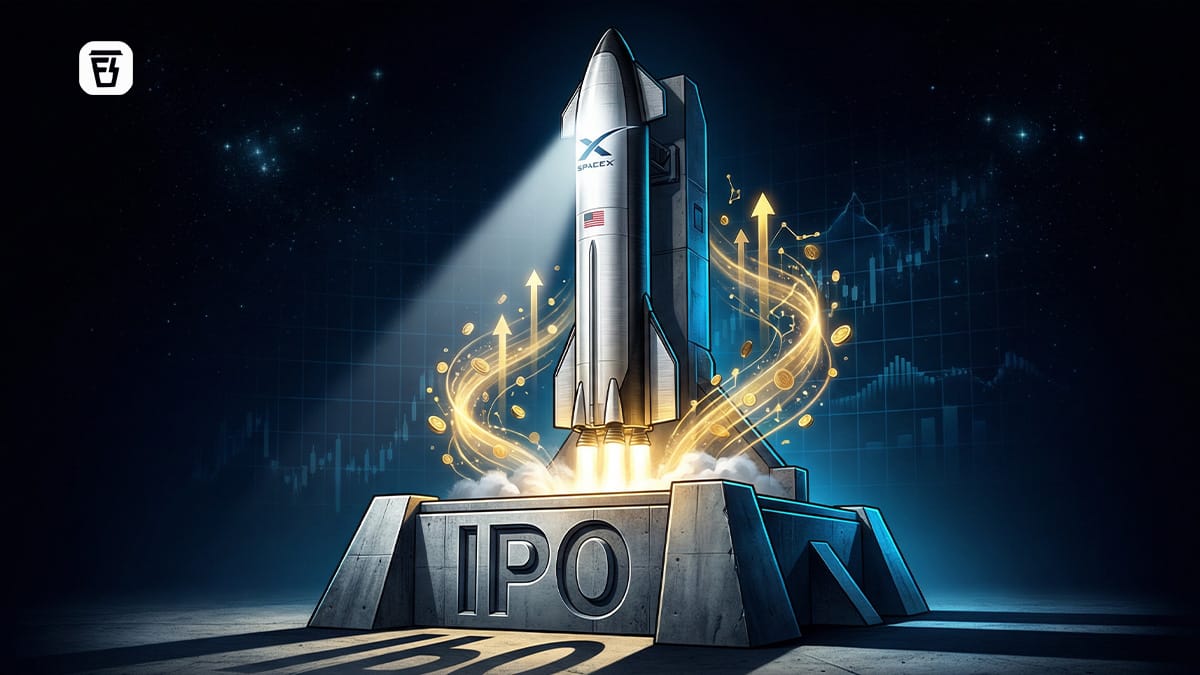
Decoding the Potential $1.5 Trillion SpaceX IPO
हिंदी में सुनें
Listen to this article in Hindi
Explore the speculation surrounding a potential $1.5 trillion SpaceX IPO, examining the factors driving its valuation and the implications for investors.
The financial world is abuzz with talk of a possible SpaceX IPO and a staggering $1.5 trillion valuation, a figure that simultaneously excites and causes concern. This analysis delves into the reasons behind this speculation and its potential impact on the markets.
For centuries, space has captivated humanity, representing both immense possibility and a humbling sense of insignificance. From ancient mariners navigating by the stars to modern astronomers mapping distant galaxies, space exploration has always pushed the boundaries of human endeavor. Governments have invested vast sums in space programs, driven by national pride and the pursuit of technological dominance.
That said, the reality is a bit more complicated. the exorbitant costs associated with space travel have long been a major constraint. Historically, space exploration has been politically driven, rarely profitable, and characterized by single-use rockets and a high tolerance for failure. The notion of space as a commercial industry, rather than a government initiative, seemed almost impossible.
For decades, launching a single kilogram into orbit could cost tens of thousands of dollars, due to the disposable nature of rockets and the slow pace of innovation. This made space the exclusive domain of superpowers like NASA, ISRO, and Roscosmos, which dictated who could access space and for what purpose.
But this paradigm has shifted dramatically in recent years. Space is increasingly viewed as essential infrastructure, and a private company is leading this transformation, potentially opening its doors to public investors. The number circulating on Wall Street is $1.5 trillion, the potential valuation of SpaceX should it go public. This would eclipse the market capitalization of giants like Apple and Meta on their IPO days and represent a substantial portion of the entire Indian stock market.
While seemingly outlandish, the speculation persists. SpaceX's current private market valuation of around $800 billion already makes it the most valuable private company globally. Furthermore, SpaceX launches more rockets than any other country and controls over 60% of the world's orbital lift capacity. Its Starlink satellite internet service boasts millions of subscribers and operates the largest satellite constellation ever assembled.
The possibility of spinning off Starlink into a separate publicly traded entity, potentially worth hundreds of billions of dollars, further fuels the speculation. Combined with SpaceX's launch business and ambitious projects like Starship, a $1.5 trillion valuation appears less far-fetched.
SpaceX is an unconventional company led by Elon Musk, who has historically resisted public markets, citing the short-term pressures and distractions they create. SpaceX was deliberately kept private to foster high-risk engineering, where failures and delays were accepted in pursuit of ambitious, long-term goals. Therefore, Musk's apparent openness to an IPO is noteworthy.
The primary driver behind this shift is scale. SpaceX is reaching a point where private capital may be insufficient to fund its ambitious projects. Starship development, Starlink satellite replacements, lunar contracts, defense launches, and deep-space exploration all require vast amounts of capital that private markets may struggle to provide indefinitely.
Another factor is the growing interest in space-based data centers, particularly as companies prepare for an AI-driven future. Training and operating advanced AI models demands immense computing power, energy, and cooling capacity. Locating infrastructure in orbit could alleviate constraints related to land, power, and data transmission latency. SpaceX is uniquely positioned to capitalize on this trend.
An IPO would significantly expand SpaceX's funding options, providing the liquidity needed to pursue long-term projects. That said, the reality is a bit more complicated. public markets prioritize tangible results over visionary goals. Shareholders will scrutinize Starlink's profit margins, satellite replacement costs, regulatory risks, and cash flow, potentially clashing with SpaceX's tolerance for risk and long-term investments in projects like Mars colonization.
SpaceX has revolutionized the space industry by drastically reducing costs. Starlink has further disrupted the industry by introducing a recurring subscription revenue model, serving a diverse customer base including rural households, maritime vessels, airlines, and the military.
That said, the reality is a bit more complicated. SpaceX's strengths also present potential risks. The company's long-term vision of establishing a multi-planetary presence may conflict with shareholder interests, as developing Starship, transporting cargo and humans, establishing habitats, and sustaining missions could cost trillions of dollars without a clear revenue model. Such a venture could be viewed as a financial drain by shareholders.
The SpaceX IPO is controversial because it raises questions about whether a company can maintain its appetite for risk and long-term vision once it becomes subject to the demands of public shareholders.
Geopolitical considerations also come into play. SpaceX's satellites play a crucial role in battlefield communications, and Starlink terminals have influenced conflicts and diplomatic negotiations. A publicly listed SpaceX would operate at the intersection of markets, militaries, and foreign policy, raising complex regulatory questions.
Elon Musk's leadership style, characterized by high-risk engineering and a willingness to embrace failure, may also face scrutiny in the public markets. Explaining rocket explosions and prototype failures to analysts accustomed to predictable results could be challenging.
The financial sustainability of Starlink is another concern. While it has a growing subscriber base, it also requires continuous capital expenditure to replace aging satellites. Valuing a business that requires constant reinvestment is complex, forcing investors to decide whether it is a utility, a tech company, or something entirely new.
Finally, the $1.5 trillion valuation itself is subject to debate. An IPO of this magnitude would be unprecedented, dwarfing the debuts of Alibaba, Google, and Meta. Even Saudi Aramco barely surpassed $1.7 trillion. SpaceX remains a capital-intensive company operating in a highly complex industry, with both immense potential and significant uncertainty.
The significance of the SpaceX IPO lies in how markets value frontier technology. Public markets have historically favored predictable cash flows over ambitious, long-shot ventures. SpaceX defies categorization, operating as an infrastructure provider, defense contractor, telecom provider, and a science-fiction startup.
If SpaceX goes public, investors will need to reassess how they value companies that are pushing the boundaries of what is possible. The $1.5 trillion valuation should be interpreted as a signal that space is no longer a niche sector but a commercial arena deeply intertwined with everyday life.
Until then, SpaceX remains a private company, characterized by volatility and unapologetic ambition, which may be the key to its success.