Scientists Chart the Sun's Outer Limit for the First Time
हिंदी में सुनें
Listen to this article in Hindi
For the first time, researchers have successfully mapped the Sun's outer boundary, the Alfvén surface, transforming our comprehension of stellar interactions.
In a landmark achievement, scientists have successfully mapped the Sun's elusive outer boundary, a region known as the Alfvén surface. This breakthrough provides unprecedented insights into where the solar wind breaks free from the Sun's magnetic grip, marking a pivotal moment in our understanding of stars and their interaction with the surrounding cosmos.
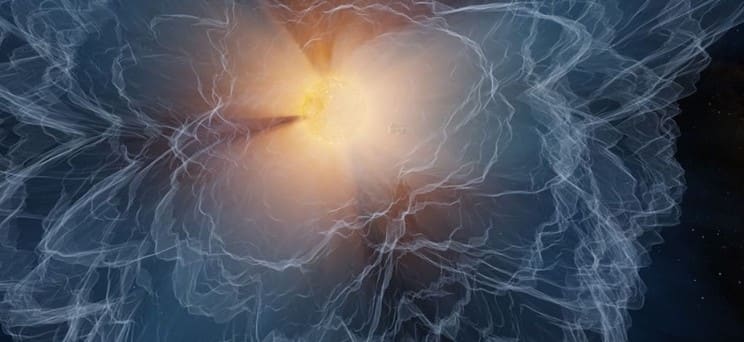
The Alfvén surface isn't a solid barrier, but rather an invisible, fluctuating frontier far beyond the Sun's visible surface. It's the point where the Sun's magnetic field weakens, allowing charged particles to escape and stream outwards as solar wind, unimpeded.
This mapping feat was made possible by NASA's Parker Solar Probe, a spacecraft specifically designed to venture closer to the Sun than any before it. The probe braved intense heat, radiation, and turbulent solar conditions to gather data from previously unreachable regions. These observations, combined with information gleaned from the Solar Orbiter and Earth-based instruments, allowed scientists to piece together the first comprehensive map of this dynamic boundary after years of intensive analysis.
The picture that emerged is far from simple. Instead of a smooth, spherical shell, the Sun's boundary is uneven and jagged, characterized by spikes, bulges, and folds. Its shape is also constantly changing, expanding outwards during periods of heightened solar activity and retracting during calmer phases. This behavior has challenged existing theoretical models.
Understanding the Alfvén surface is crucial because the solar wind that originates here significantly influences space weather. Strong solar storms can disrupt satellites, navigation systems, and even power grids on Earth. By mapping this boundary with greater accuracy, scientists hope to improve space weather forecasting and safeguard critical infrastructure.
The Sun, as our nearest star, serves as a vital laboratory for understanding stellar phenomena throughout the universe. The discovery of its complex and dynamic boundary provides clues about how other stars might shape the environments around their planets, potentially influencing their atmospheres and habitability. This new data paints a picture of a far more active and complex Sun than previously imagined. Each close pass by the Parker Solar Probe continues to reveal unexpected aspects of our star's behavior, promising further revelations in the years to come.
In essence, humanity has now charted a crucial frontier – not on the Sun's surface, but in the vastness of space surrounding it. This boundary marks the limit of the Sun's influence, beyond which the universe takes over. Despite centuries of solar study, this discovery underscores the vast amount that remains unknown, and how even our closest star can still surprise us.