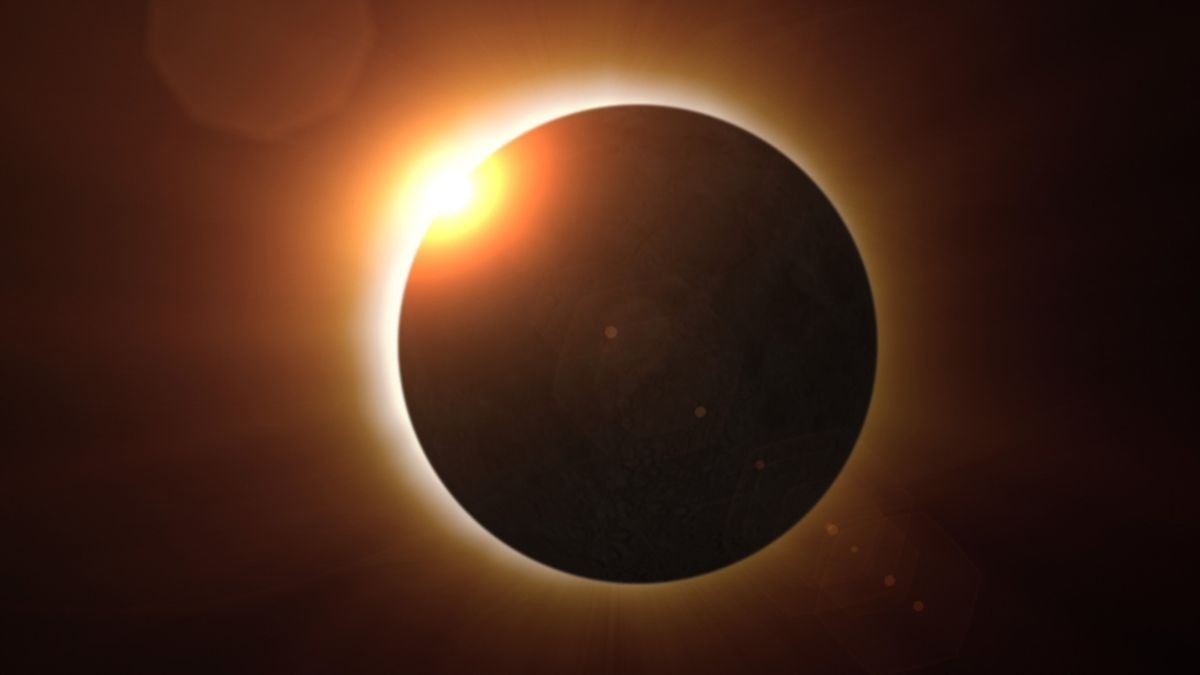
Sun to briefly disappear in 2026. Here's what's happening
हिंदी में सुनें
Listen to this article in Hindi
Get ready for a celestial spectacle! In 2026, an annular solar eclipse will create a 'ring of fire.' Find out where and how to witness this rare event.
Skywatchers are in for a treat in 2026. On February 17th, an annular solar eclipse will transform the sun into a breathtaking "ring of fire." This occurs when the Moon passes in front of the Sun but, due to its distance from Earth, appears slightly smaller, leaving a brilliant ring of sunlight visible around the Moon's edges.
During this type of eclipse, the Moon covers approximately 96% of the Sun's disc, rather than completely blocking it out. This creates the stunning fiery ring effect.
**Viewing the Eclipse**
The peak of the "ring of fire" effect, known as annularity, will last for up to two minutes and 20 seconds. The eclipse's path will sweep across Antarctica, tracing a route thousands of kilometers long but only a few hundred kilometers wide across the remote ice. Consequently, very few people will have the opportunity to witness the full annular phase in person.
It's possible that scientists at research stations such as Concordia and Mirny will be among the lucky few, along with passengers on adventurous cruises in the Southern Ocean. For the vast majority, the event will be experienced through live streams and photographs captured by those with a front-row seat.
Even outside this narrow path, a partial eclipse will be visible. Observers in parts of Southern Africa, the southern tips of South America, and across sections of the southern oceans will see the Sun partially obscured, as if a bite has been taken from it.
**The Captivating Nature of Eclipses**
Solar eclipses serve as a reminder of the precision of cosmic movements. The Sun's size and distance...