Sinking Russia’s ‘shadow fleet’: Has the Ukraine war reached Senegal?
A Turkish-owned oil tanker that recently visited a Russian port was heavily damaged by explosions off the coast of Senegal last Thursday. While Kyiv has not claimed responsibility for the attack, the…
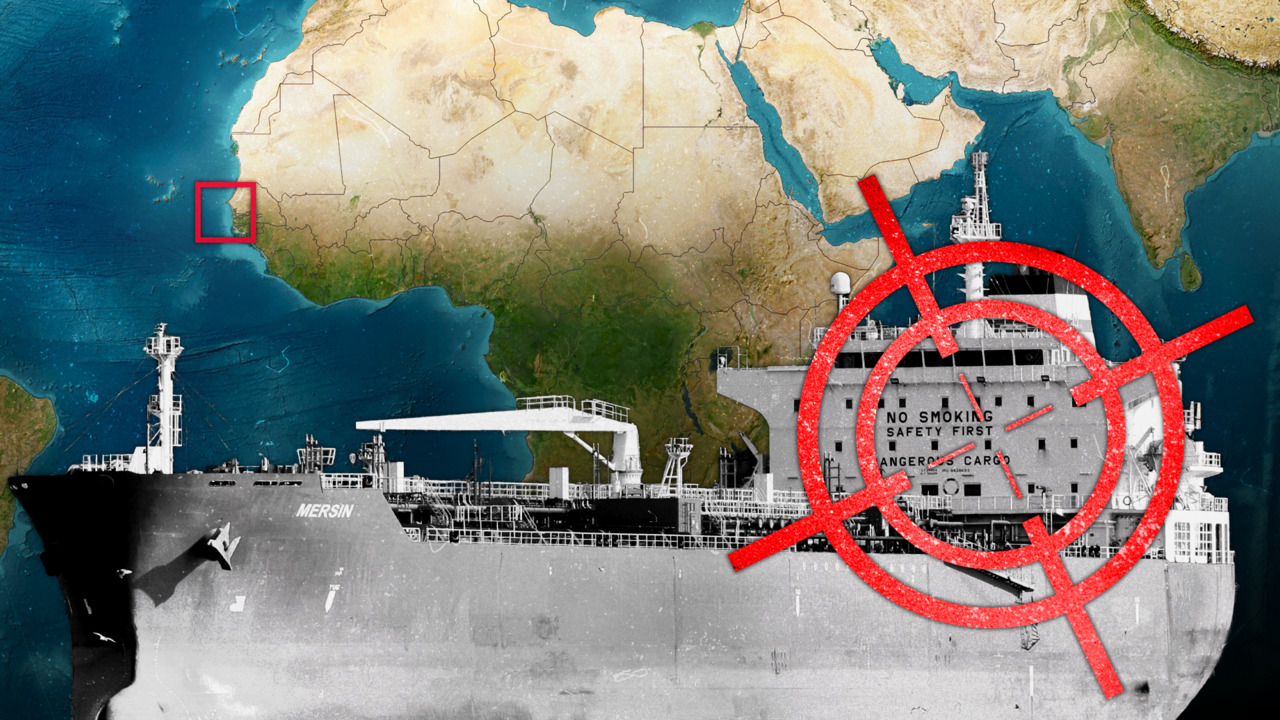
Does the long arm of Ukraine’s intelligence services stretch all the way to Senegal? Kyiv has come under suspicion of pursuing the fight against Moscow all the way to Africa's Atlantic coast after a series of explosions ripped through the Mersin oil tanker – accused of belonging to Russia’s “shadow fleet” – off the shores of Dakar last Thursday.
The Turkish-owned Mersin, which was sailing under a Panamanian flag and carrying nearly 39,000 tonnes of fuel, was hit from outside by four explosions, the ship’s operator Besiktas Shipping confirmed on Monday. No one on board was hurt.
A legitimate target?
“The situation was immediately brought under control, and we confirm that all crew members are safe; there are no injuries, no loss of life and no pollution,” Besiktas Shipping said in a statement. The company added that the cause of the explosions remained unclear.
Suspicion immediately fell on Ukraine, which has not claimed responsibility for the attack. Kyiv’s silence is unsurprising – the oil tanker is not on any list of sanctioned vessels.
Read moreFrance investigates oil tanker listed under Russia 'shadow fleet' sanctions
“Under the law of armed conflict, belligerents must distinguish between civilian and military targets,” said Basil Germond, a specialist in international and maritime security at the University of Lancaster.
“That said, historically, in total wars such as the two world wars, commercial shipping was often targeted as part of economic warfare. So, energy exports can be considered as strategic objectives – similar to Russia's attacks on Ukraine's energy grid or Ukraine's attacks on Russian refineries.”
Be that as it may, Ukraine claiming official responsibility for the explosion would likely be controversial in the case of the Mersin, a commercial freighter without any official links to Russia.
Dirk Siebels, a specialist in maritime security at the Risk Intelligence consulting firm, said the tanker would likely be a legitimate target in Ukraine's eyes.
The Mersin has been identified stopping at Russian ports on several occasions since the start of the year, including Novorossiysk and Tuapse on the Black Sea and Ust-Luga in the Gulf of Finland, according to Russian investigative outlet The Insider. Bloomberg has reported that the Mersin has a history of transporting Russian oil.
“From a Ukrainian point of view, of course, that's still something that finances the Russian government – and therefore the Russian war effort in Ukraine,” Siebels said.
Russia’s ‘shadow fleet’ under fire
The explosions off Senegal’s coast come during a mounting campaign of attacks against commercial ships suspected of belonging to Russia’s “shadow fleet” – ageing commercial oil tankers with often opaque ownership structures used by Moscow to export its oil and gas and slip through Western sanctions.
The EU, US and UK have largely banned Russian oil imports, and companies based in G7 countries can only provide critical services such as insurance and transport for Russian oil being sold to third countries under a fixed price cap.
“This fits into the pattern of these vessels that have been attacked in a very similar fashion earlier this year,” Siebels said.
FRANCE 24’s Observers team has recorded seven vessels linked to Russia that have either been damaged or sunk following “mysterious” explosions off the coasts of Russia, Spain, Libya, Turkey and Italy since December 2024.
None of the ships were under Western sanctions at the time of the attacks.
“Even though the Ukrainians never actually admitted to being involved in any of these incidents individually, they have communicated in relatively certain terms that they wanted to send a signal with these particular incidents,” Siebels said. “And in all these cases, they targeted tankers specifically, and they targeted tankers which were involved in transporting Russian oil and oil products.”
In the days after the Mersin was wracked by explosions, two other freighters suspected of belonging to Russia’s “shadow fleet” were attacked in the Black Sea. This time, Ukraine claimed full responsibility.
Sea Baby naval drones inflicted heavy damage against two ships off the Turkish coast last week. The Kairos and the Virat – both flying Gambian flags of convenience – were headed to Russia’s Novorossiysk oil terminal. Both ships were empty at the time of the attacks.
It was the first time that Kyiv explicitly took credit for using naval drones against civilian ships. Unlike the other tankers rocked by explosions in recent months, both the Kairos and the Virat were on a list of ships sanctioned for facilitating illegal exports of Russian oil.
Read moreEurope needs help funding Ukraine. So why can't it agree on using frozen Russian assets?
But while these targets may seem more legitimate, Siebels said the operations remained fraught with risk.
“When you're targeting vessels in an area with a relatively good amount of maritime traffic, then yes, definitely things can go wrong,” Siebels said. “They may actually end up hitting the wrong vessel … there's always the risk of something going wrong. You're definitely running the risk of injuring or even killing seafarers.”
This is likely the reason why Ukraine has used its most advanced naval drones to carry out the attacks, said Patrick René Haasler, an analyst specialising in the post-Soviet space at the Verona-based International Team for the Study of Security.
“The Ukrainian Sea Baby drones are remotely controlled in real time via Starlink satellite connections and use high-resolution front cameras and thermal sensors,” he said. “Since the 2025 upgrades, AI-based object recognition and automatic target tracking have been added, increasing accuracy to less than 10 metres.”
Despite this, he said, it was vital that such attacks did not target tankers that were currently transporting oil.
“Despite their high precision, Sea Baby drones pose a significant potential for collateral damage in the Black Sea,” he said. “Their 850kg explosive payload can cause oil spills and create wave effects on neighbouring ships or coastlines if they miss their targets or hit loaded tankers.”
High risk, high reward
Despite the risks, Haasler said that Ukraine’s attacks made sense given Russia’s increasing reinforcement of its own energy infrastructure against Kyiv’s ongoing assaults.
“Against this backdrop, it seems reasonable to assume that Ukrainian drone attacks on Russian energy facilities could be less effective in the future,” he said. “Kyiv could therefore focus on supposedly easier targets in order to achieve success at least on an operational level in times of crumbling front lines.”
Germond said that the clandestine nature of Russia’s shadow fleet made it a tempting target.
“These vessels, by design, operate independently and covertly, leaving them vulnerable to attack in the 'grey zone' with limited options for protection or for claiming liability following an attack,” he said.
Moscow, which does not acknowledge the existence of a shadow fleet of oil tankers tasked with shipping Russian oil, is unlikely to provide the vessels with a naval escort or station troops aboard.
Read moreFrance detains two crew members of Russia-linked tanker off western French coast
If Ukraine’s intelligence services were in fact behind the blasts that targeted the Mersin last week, it would mark a significant extension of the Russia-Ukraine war beyond the waters of the Black Sea and the Mediterranean.
So how would Ukraine have been able to launch such an attack more than 5,000 kilometres from Kyiv? For Siebels, it was not such a stretch.
“The Ukrainians have also been involved in other land-based operations in Africa, targeting Russian mercenaries or Russian personnel in Mali and Sudan, for example,” he said.
He said that the attacks on ships involved in shipping Russian oil seemed to be a calculated risk.
“If you can actually make a dent in the number of companies that are willing to engage in transporting Russian oil and oil products, and then I would say it's definitely worth it. Because that is, to a large extent, the Russian government budget and by extension, the Russian military budget,” he said. “So for Ukraine, as a long-term strategy, that makes a lot of sense.”