IIT Bombay: Single Light Pulse Can Now Control Quantum States in 2D Materials
हिंदी में सुनें
Listen to this article in Hindi
IIT Bombay scientists discovered a new method using single light pulses to control quantum states in 2D materials, potentially revolutionizing computing.
Mumbai, Dec 14 (IANS) – IIT Bombay researchers have achieved a breakthrough in controlling quantum states within ultra-thin materials using only light. This new method could pave the way for faster and more energy-efficient computers, the institute announced Sunday.
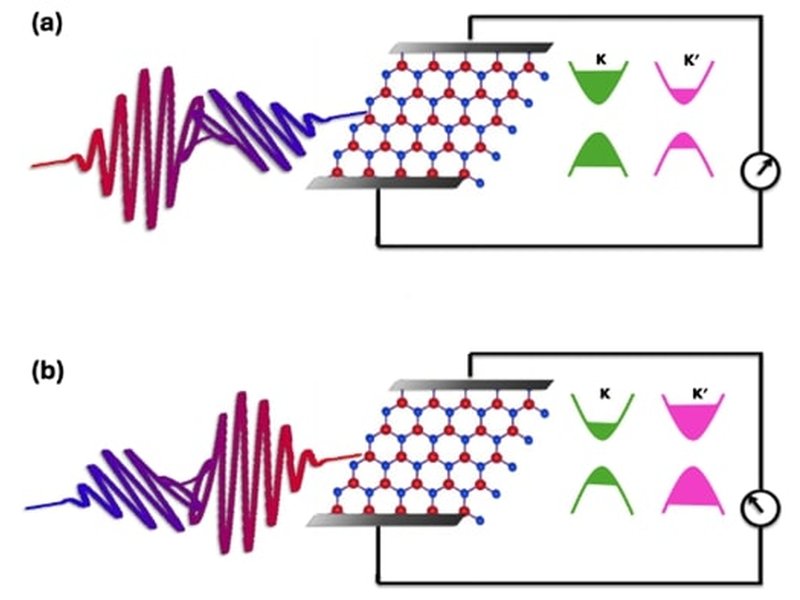
The research centers on two-dimensional semiconductors, materials that are just a single atom thick – thousands of times thinner than a human hair. Within these materials, electrons can exist in two separate quantum states, known as valleys and labeled K and K′. These states are analogous to the 0s and 1s used in digital computing, and they form the foundation of a growing field of study called valleytronics.
Previously, controlling these valley states was a complex process. Existing methods required intricate laser setups that used circularly polarized light and multiple laser pulses. Even with these complex setups, control was often incomplete or difficult to accurately measure. Achieving reliable and reversible switching between the two valley states remained a significant hurdle.
The IIT Bombay team has demonstrated that this complex setup is unnecessary. Their research, published in the journal 'Advanced Optical Materials,' shows that a single, linearly polarized laser pulse can effectively control and read the valley state of electrons. The key to this simplified method is introducing a small, precisely controlled skew in the laser pulse's polarization.
According to Prof. Gopal Dixit from IIT Bombay, this slight...