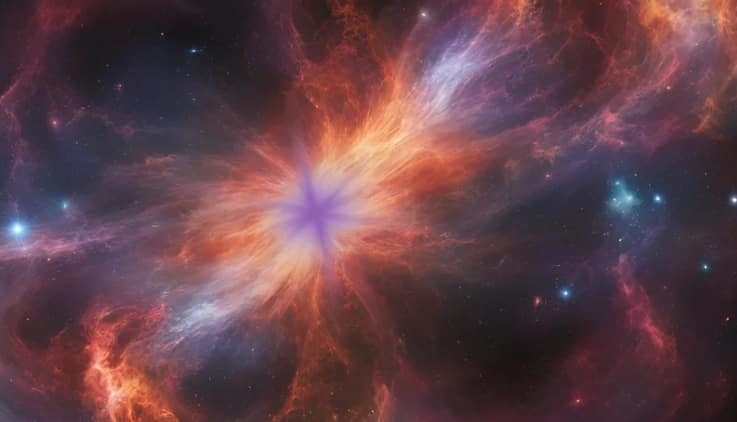
How Dark Matter Might Have Created the Universe's First Stars, According to Scientists
हिंदी में सुनें
Listen to this article in Hindi
Scientists propose that dark matter fueled the universe's first stars before normal fusion, suggesting a new explanation for early supermassive black holes.
A new theory suggests that the earliest stars in the universe were powered by dark matter, not by the nuclear fusion that fuels modern stars. These hypothetical "dark stars" could have formed within the first 100 million years after the Big Bang, when dense gas clouds encountered concentrated halos of dark matter due to gravitational forces.
**The Mechanism Behind the Darkness-Fueled Light**
The theory posits that dark matter particles, trapped within these protostars, annihilated each other, releasing heat. This heat would have prevented the protostar from collapsing and initiating nuclear fusion. The resulting objects would have been enormous and luminous, but with relatively cool surfaces.
Unlike ordinary stars, these dark stars would have lacked fusion-powered cores. Models predict that they could have been thousands or even millions of times more massive than our Sun. Their cooler temperatures would have shifted their light into infrared wavelengths, making them potentially detectable today.
**The Search with the Webb Telescope**
Astronomers are now using the James Webb Space Telescope to search for these dark star candidates. Some distant, bright objects that defy explanation as typical galaxies or stars have been identified. These objects' profiles match predictions for massive dark stars. That said, the reality is a bit more complicated. researchers emphasize that the evidence is still uncertain and subject to ongoing debate.
**Why Dark Stars Matter**
Dark stars offer a potential explanation for the surprisingly rapid emergence of supermassive black holes in the early universe. When the dark matter fuel within a dark star was exhausted, the star may have collapsed directly into a black hole. Such collapses could have seeded the supermassive black holes we observe today. Confirmation of dark stars would also provide valuable insights into the behavior of dark matter beyond its gravitational effects.
**Future Research**
Further observations with the James Webb Space Telescope will be crucial for testing the theoretical predictions about dark stars. Advanced simulations will also help refine the expected brightness and spectra of these objects, aiding in their identification.