Saturn's moon Titan may not have a buried ocean as long suspected, new study suggests
हिंदी में सुनें
Listen to this article in Hindi
New analysis of Cassini data challenges the long-held belief that Saturn's moon Titan possesses a global subsurface ocean, suggesting a slushy interior.
New research suggests that Titan, Saturn's largest moon, might not harbor a vast subsurface ocean as many scientists have long believed.
Instead of a global ocean, Titan's interior may consist of deep layers of ice and slush, punctuated by pockets of liquid water. This environment, more akin to Earth's polar seas, could potentially support life, according to a study published in the journal *Nature*.
Researchers at NASA's Jet Propulsion Laboratory (JPL) re-examined data collected years ago by NASA's Cassini spacecraft, which orbited Saturn. Their analysis challenges the decade-old hypothesis of a global ocean hidden beneath Titan's surface.
While no evidence of life has been discovered on Titan, Baptiste Journaux from the University of Washington, a participant in the study, stated that these findings provide "strong justification for continued optimism regarding the potential for extraterrestrial life."
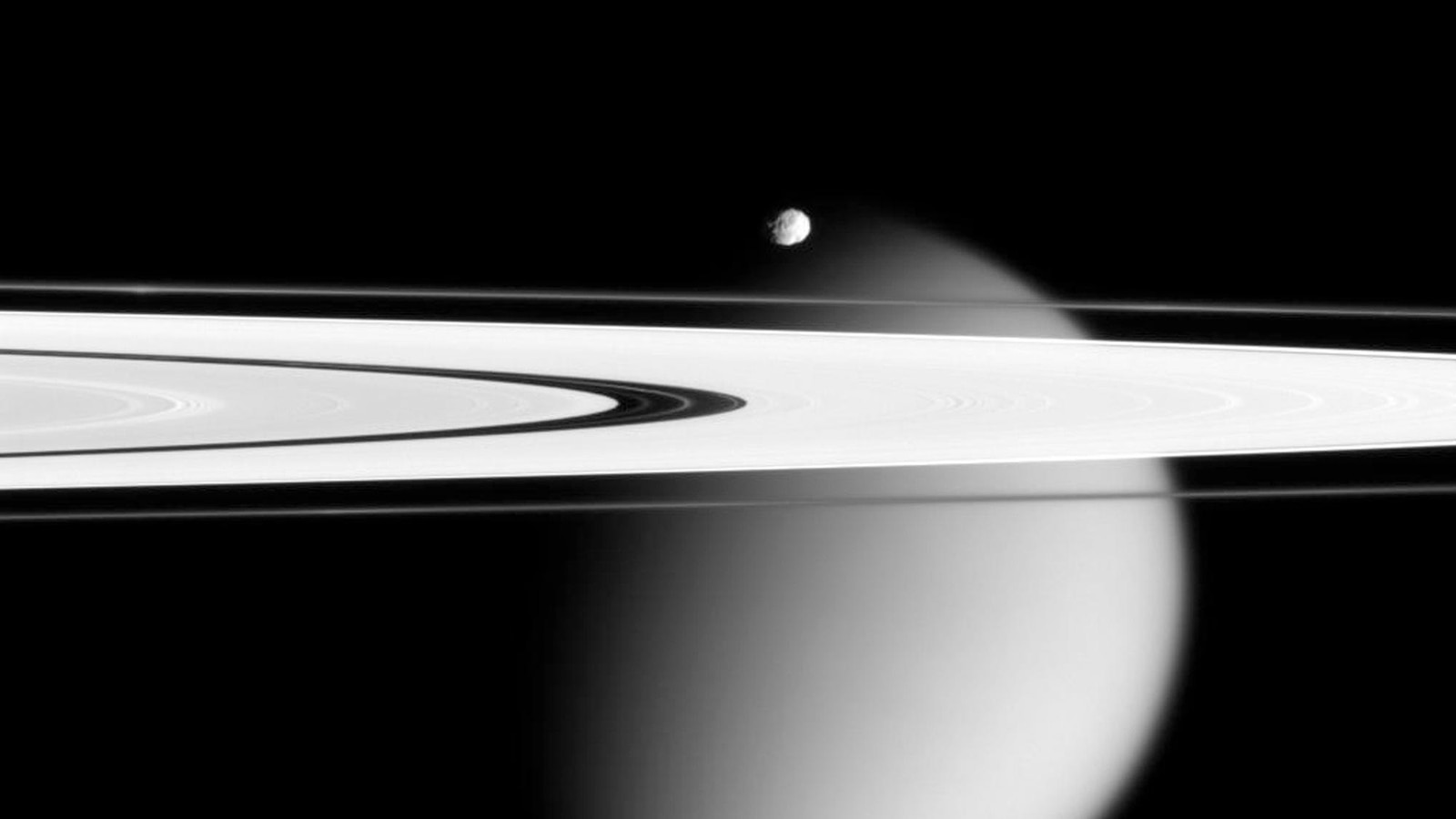
Titan, the second-largest moon in our solar system, spans 3,200 miles (5,150 kilometers) and features lakes of liquid methane on its icy surface. The question of what form life might take on Titan remains open, with Journaux suggesting that "nature has repeatedly demonstrated far greater creativity than the most imaginative scientists."
Flavio Petricca, the lead author from JPL, proposes that Titan's ocean may have frozen in the past and is currently thawing, or that its hydrosphere is gradually freezing. Computer models indicate that these layers of ice, slush, and water extend to depths exceeding 340 miles (550 kilometers). The outer ice shell is estimated to be around 100 miles (170 kilometers) thick, covering layers of slush and pools of water that could reach another 250 miles (400 kilometers) deep, with temperatures potentially reaching 68 degrees Fahrenheit (20 degrees Celsius).
Titan is tidally locked with Saturn, meaning the same side always faces the planet, similar to the Earth-Moon relationship. Saturn's strong gravitational pull deforms Titan's surface, creating bulges as high as 30 feet (10 meters) when the two are closest.
Petricca's team measured the time difference between Saturn's peak gravitational pull and the rise of Titan's surface using enhanced data processing techniques. A 15-hour delay was detected, suggesting a slushy interior with liquid water pockets, rather than an immediate response expected with a wet ocean. Computer models of Titan's orientation supported this conclusion.
Luciano Iess from Sapienza University of Rome, whose earlier research using Cassini data suggested a subsurface ocean, remains unconvinced. He acknowledged the findings as "certainly intriguing and will stimulate renewed discussion" but believes that "at present, the available evidence looks certainly not sufficient to exclude Titan from the family of ocean worlds."
Further insights into Titan's interior are expected from NASA's Dragonfly mission, which will send a helicopter-like spacecraft to Titan later this decade. Journaux is involved in this mission.
Saturn has the most moons in the solar system with 146. Ganymede, Jupiter's moon, is slightly larger than Titan and also potentially has a subsurface ocean. Other potential water worlds include Saturn's Enceladus and Jupiter's Europa, both believed to have water geysers erupting from their icy surfaces.
The Cassini spacecraft, launched in 1997, arrived at Saturn in 2004 and orbited the planet and its moons until 2017, when it was deliberately sent into Saturn's atmosphere.