Pune researchers find spiral galaxy like Milky Way from early universe
The striking thing about Alaknanda is its textbook spiral structure.
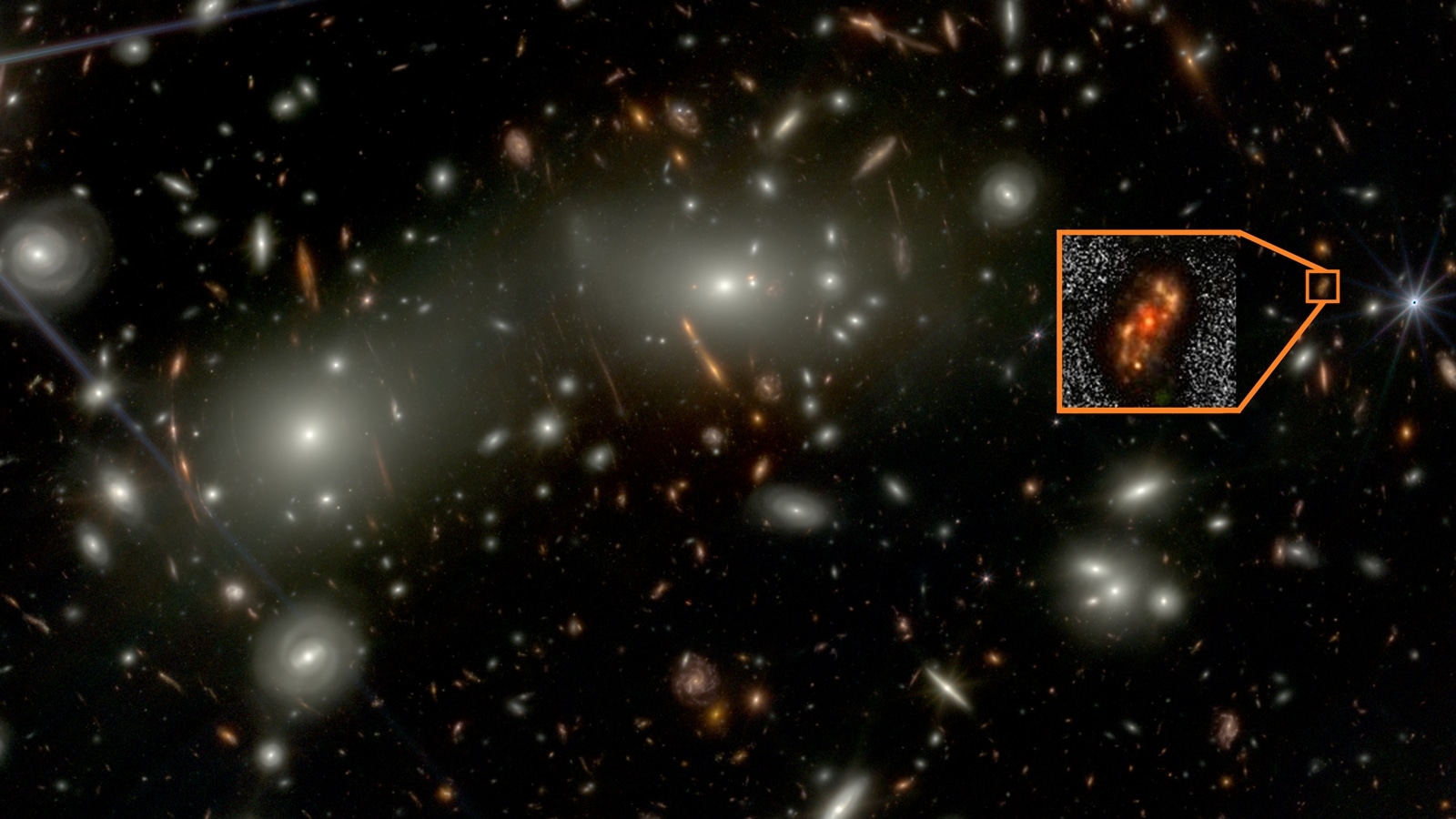
“We have named it Alaknanda, after the Himalayan river,” Professor Yogesh Wadadekar at the National Centre for Radio Astrophysics of the Tata Institute of Fundamental Research (NCRA-TIFR) in Pune said Tuesday while announcing the discovery.
Rashi Jain, a PhD student who led this research under Wadadekar’s guidance, said the discovery was a little unexpected. “The galaxy looks remarkably similar to our own Milky Way despite being present when the universe was only 10 per cent of its current age,” she said.
The discovery has been published in the leading European astronomy journal Astronomy and Astrophysics.
The striking thing about Alaknanda is its textbook spiral structure. The galaxy has two well-defined spiral arms wrapping around a bright central bulge, spanning approximately 30,000 light-years in diameter. According to the current understanding of scientists, the earliest formed galaxies did not have well-defined structures, were chaotic and clumpy, extremely hot and turbulent. But Alaknanda is nothing like that.
“Finding such a well-formed spiral galaxy at this early epoch is quite unexpected. It tells us that sophisticated structures were being built in our universe much earlier than we thought possible,” Jain said.
Story continues below this ad
The discovery was made using NASA’s James Webb Space Telescope (JWST), the most powerful piece of observation equipment put into space. Launched in December 2021, JWST has already produced data that is redefining our understanding of the universe. This includes spotting some of the oldest galaxies in the universe, those that were formed just a few hundred million years after the Big Bang.
Jain explained the reason why the researchers decided to name it Alaknanda. “Alaknanda is a spiral galaxy located about 12 billion light years away and has a prominent grand design spiral structure just like our own galaxy, the Milky Way. Just as Alaknanda is the sister river of Mandakini river, which is also the Hindi name for our own Milky Way galaxy, we thought it fitting to name this distant sister after the Alaknanda river,” she said.
Jain said the discovery of Alaknanda adds to the growing body of evidence coming from JWST that the early universe was more mature than previously thought.
Wadadekar told The Indian Express that the next step was to measure the kinematics of the gas and stars in Alaknanda galaxy. “Depending on whether the motion is regular or chaotic, we will get some clues about the mechanism that resulted in the formation of the spiral arms. Understanding whether Alaknanda’s disk is cold or hot will tell us which formation mechanism created the spiral arms,” he said.
Story continues below this ad
The next set of studies would have to be done using data from JWST and the ALMA telescope based in Chile. “Further studies would tell us whether galaxies like Alaknanda represent a different evolutionary pathway that existed in early universe,” Wadadekar said.