Beyond Beauty: Peacock Feather Lasers and the Future of Biophotonics
हिंदी में सुनें
Listen to this article in Hindi
New research shows peacock feathers can emit laser light, opening doors for advanced biocompatible imaging and sensing technologies. Understand the public health implications.
Peacock feathers, renowned for their iridescent beauty, have recently revealed a hidden talent: the ability to generate laser light. While seemingly a curiosity, this discovery, detailed in *Scientific Reports*, carries implications for how we might approach the development of biocompatible imaging and sensing technologies in the future. This isn't about turning peacocks into lightbulb factories, but rather understanding the underlying principles that could lead to safer and more effective diagnostic tools.
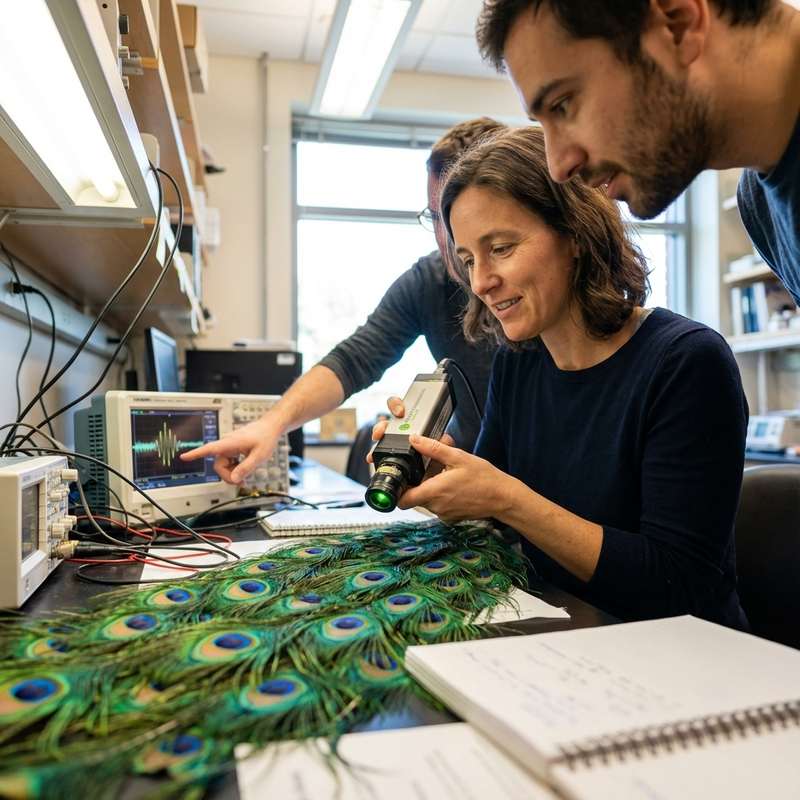
The study demonstrated that peacock feathers, when treated with a common dye and exposed to a specific light frequency, emitted laser light. This phenomenon isn't due to simple reflection or glowing; it's a result of the feather's intricate nanostructure interacting with the dye and light in a way that produces coherent light emission—the hallmark of a laser.
To achieve this, researchers repeatedly soaked and dried sections of peacock feathers in rhodamine 6G, a fluorescent dye. Subsequently, they illuminated the treated feathers with green light pulses. This process resulted in the emission of two distinct and narrow laser lines, indicating true lasing action originating from within the feather's structure. The green regions of the feather's eyespot produced the strongest signals, but the same laser lines were also observed in yellow and brown areas.
The significance lies not in the peacock itself, but in the potential for bio-inspired design. Current laser-based diagnostic and imaging techniques often rely on synthetic materials that can be toxic or damaging to living tissue. The discovery that a natural structure, like a feather, can be induced to produce laser light suggests alternative pathways for creating biocompatible light sources. This could pave the way for less invasive and more sensitive diagnostic tools. Understanding [public health context] through the lens of technological advancements enables innovative solutions for various medical challenges.
One potential application lies in the development of advanced biosensors. Imagine sensors that can be implanted or applied to the skin to monitor subtle changes in cellular activity or detect early signs of disease. By leveraging the principles observed in peacock feathers, researchers might be able to create sensors that use minimal power and operate safely within the body. This could lead to earlier and more accurate diagnoses for a range of conditions.
Another area of interest is in vivo imaging. Current imaging techniques, such as X-rays and MRIs, have limitations in terms of resolution, safety, or cost. Biophotonic approaches, inspired by the peacock feather laser, could offer a complementary imaging modality that is both high-resolution and biocompatible. This could be particularly useful for visualizing small structures within tissues or monitoring the response of cells to drugs or therapies. Understanding the system-level context of [disease or system explainer] helps in developing better diagnostic tools.
It's important to note that this research is still in its early stages. Many questions remain about the precise mechanisms underlying the laser action in peacock feathers. The exact structures within the feather that act as resonators, providing the feedback needed for lasing, are yet to be fully identified. Further research is needed to optimize the process and translate it into practical applications.
Additionally, the current method requires the use of a dye, which may have its own limitations in terms of biocompatibility. Future efforts will likely focus on finding alternative ways to induce lasing without the need for external dyes or on developing dyes that are inherently biocompatible. The World Health Organization (WHO) provides a [government or WHO-style overview (internal)] of health technology innovations, offering insights into the global landscape and future directions.
Despite these challenges, the discovery of laser action in peacock feathers represents a significant step forward in the field of biophotonics. It highlights the potential of nature as a source of inspiration for new technologies that can improve human health. As research progresses, we can expect to see further advancements in biocompatible imaging and sensing, leading to more effective and less invasive diagnostic and therapeutic approaches. The key is to proceed with cautious optimism, recognizing both the potential benefits and the limitations of this emerging field.
Editor’s note: This article was independently written by the Scoopliner Editorial Team using publicly available information.