One year after Assad's toppling: What has Syria achieved?
हिंदी में सुनें
Listen to this article in Hindi
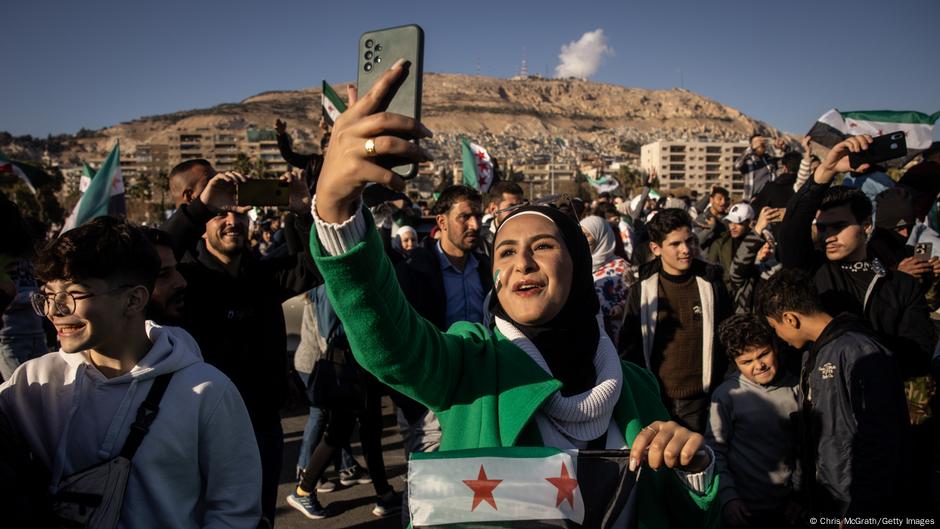
On the anniversary of the fall of Syria's dictator, the country is at a crucial juncture. There have been important achievements in areas like foreign policy but at the same time, many ordinary Syrians are struggling.
December 8 marks the first anniversary of the fall of Syrian dictator Bashar Assad. The Assad family ruled Syria for over 50 years, with Hafez Assad in power from 1971 and then, after his death, his son Bashar taking over in 2000.
The Assads' autocratic rule led to a popular uprising in 2011, then a brutal civil war that lasted almost 14 years. But on December 8, 2024, a lightning offensive led by the rebel militia group Hayat Tahrir al-Sham, or HTS, saw the Assad regime fall with very little resistance. Assad and his family fled to Russia and in January, the head of HTS, Ahmad al-Sharaa, became Syria's interim president.
A year later, what has — and what has not — been achieved in Syria?
Security and stability: 'Fragmented landscape'
There are no longer barrel bombs being thrown out of helicopters or Russian air strikes on medical clinics. But, as a November briefing by the United Nations Security Council (UNSC) reported, "Syria continues to grapple with a fragmented security landscape."
The capital Damascus is comparatively calm, and according to Syria Weekly, a regular newsletter by Charles Lister, an expert at the US think thank the Middle East Institute, levels of violence are falling.
But there are still clashes between the new Syrian government's security forces and other groups around the country, such as those belonging to Syria's Kurdish and Druze minorities, the UNSC briefing noted.
Pro-Assad forces are also still present, although hidden, and the resurgence of the extremist "Islamic State" group is also problematic as the group takes advantage of patchy security.
It's clear the new Syrian authorities don't have full control of the country, a recent report by the EU Agency for Asylum (EUAA) says. "Incidents of lawlessness, criminality and retaliatory violence are reported," the agency noted.
Transitional justice lacking 'support from the central government'
One of the main reasons for ongoing incidents of violence is the targeting of those believed to be former Assad regime collaborators. This is why transitional justice — a process that would acknowledge crimes committed by the Assad regime as well as other groups — is so important, the Washington-based Syria Justice and Accountability Centre (SJAC) argued in a September article.
In May, two independent commissions were created by the government — one that focuses on finding the thousands of Syrians still missing after the war, and another on crimes committed by the Assad regime.
The SJAC reported that the former has been the most active while the latter "has seen less progress, possibly because of less support from the central government."
Groups like Human Rights Watch have also criticized Syria's National Commission for Transitional Justice for only looking into crimes committed by Assad's government, and overlooking crimes committed by other groups such as — potentially — the HTS and its allies.
Politics: 'too soon' for democracy in Syria?
Syria held its first comparatively free elections for parliamentary representatives earlier this year. Due to circumstances, officials explained that the election could not be direct — instead it worked mostly through electoral colleges. Al-Sharaa will remain interim president until a new constitution is in place.
Syria is currently drafting a new constitution and has held a national dialogue to consult on this and other topics.
However, serious differences between the interim government and other communities concerning the country's future governance remain. Critics also claim al-Sharaa is consolidating power and increasingly behaving like an autocrat.
For now, analysts are maintaining a "wait and see" attitude.
"It is surely too soon to talk about democratizing Syria, but the new institutions that have emerged represent a modest re‑entry into electoral politics," Patricia Karam, a fellow at the Arab Center Washington, wrote in November. "These developments place Syria at a pivotal juncture: The country could move toward genuine participatory governance or relapse into authoritarianism."
Foreign policy: foreign military operations 'inflame regional tensions'
This is the sector in which Syria has probably seen the biggest changes. Shuttered embassies are being reopened and newly appointed politicians, like the Syrian foreign minister and President al-Sharaa have toured the world.
Previously, al-Sharaa, who once worked with the terrorist group al-Qaeda, was on numerous sanctions lists and even had a $10 million (€8.6 million) bounty on his head. But in September, he was able to address the UN General Assembly and in November, he became the first Syrian leader to visit the White House since 1946.
Syrian officials have reached out to all five permanent members of the UN Security Council, including Russia and China. This is seen as a sign of how pragmatic Syria's foreign policy has become: Russia was an ally of the Assad regime, and al-Sharaa as well as many of his colleagues would previously have been targeted by Russia.
Currently, Syria's largest foreign policy problem likely to be ongoing incursions by neighboring Israel into Syrian territory. "Israeli military operations … endanger civilians, inflame regional tensions, undermine the fragile security environment, and threaten the political transition," the UN deputy special envoy for Syria, Najat Rochdi, said in November.
Society: 'families return to find nothing but ruins'
Many Syrians who fled the country during the war are returning home. Recent figures show that about 2.9 million Syrians have returned — that includes about 1.9 million internally displaced Syrians and over a million who returned from overseas.
But they face significant problems. According to the Norwegian Refugee Council data, "many families return to [Syria] to find nothing but ruins … people are returning to damaged infrastructure, destroyed schools and hospitals, and disputes over who owns their homes."
In November the International Rescue Committee reported that "more than half of the water supply networks and four out of five electricity grids are either destroyed or non-functional."
Estimates for reconstruction in Syria are somewhere between $250 billion (€172 billion) and $400 billion (€345 billion), and may possibly be even higher.
Syrians have been making efforts to change this.
Among other things, recent analysis by US-based aid organization, Mercy Corps, based on satellite imagery of nighttime lighting in the country, found that electricity production has been improving — although the improvements are not yet country-wide.
And in early November, Syria's official news agency SANA, reported that 823 schools around the country had been renovated while work was continued on another 838.
Economy: material improvement 'has yet to be felt'
Many of those returning are also unable to find work. The country's civil war devastated its economy. Today, around a quarter of Syrians still live in extreme poverty.
There is good news though. A World Bank report published in July this year forecasts the Syrian economy is likely to grow by 1% in 2025.
Most Assad-era sanctions have been permanently or temporarily lifted, and this should aid economic recovery. Additionally financial support from countries like Saudi Arabia and Qatar, in the form of billions of dollars' worth of investment deals, could also help — although as the Tahrir Institute for Middle East Policy pointed out, "the material impact on everyday Syrians' lives has yet to be felt."
Edited by: Maren Sass