Northern Lights Forecast: When and where can you see Aurora Borealis this weekend in the US
हिंदी में सुनें
Listen to this article in Hindi
Northern Lights Forecast: NOAA has forecast a G1-class geomagnetic storm, the mildest level on the geomagnetic scale, yet still powerful enough to expand aurora visibility far beyond its typical range.
Synopsis
Northern Lights Forecast: NOAA has forecast a G1-class geomagnetic storm, the mildest level on the geomagnetic scale, yet still powerful enough to expand aurora visibility far beyond its typical range.
Parts of the northern United States may witness a faint display of the Northern Lights on the night of Sunday, December 7, extending into the early hours of Monday, December 8, according to an updated forecast from space weather experts at the National Oceanic and Atmospheric Administration (NOAA). The possibility follows a recent burst of solar activity, including a coronal mass ejection (CME) and heightened geomagnetic disturbance across Earth’s magnetic field.
The development comes as the Geminid meteor shower, regarded as one of 2025’s strongest annual astronomical events, begins to intensify ahead of its peak next weekend.
Northern Lights Forecast: Geomagnetic Storm Alert Issued
NOAA has predicted a G1-rated geomagnetic storm, the lowest on the geomagnetic scale but strong enough to create auroral visibility across a broader-than-usual region. Officials said the auroral oval could expand far enough south to be glimpsed from as many as 12 U.S. states, provided the skies remain clear and light pollution is minimal.
The expected disturbance stems from a coronal mass ejection that departed the sun on December 4, shortly after an M6-class solar flare. A CME consists of fast-moving charged particles that travel through the solar system and can significantly distort Earth’s magnetic field upon arrival. Such interactions often produce vivid auroral displays near the poles.
Independent forecasts from Spaceweather.com report that a large Earth-facing sunspot is currently active and capable of releasing major solar flares. Experts say this may lead to enhanced auroral conditions through next week.
Live Events
Northern Lights Forecast: Moonlight May Hinder Faint Displays
This week’s auroral visibility coincides with the presence of a waning gibbous moon, which rose as a full supermoon on December 4. While the moon is now shrinking in brightness, its illumination may still make faint aurora difficult to detect with the naked eye. Amateur astronomers and photographers may, however, capture subtle glows through long-exposure imaging.
The Northern Lights forecast overlaps with the Geminid meteor shower, which began on December 4 and will continue through December 17. The shower is expected to peak on the night of December 13–14, according to the American Meteor Society, as per a report by Forbes.
Northern Lights Forecast: Where the Northern Lights May Be Visible
NOAA’s models indicate that faint aurora may be visible low on the northern horizon across several northern U.S. states. These include:
Alaska
Northern parts of Washington, Idaho, Montana and Wyoming
North Dakota and South Dakota
Minnesota and Wisconsin
Michigan
New York
Maine
Viewers are advised to seek out dark, open skies for best visibility. Tools such as the Dark Sky Place Finder or light pollution maps can help observers locate favourable viewing spots away from urban glare. NOAA officials noted that some auroral displays during minor storms may be visible only to cameras, even in favourable conditions.
What Causes the Northern Lights
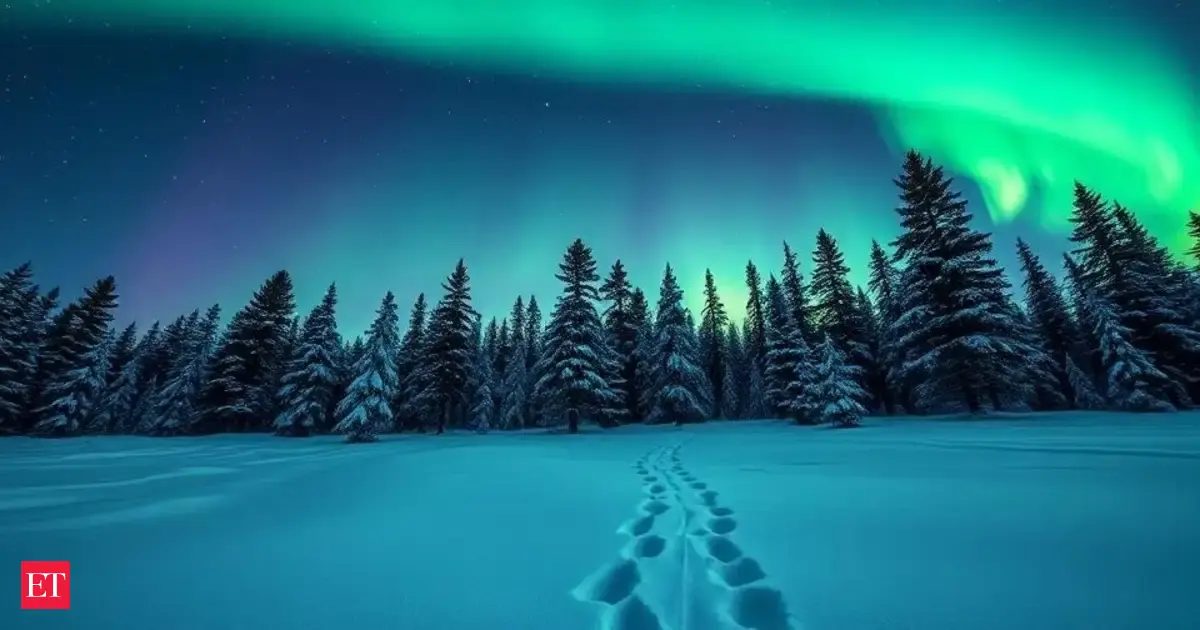
The Northern Lights, or aurora borealis, occur when charged particles from the sun stream toward Earth and interact with the planet’s magnetic field. While most particles are deflected, some travel along magnetic field lines near the poles and collide with atmospheric gases. These collisions energise oxygen and nitrogen atoms, producing the glowing green, red or purple lights characteristic of auroral displays.
NOAA summarised the current outlook as follows: “The geomagnetic field is likely to reach active levels over 06 Dec as influence from the coronal hole slowly wanes. G1 (Minor) geomagnetic storm levels are likely on 07–08 Dec due to the anticipated onset of influence from the periphery of a CME that left the Sun on 04 Dec.”
FAQs
When are the Northern Lights most likely to be visible?
The aurora may be visible overnight from Sunday, Dec. 7 to early Monday, Dec. 8, coinciding with the expected arrival of a G1 geomagnetic storm.
Which U.S. states could spot the Northern Lights?
States with a chance include Alaska, Washington, Idaho, Montana, Wyoming, the Dakotas, Minnesota, Wisconsin, Michigan, New York and Maine.
(You can now subscribe to our Economic Times WhatsApp channel)
(Catch all the US News, UK News, Canada News, International Breaking News Events, and Latest News Updates on The Economic Times.)
Download The Economic Times News App to get Daily International News Updates.
...moreless
(You can now subscribe to our Economic Times WhatsApp channel)
(Catch all the US News, UK News, Canada News, International Breaking News Events, and Latest News Updates on The Economic Times.)
Download The Economic Times News App to get Daily International News Updates.
...moreless
Explore More Stories
Amazon warns over 300 million users of major Black Friday impersonation scams targeting personal data
What is Canada’s new colour-coded alert system and how it will ensure public safety during extreme weather
Canada launches new alert system for extreme weather; Colour-coded system marks shift to impact-based forecasting
Canadian Olympic swimming champion Penny Oleksiak suspended for two years over anti-doping whereabouts failures
Who is Colleen Jones? Two-time World champion curler and veteran Canadian broadcaster dies at 65
What exactly is the Canada Pension Plan? New CPP payments rolling out nationwide on November 26; Check all the payment dates of 2025-26 - Why is Quebec not part of CPP?
Madeleine Poulin, Radio-Canada’s first female correspondent in Ottawa and Paris, dies at 87
Yoplait recalls 'Yop yogurt' drinks in Canada over plastic contamination fears under Class 1 category - Check out which flavor and best-before dates beverage are subject to recall
CMA Awards: Vince Gill honored with prestigious Willie Nelson Lifetime Achievement Award at 59th CMA Awards in Tennessee
MGK rocks Canadian fans with explosive Grey Cup halftime show; Are Megan Fox, MGK really working on their relationship post daughter’s birth?
Roughriders end 12-year drought, beat Alouettes for 5th Grey Cup title
Who is Dr Sanjeev Sirpal? Trouble mounts for New Brunswick doctor accused of sexual assault in hospitals as he faces additional charges; what do we know so far
Russian humanoid robot 'AIDOL' shockingly faceplants during much-hyped public debut - WATCH
1
2
3