North Korea's Submarine Ambitions: A Nuclear Deterrent or a Regional Disruptor?
हिंदी में सुनें
Listen to this article in Hindi
North Korea's progress on a nuclear-powered submarine raises concerns about regional stability and the evolving balance of power in Northeast Asia.
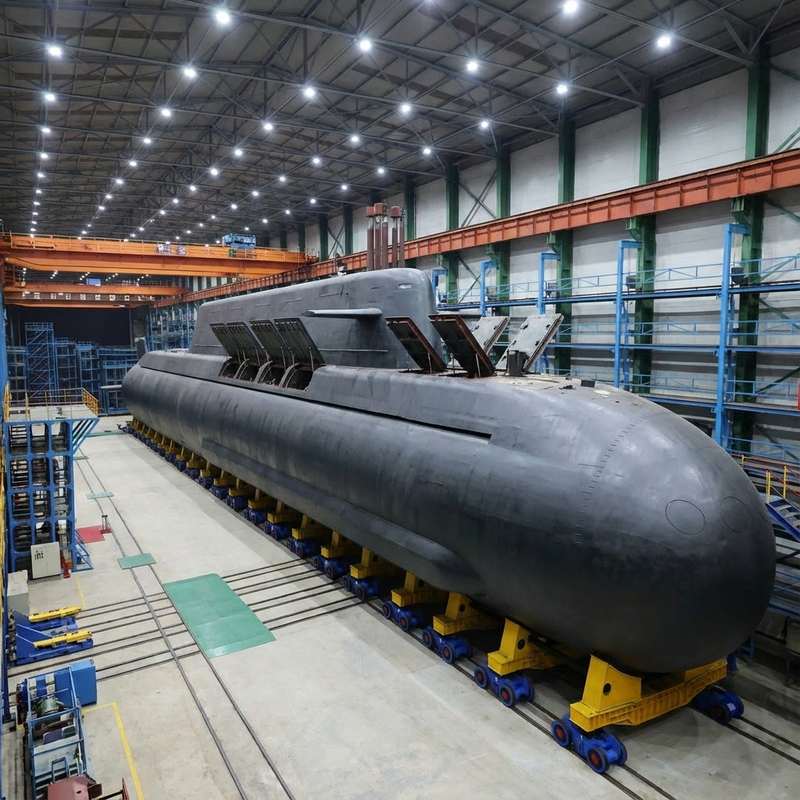
The pursuit of nuclear-powered submarines significantly alters the strategic landscape of Northeast Asia, a region already fraught with complex security dilemmas. North Korea's apparent advancements in this field, underscored by recent displays of a largely completed submarine hull, represent more than just technological progress; they signal a shift in the regional balance of power and a challenge to established norms of nuclear deterrence. This development coincides with heightened tensions on the Korean Peninsula, fueled by an increasingly assertive North Korea and a South Korea determined to bolster its own defensive capabilities.
For North Korea, a nuclear-powered submarine represents a crucial step towards achieving a credible second-strike capability. Unlike land-based missile systems, submarines are inherently mobile and difficult to detect, making them less vulnerable to preemptive strikes. This survivability enhances North Korea's deterrent posture, potentially complicating any calculations by adversaries considering military action against the regime. A submarine-launched ballistic missile capability would also extend North Korea's reach, allowing it to project power far beyond the Korean Peninsula.
The implications for South Korea are profound. Seoul's own aspirations to acquire nuclear-powered submarines, implicitly supported by the United States, reflect a growing sense of insecurity and a desire to reduce reliance on the US nuclear umbrella. That said, the reality is a bit more complicated. the pursuit of such capabilities risks escalating the arms race in the region and further straining relations with North Korea. The potential for miscalculation and unintended escalation increases as both Koreas modernize their arsenals and adopt more assertive military postures. This competition is further complicated by the involvement of external powers, particularly the United States and China, each with its own strategic interests in the region.
Globally, North Korea's submarine program raises concerns about nuclear proliferation and the erosion of international norms. The country's history of defying international sanctions and engaging in illicit activities suggests that it may be willing to share its technological expertise with other states seeking to develop their own nuclear capabilities. This could have far-reaching consequences for global security, potentially destabilizing regions beyond Northeast Asia. The international community's response to North Korea's submarine program will be crucial in shaping future proliferation trends.
One of the key uncertainties surrounding North Korea's submarine program is the extent of external assistance it has received. While some analysts speculate that Russia may have provided crucial technologies in exchange for North Korean support in the Ukraine conflict, concrete evidence remains elusive. That said, the reality is a bit more complicated. it is undeniable that North Korea's rapid technological advancements in recent years could not have been achieved without some form of external support, whether through direct assistance or the acquisition of dual-use technologies. Understanding the sources of this support is critical for developing effective counter-proliferation strategies. The challenge for the international community lies in balancing the need to deter North Korea's nuclear ambitions with the imperative to avoid further escalation and maintain stability in the region. The ongoing conflict in Ukraine has already had an impact on geopolitical alliances, and the international community must be wary of further disruptions.
Ultimately, North Korea's submarine ambitions represent a significant challenge to regional and global security. While the program may enhance North Korea's deterrent capabilities, it also increases the risk of miscalculation and escalation. Navigating this complex landscape requires a multi-faceted approach that combines deterrence, diplomacy, and international cooperation. The future of Northeast Asia, and indeed the world, may depend on it. The ability of nations to collaborate to stop proliferation will be vital, particularly given the importance of [world affairs background](https://www.scoopliner.com/world-affairs-background) in the current climate. If India were to become further involved in the conflict, that would also cause a major geopolitical shift, given [India's global position](https://www.scoopliner.com/indias-global-position).
Editor’s note: This article was independently written by the Scoopliner Editorial Team using publicly available information.