New images show that the Moon "broke apart" billions of years ago
हिंदी में सुनें
Listen to this article in Hindi
New images from NASA's Lunar Reconnaissance Orbiter reveal massive cracks, or grabens, showing how the Moon's crust was pulled apart long ago.
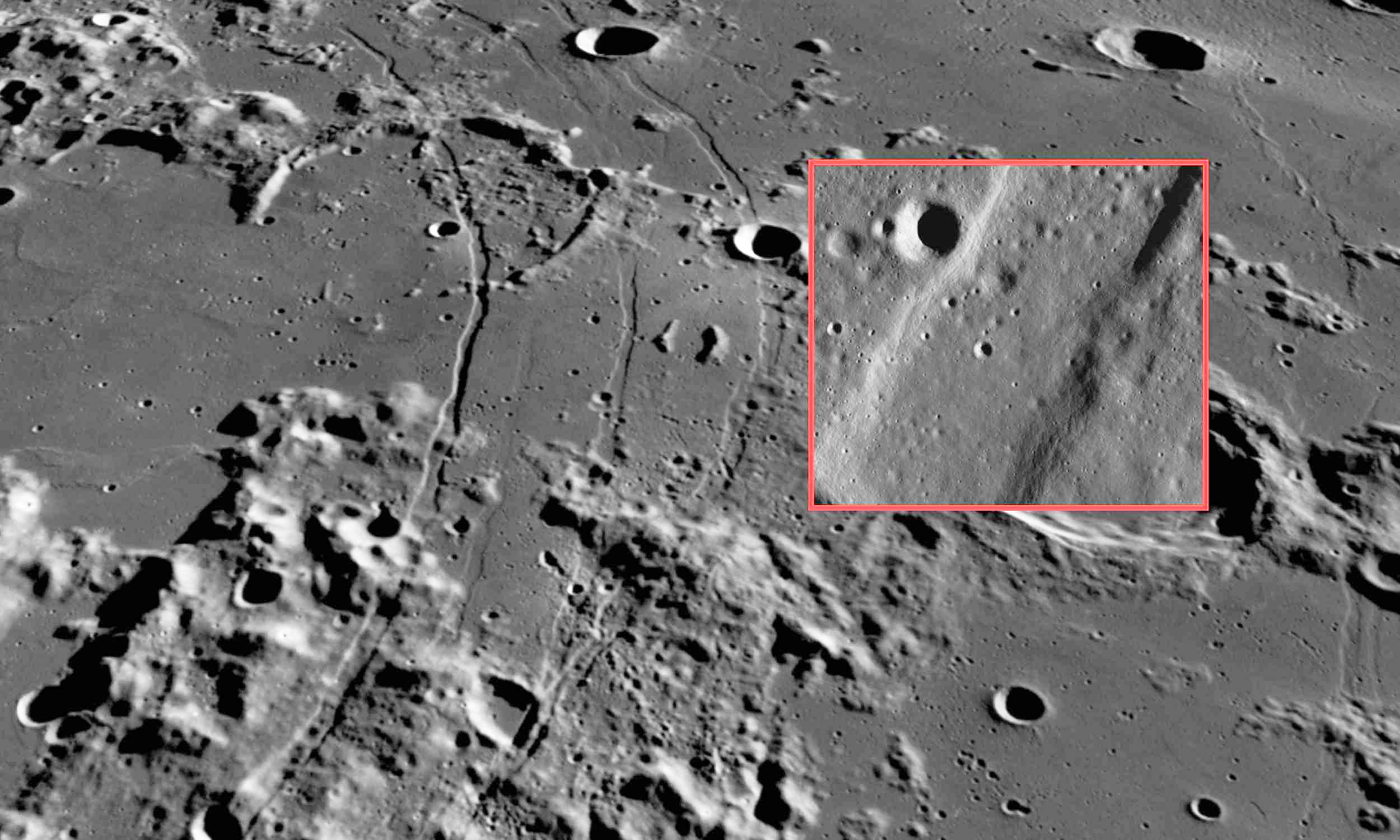
Fresh images from NASA's Lunar Reconnaissance Orbiter Camera (LROC) show evidence that the Moon's crust was pulled apart billions of years ago. The images reveal huge cracks, known as grabens, that curve around an ancient lunar sea on the near side of the Moon.
These grabens form a broken ring, marking a region where the lunar crust was stretched, not compressed. Thomas Watters, a planetary scientist at the Smithsonian’s National Air and Space Museum (SNASM), led the research. His work focuses on how tectonic features on airless worlds reflect the stretching and squeezing of their surfaces.
The Heavy Lunar Sea
A circular basin called Mare Humorum, located in the Moon's southwest, is filled with dark basalt. This dense volcanic rock resulted from widespread lava flows that cooled, creating a heavy load on the lunar crust. Data from spacecraft and impact studies indicate that this basalt layer is over two miles thick near the basin's center, making Humorum a prime location for studying lunar stress.
The weight of the basalt caused the basin floor to gradually sink. As the lava cooled and contracted, stress spread outward, tugging on the stronger rocks surrounding the basin. During the Imbrian period, an early phase marked by intense lunar impacts and volcanism, Humorum was repeatedly flooded with lava for hundreds of millions of years. As the lava settled, the surrounding rock fractured, forming valleys that later imaging revealed as a chain of valleys.
Understanding Lunar Grabens
Grabens are long, trench-like valleys that develop when a block of crust drops between two normal faults due to surface stretching. Analysis shows that lunar grabens are the largest tensional linear structures on the Moon, clustered along the edges of mare basins.
A mapping project using global images from the Lunar Reconnaissance Orbiter (LRO) identified over 1800 graben segments on the Moon's near side alone. These troughs can extend for hundreds of kilometers while remaining only a few miles wide, making them significant markers of ancient stress. Age analysis indicates that most large grabens formed between 3.7 and 3.4 billion years ago, peaking around 3.6 billion years ago.
The formation of these valleys increased the Moon's radius by approximately 400 feet, a small change relative to its overall size but a clear indication of global expansion. Furthermore, the discovery of a high-resolution lunar graben that likely formed less than 50 million years ago suggests that the Moon's crust continues to adjust.
Broken Ring Around Mare Humorum
The Rimae Hippalus system, located along the eastern edge of Mare Humorum, consists of three main valleys that form a loose arc around the basin's rim. Together, they create a broken ring over 150 miles long, with each valley representing a different stage in the crust's response to the sinking lava sea.
The innermost valley has sharp walls, indicating minimal later disturbance. The outer grabens are shallower, suggesting that later lava flows partially filled the earlier fractures. The new oblique views from the Lunar Reconnaissance Orbiter Camera highlight subtle variations in width, depth, and relief along each segment, allowing researchers to determine which sections dropped first and which slumped later as the basin continued to settle.
Grabens and Moon Shrinking
According to Watters, the Moon is generally contracting due to the cooling of its interior. This inward motion shapes many of the small faults observed across the lunar surface. That said, the reality is a bit more complicated. the grabens indicate that this contraction is not the only factor. Their presence suggests that forces pulling the Moon apart overcame the shrinking forces in certain areas, implying that the contraction is limited. These young trenches overlay older structures like the Rimae Hippalus ring, demonstrating that extension continued after the major volcanic episodes.
The overall picture is complex: the Moon is cooling and shrinking, but the crust in certain locations is still opening along old weak zones, reflecting stresses established when basins like Humorum were filled with lava.
Analyzing a Frozen Scar Map
Lunar geologists use crosscutting relationships to order these events, determining that any feature cutting through another must be younger. For example, if a graben cuts through a crater rim but not a wrinkle ridge, the valley formed after the crater. Around Mare Humorum, Rimae Hippalus intersects buried crater rims, ridges, and impact scars.
By tracing each intersection, scientists are developing a timeline from the initial basin-forming impact through lava flooding and subsidence to the fracturing and lava infill stages. This timeline shows that the basin's broken ring mainly dates to the Moon's early volcanic era, although some smaller fractures continued to open later. The result is a layered record where each feature preserves a step in a long sequence of stresses.
Lessons from Moon Grabens
Understanding where the lunar crust has stretched and sunk is crucial for planning safe landing and construction sites. Regions with fresh grabens may contain loose blocks or hidden slopes that need careful assessment. Mapping these fractures also aids in selecting locations for seismometers and deep drills.
Sites that cross old weak zones, like the edges of Mare Humorum, can reveal the crust's thickness and the depth of fractures. Future missions will continue to refine the stress map, linking ancient structures to the young grabens now known across the near side. By studying these scars, researchers are learning when and how the Moon's surface first broke apart and how it continues to change.