Neanderthals were making fire as early as 400,000 years ago, says new study
हिंदी में सुनें
Listen to this article in Hindi
Findings suggest Neanderthals mastered fire long before modern humans, challenging long-held assumptions.
“A lot of people had a hunch that they were making fire at this date,” said Nick Ashton, an archaeologist at the British Museum and one of the study’s authors. “But now we can convincingly say, ‘Yeah, this was the case.’”
For more than a century, scientists have regarded the controlled use of fire as one of the defining steps in human evolution. Biologists since Darwin have argued that fire transformed the way early humans lived – allowing them to cook food, unlock more nutrients, ward off predators and survive harsh nights. As our ancestors became more adept, fire became a tool for crafting and engineering, from heating tree bark to making adhesives to smelting the first metals.
Also Read: Pompeii study suggests Rome’s iconic concrete was more complex than ancient texts claim
But pinning down when humans first learned to make fire on demand has proved notoriously difficult. Ash and charcoal degrade easily, and ancient burn sites often look identical to the remnants of naturally ignited wildfires.
Older evidence does exist for fire use, notably in a South African cave where bones dating back up to 1.5 million years show signs of burning. But researchers have long argued that those early hominins may simply have harvested flames from natural fires. As Ashton put it, “You’re dependent on local lightning strikes. It’s very unpredictable, and you can’t rely on it.”
A deliberate fire-maker, by contrast, must create sparks or friction at will.
Breakthrough at Barnham
The breakthrough at Barnham began modestly in 2013. Excavators found fragments of flint that appeared heat-shattered – a sign of intense, prolonged burning. But the team could not yet determine whether the blaze had been natural or human-made. Year after year, they returned to search for clearer answers.
In 2021, that changed unexpectedly. While preparing to lie down beneath an oak tree, Ashton suddenly recalled a flash of red clay he had seen during an earlier season. Instead of resting, he went to look.
“I thought, I’ll have a little poke around,” he said.
That “poke” exposed a two-foot band of ancient scorched soil. Over the next four years, Ashton and collaborators conducted chemical analyses, tracked sediment layers and expanded their excavation. Their results painted a detailed picture of the landscape 4,00,000 years ago: a freshwater pond attracting Neanderthal groups moving through the region.
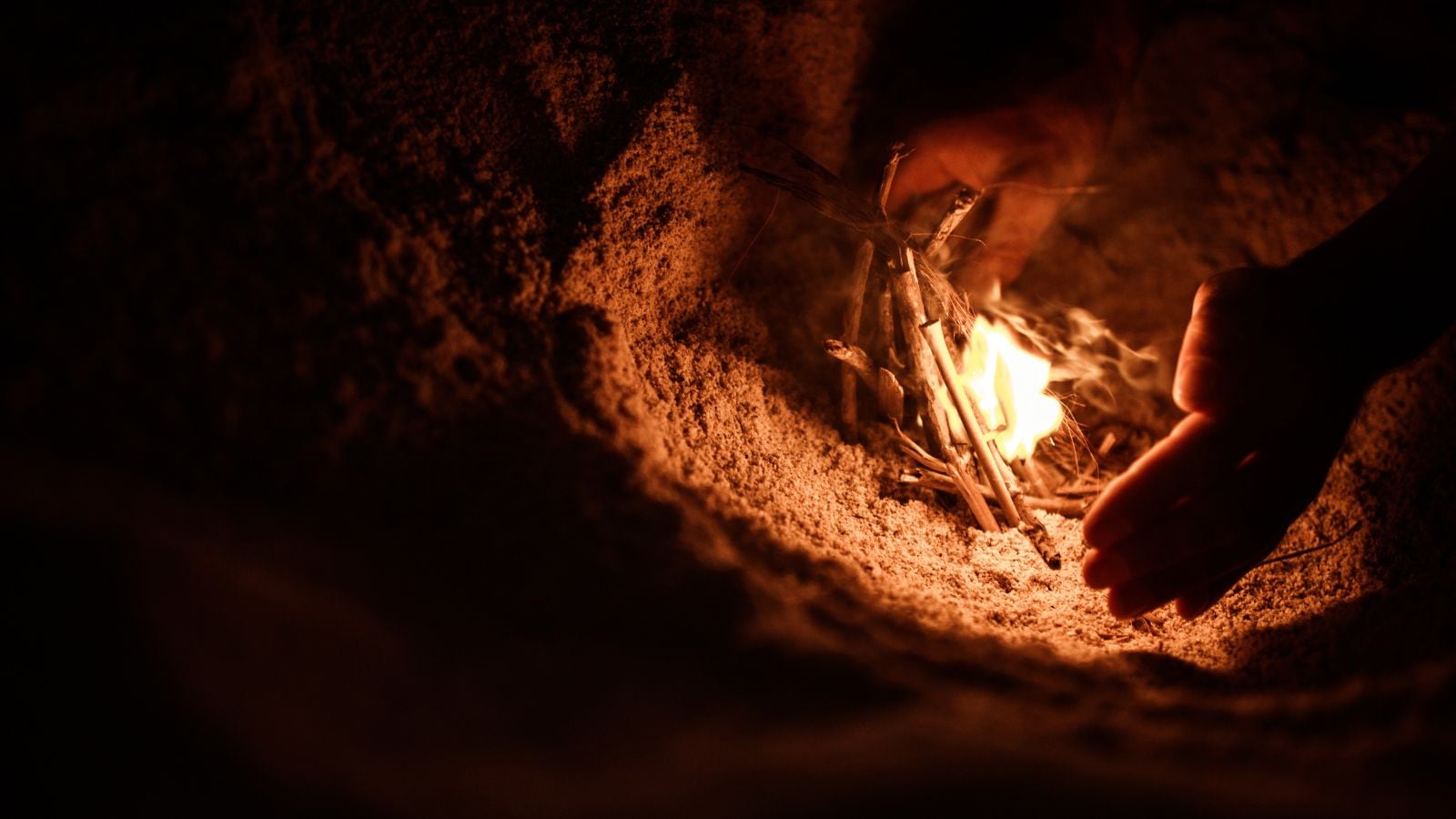
A lightning-sparked wildfire would have left burn traces across the surrounding terrain, but the researchers found none. Instead, only a single spot – the same one – showed signs of burning again and again over decades. The fire reached high temperatures, burned for long durations and was rekindled at the same location, suggesting an intentional return to a familiar campfire site.
The decisive clue emerged when researchers uncovered pieces of pyrite alongside flint fragments. Many Indigenous groups worldwide have used pyrite struck against flint to generate sparks. The discovery was even more striking because the local geology around Barnham does not naturally contain pyrite. The nearest-known source lies roughly 40 miles to the east, meaning the toolmakers had carried the mineral deliberately.
The pyrite was “the icing on the cake,” said Ségolène Vandevelde, an archaeologist at the University of Quebec in Chicoutimi who was not part of the study. “Altogether, it’s a really convincing case.”
This assemblage – repeated burning, transported pyrite, and heat-shattered flint – offers the strongest evidence yet that Neanderthals at Barnham were not only using fire but generating it themselves. The pattern implies knowledge passed along through generations, a tradition rather than a one-off discovery.
Yet how widespread this ability was remains uncertain. Michael Chazan, an anthropologist at the University of Toronto who was not involved in the research, cautioned that the practice may have been limited. “This experiment seems to be local in scope,” he said. “It still stands to reason that many Neanderthal groups did not have access to materials that could be used to strike a light.”
Ashton, however, suspects the skill spread far beyond Barnham. He suggests that Neanderthals, Denisovans in Asia, and early Homo Sapiens in Africa may all have developed or adopted fire-making techniques earlier than previously assumed.
For now, Barnham remains the earliest confirmed site where humans made fire. But Ashton believes that it is more a reflection of limited excavation than limited behaviour. Years of meticulous digging were needed to uncover the crucial evidence in England. Similar efforts elsewhere may reveal comparable traces of ancient fire-makers.
“One lesson that archaeology has taught me is that the more effort you put in, the more reward you get,” Ashton said.