Nasa's robo dog tackles Earth's harsh terrains to prep for Moon and Mars missions
Scientists are testing advanced drones and robot dogs in some of Earth's toughest deserts to prepare for autonomous exploration of Mars. Nasa's projects in Death Valley and beyond are shaping the future of Moon and Red Planet missions.
Nasa is driving a new generation of robotic explorers for the Moon and Mars, putting its latest drones and legged robots through their paces in some of the harshest landscapes on Earth. These field tests aim to solve navigation challenges and prepare technology to operate autonomously in the extreme environments found beyond our planet.
From Death Valley's dunes in California to White Sands' shifting surfaces in New Mexico, these experiments are shaping the future of off-world exploration, where robots may one day scout for astronauts and make discoveries on their own.
advertisement
Earlier this year, a Jet Propulsion Laboratory (JPL) team took three research drones to California's Death Valley National Park and the Mojave Desert.
The engineers chose the featureless desert dunes to hone the Extended Robust Aerial Autonomy navigation software, a research project funded by Nasa's Mars Exploration Program, after the Red Planet's own sandy terrain confused the Ingenuity helicopter's navigation algorithm on its final flights. This work is part of 25 new technologies funded for development in the Mars Exploration Program.
Roland Brockers, JPL researcher and drone pilot, explained the need for adaptable flight technology: "Ingenuity was designed to fly over well-textured terrain, estimating its motion by looking at visual features on the ground. But eventually it had to cross over blander areas where this became hard. We want future vehicles to be more versatile and not have to worry about flying over challenging areas like these sand dunes."
Death Valley, long a stand-in for Mars, has hosted Nasa testing since the 1970s. At Mars Hill, JPL engineers previously tested the Perseverance rover's landing system.
This year, the JPL drone team returned to Mars Hill and Mesquite Flats Sand Dunes in April and September.
HOW THE CAMPAIGN CAN FACILITATE FUTURE MARS MISSIONS
The campaign is already producing results, such as understanding how different camera filters aid drone ground tracking and how new algorithms help safe drone landings in cluttered terrain.
advertisement
Death Valley National Park Superintendent Mike Reynolds commented, "It's incredibly exciting to see scientists using Death Valley as a proving ground for space exploration. It's a powerful reminder that the park is protected not just for its scenic beauty or recreational opportunities, but as a living laboratory that actively helps us understand desert environments and worlds beyond our own."
For further testing, the team ventured to Mojave Desert's Dumont Dunes. These rippled sands, previously a site for the Curiosity rover's mobility system trials, offered varied conditions to push the drone software.
JPL's Nathan Williams, a geologist on the project, stated, "Field tests give you a much more comprehensive perspective than solely looking at computer models and limited satellite images. Scientifically interesting features aren't always located in the most benign places, so we want to be prepared to explore even more challenging terrains than Ingenuity did."
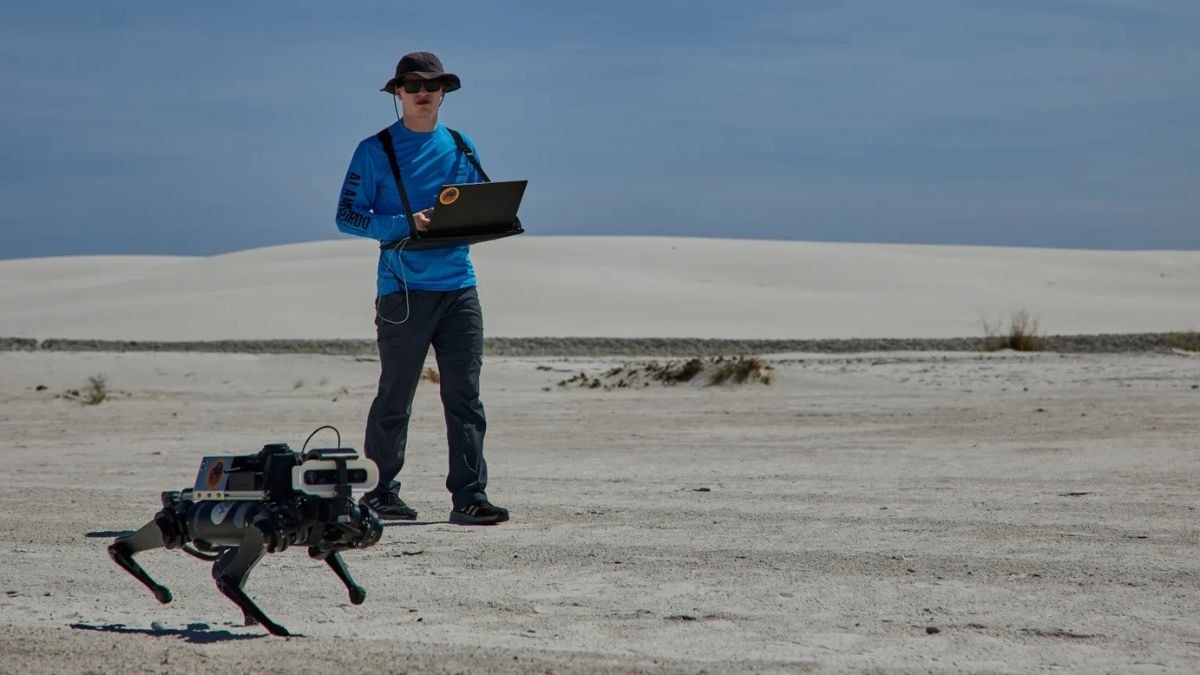
Nasa's Mars technology trials extend beyond drones. In August, Johnson Space Center researchers tested a four-legged robot called LASSIE-M at the White Sands National Park. The robot can shift its gait in response to soft, loose or crusty terrain, using sensors in its legs. The team aims to develop robots that can safely scout areas too hazardous for wheeled rovers, leading exploration for both humans and machines.
advertisement
Nasa's Langley Research Center is also advancing autonomous flight with the Mars Electric Reusable Flyer (MERF), a single-wing design with twin propellers built to function in Mars' thin atmosphere.
Engineers have tested half-scale prototypes in Virginia to study the aerodynamics and lightweight construction needed for future Mars aerial vehicles.
Alongside projects in power, drills, and autonomous software, these efforts are laying the groundwork for advanced exploration on the Moon and Mars.
- Ends