Decoding Celestial Motion: How a Comet Could Explain the Star of Bethlehem
हिंदी में सुनें
Listen to this article in Hindi
A new theory suggests the Star of Bethlehem wasn't a star at all, but a comet whose unique path created the illusion of standing still, explained.
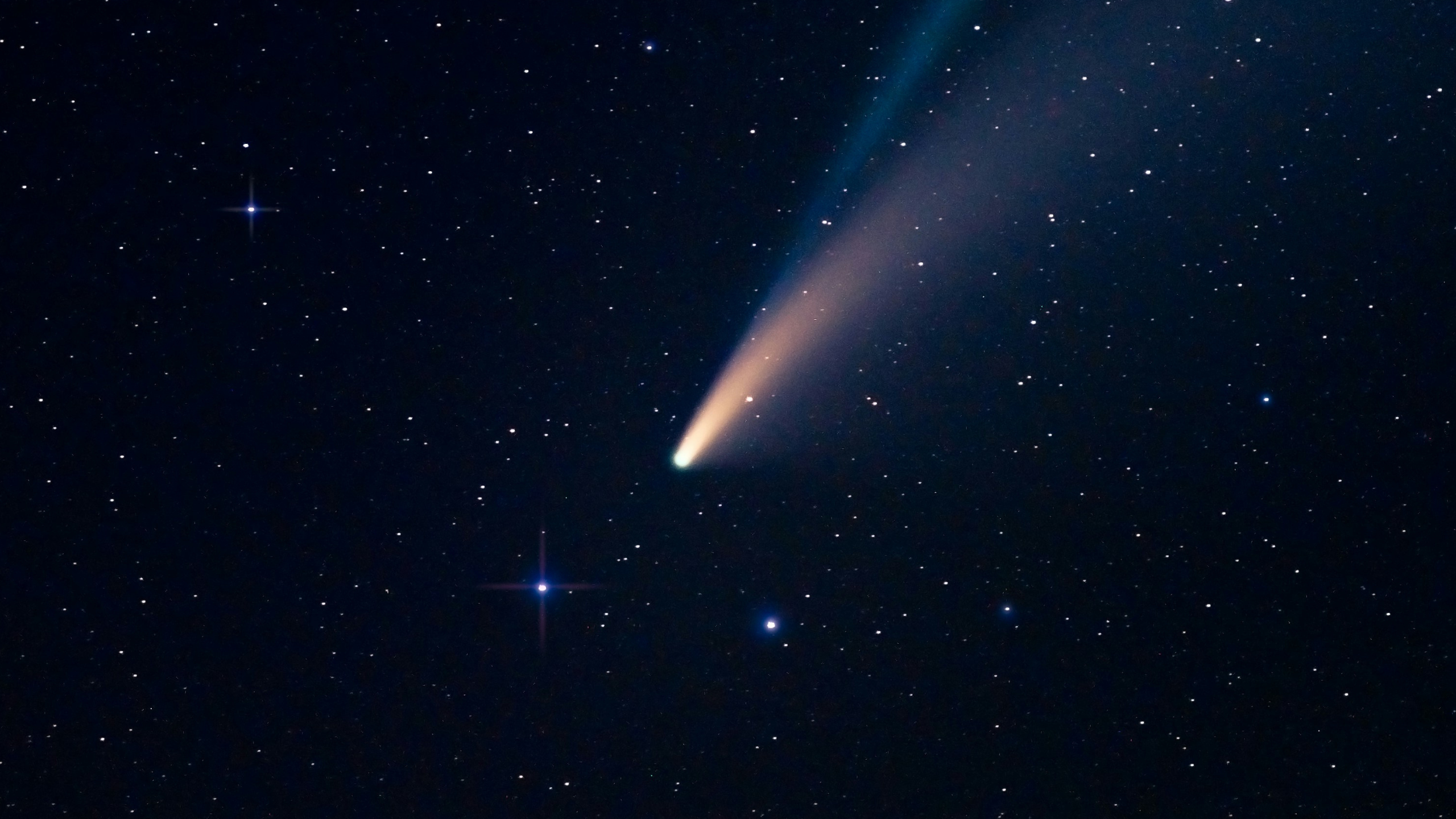
The Star of Bethlehem, a fixture of Christmas tradition, has intrigued astronomers and historians for centuries. Was it a miraculous sign, a religious metaphor, or a real, observable celestial event? While definitive answers remain elusive, a recent study offers a compelling, scientifically grounded explanation, linking the 'star' to a potentially unique cometary encounter.
Planetary scientist Mark Matney, in a study published in the *Journal of the British Astronomical Association*, proposes that the Star of Bethlehem may have been a long-period comet whose trajectory created a unique visual effect when viewed from Earth. This theory gains credence with the recent observation of interstellar objects like 3I/ATLAS, highlighting the possibility of comets originating from outside our solar system interacting with our skies. Understanding the movement of objects in space, also known as [celestial mechanics](internal_link_to_celestial_mechanics_explainer), is key to understanding the plausibility of this theory.
**The Comet Hypothesis: A Matter of Apparent Motion**
Matney's work challenges previous hypotheses, which have included planetary alignments and supernovae. These earlier explanations often struggle to fully account for the biblical description in the Gospel of Matthew, specifically the star's apparent movement 'before' the Magi and its subsequent 'standing over' the birthplace of Jesus. To address this, Matney looked to ancient Chinese astronomical records, specifically those from 5 BC, which describe a 'broom star' (a comet) visible for over 70 days.
By analyzing these historical observations and employing modern numerical techniques, Matney calculated a potential orbit for a comet that would have brought it exceptionally close to Earth – within roughly the distance of the Moon. This proximity, between 236,000 and 249,000 miles, would have made the comet extraordinarily bright, potentially visible even during daylight. More importantly, this close passage could have resulted in what Matney terms 'temporary geosynchronous' motion.
**Geosynchronous Motion: The Illusion of Stillness**
Geosynchronous motion, in this context, refers to the apparent slowing or stopping of the comet's movement in the sky. Because the comet passed so close to Earth, its apparent motion would have been affected by the Earth's rotation. For observers on the ground, this could create the illusion of the comet moving ahead of them before appearing to halt. Imagine driving alongside a slower-moving car; from your perspective, it might seem to slow down, stop, and then move backward as you overtake it. A similar effect, albeit far more complex, could have occurred with the comet.
Specifically, Matney suggests that as the Magi traveled south from Jerusalem to Bethlehem, the comet would have appeared to lead them, eventually seeming to 'stop' directly above Bethlehem as it made its closest approach. From their perspective, the comet would have appeared to hover, offering a possible explanation for the biblical account. This hypothesis addresses a major weakness of previous theories, which struggled to account for the 'stopping' motion. The broader field of [archaeoastronomy](internal_link_to_archaeoastronomy), which combines archaeology and astronomy, also provides context for understanding how ancient cultures interpreted celestial events.
**3I/ATLAS: A Modern Analogue**
The recent discovery of interstellar objects like 3I/ATLAS adds further weight to Matney's hypothesis. 3I/ATLAS, a comet originating from outside our solar system, offers scientists a modern-day example of a rare and fast-moving celestial object. While 3I/ATLAS is not the Star of Bethlehem, its existence demonstrates that our solar system is not as isolated as we once thought and that encounters with interstellar objects, while rare, are possible.
**Limitations and Future Research**
While Matney's theory offers a compelling explanation, it's essential to acknowledge its limitations. The precise orbit of the proposed comet cannot be definitively determined, as we are relying on historical records. Additionally, the psychological impact of such a celestial event on observers cannot be fully accounted for. How did cultural and religious beliefs influence their interpretation of what they saw? These are questions that require further investigation. Further study into [cometary composition and behavior](internal_link_to_comet_research) could also provide additional insights.
**Conclusion: A New Perspective on an Ancient Mystery**
Matney's research doesn't definitively solve the mystery of the Star of Bethlehem. That said, the reality is a bit more complicated. it offers a scientifically plausible explanation grounded in astronomical principles and historical observations. By proposing a comet whose unique trajectory created the illusion of stationary motion, Matney provides a fresh perspective on this enduring enigma. Whether or not this comet was indeed the Star of Bethlehem, Matney's work highlights the dynamic nature of our solar system and the potential for rare celestial events to capture the imagination of humankind, even shaping the course of history.
Editor’s note: This article was independently written by the Scoopliner Editorial Team using publicly available information.