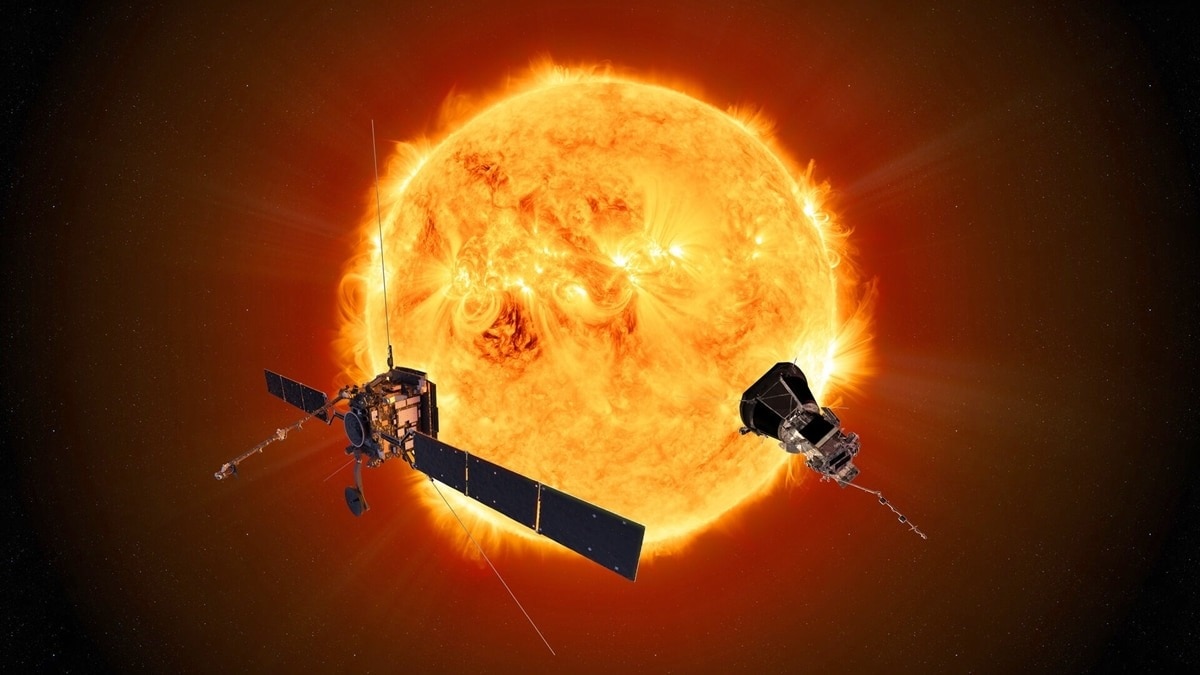
NASA's Parker Probe Spots Solar Wind Reversing Course Back to the Sun
हिंदी में सुनें
Listen to this article in Hindi
NASA's Parker Solar Probe observed solar wind making a U-turn back to the Sun, offering crucial insights into solar atmosphere dynamics and space weather.
NASA's Parker Solar Probe has captured a remarkable event in the Sun's atmosphere: solar wind reversing direction and heading back towards the Sun. This discovery provides valuable new information about the behavior of magnetic fields near our star.
During its closest-ever approach to the Sun in December 2024 – a distance of just 3.8 million miles (6.8 million kilometers) from the solar surface – the probe observed material ejected from the Sun in coronal mass ejections (CMEs) failing to escape completely. Instead, this material curved back, subtly reshaping the Sun's atmosphere as it returned.
The Parker Solar Probe used its Wide-Field Imager for Solar Probe (WISPR) to capture detailed images of this process.
Nour Rawafi, the Parker Solar Probe project scientist at Johns Hopkins Applied Physics Laboratory, emphasized the importance of these observations. "We have previously seen hints that material can fall back into the Sun, but to see it with this clarity is amazing," Rawafi stated.
What These Images Reveal
The images captured by the Parker Solar Probe significantly enhance our understanding of solar recycling, revealing how material is pulled back into the Sun along newly configured magnetic pathways. This recycling process can also alter the paths of subsequent CMEs.
Joe Westlake, the heliophysics division director at NASA, noted the broader implications of this discovery: "The insights we gain from these images are crucial for understanding and predicting space weather, especially for mission planning beyond Earth's protective atmosphere."
Ultimately, this recycling phenomenon has the potential to affect planetary systems and missions throughout the solar system. The Parker Solar Probe's ongoing observations continue to provide invaluable data about our Sun.