Unlocking Star Formation Secrets: NASA's Festive Star Cluster Offers Clues to Stellar Evolution
हिंदी में सुनें
Listen to this article in Hindi
NASA's NGC 2264 'Christmas Tree' cluster offers a unique window into star formation. Analysis reveals insights into young star behavior and nebula evolution.
The cosmos delivered an early holiday gift this year in the form of NGC 2264, a star cluster whose arrangement of bright, young stars and glowing gas strikingly resembles a Christmas tree. While the festive imagery is captivating, the real value of this observation lies in the scientific insights it provides into the chaotic and crucial process of star formation. Located roughly 2,500 light-years away in the constellation Monoceros, NGC 2264 is more than just a cosmic coincidence; it's a natural laboratory for studying the birth and evolution of stars.
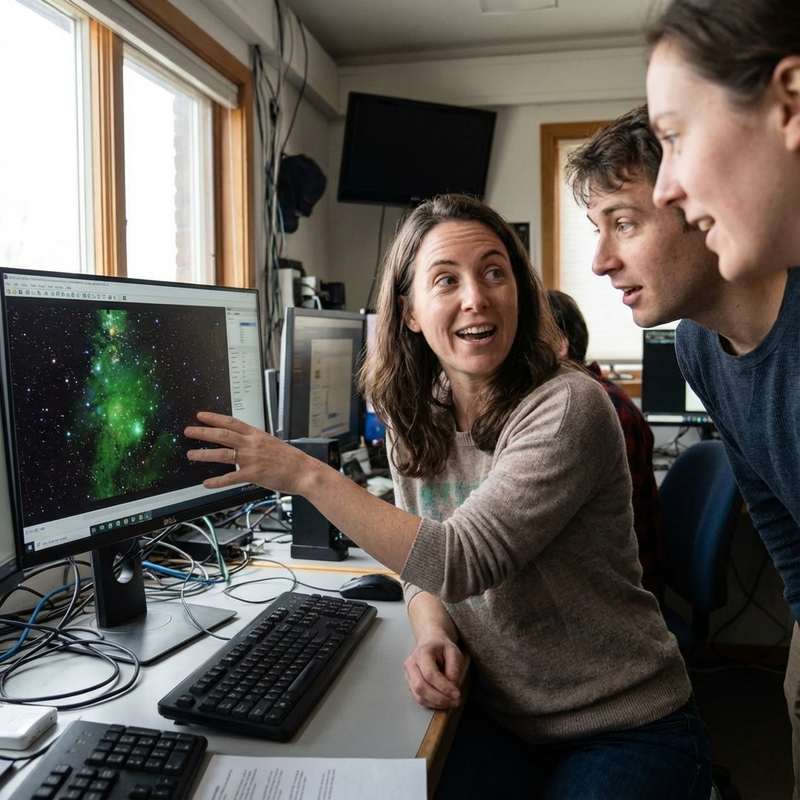
NGC 2264 is a nebula complex, a region of space filled with gas and dust, which serves as the birthplace for stars. The 'Christmas tree' appearance arises from the specific arrangement of young, hot stars embedded within this glowing interstellar material. The green hues outlining the “branches” are produced by ionized gas, while the brighter stars act as the “ornaments.” This visual effect is enhanced by combining data from both optical telescopes, which capture visible light, and the Chandra X-ray Observatory, which detects high-energy X-rays. This multi-wavelength approach is crucial because young stars are often shrouded in dust and gas, making them difficult to observe with optical telescopes alone. The X-ray data reveals the energetic activity of these nascent stars, providing a more complete picture of the cluster's composition and dynamics.
The significance of NGC 2264 extends beyond its aesthetic appeal. The stars within this cluster are relatively young, only a few million years old. This makes them valuable subjects for studying the early stages of stellar evolution. By observing these young stars, astronomers can gather data about their mass, temperature, and luminosity, which are all key factors in determining how a star will evolve over its lifespan. The surrounding gas and dust also offer clues about how stars interact with their environment. These interactions can trigger further star formation, shape the nebula's structure, and influence the chemical composition of the surrounding space. Nebulae evolve over millions of years, and studying different nebulae provides a glimpse into various stages of this evolution.
The use of multi-wavelength astronomy is particularly important in understanding objects like NGC 2264. Optical telescopes reveal the glowing gas and dust, but they can't penetrate the dense clouds that surround many young stars. X-ray telescopes, on the other hand, can detect the high-energy radiation emitted by these stars, providing a view of what's happening beneath the surface. Combining these different types of data allows astronomers to create a more complete and accurate picture of the star cluster. This approach exemplifies the power of modern astronomy to unveil the hidden secrets of the universe. Understanding the basics of electromagnetic radiation is key to interpreting the data from these diverse telescopes.
While NGC 2264 offers valuable insights, it's important to acknowledge the limitations of our current understanding. Star formation is a complex process influenced by many factors, including the density and temperature of the gas clouds, the presence of magnetic fields, and the influence of nearby stars. Astronomers are still working to unravel the intricate details of these interactions. Furthermore, our observations of NGC 2264 are limited by our current technology. Future telescopes with greater sensitivity and resolution will undoubtedly reveal even more about this fascinating star cluster. For example, studying other star-forming regions, like the Orion Nebula, provides valuable comparative data.
So where does that leave things? NASA's image of the 'Christmas Tree' star cluster, NGC 2264, is more than just a pretty picture. It is a valuable scientific resource that provides crucial insights into the process of star formation and stellar evolution. By combining data from different types of telescopes, astronomers are able to study the young stars and glowing gas within this cluster in unprecedented detail. While many questions remain unanswered, NGC 2264 serves as a reminder of the beauty and complexity of the universe, and the power of science to unlock its secrets. The ongoing observation of NGC 2264 promises to further refine our understanding of the cosmos for years to come.
Editor’s note: This article was independently written by the Scoopliner Editorial Team using publicly available information.