Unlocking the Chemistry of Star Birth: New Insights from the Large Magellanic Cloud
हिंदी में सुनें
Listen to this article in Hindi
ALMA observations reveal diverse chemical compositions in star-forming regions of the LMC, challenging our understanding of star birth under varying metallicity conditions.
The birth of stars is a complex process deeply intertwined with chemistry. Deep within molecular clouds, dense pockets of gas and dust collapse under gravity, eventually igniting nuclear fusion and giving birth to a star. But before that fiery debut, a rich tapestry of chemical reactions unfolds, creating a diverse array of molecules that can influence the star's formation and the potential for planet formation around it.
One particularly interesting stage in this process involves what astronomers call "hot cores." These are compact, warm (relatively speaking, at around -173 degrees Celsius) regions surrounding young, massive protostars. The heat from the protostar causes ice mantles on dust grains to evaporate, releasing a variety of molecules into the gas phase. This creates a chemically rich environment where complex organic molecules (COMs), the building blocks of life as we know it, can form.
Now, a team of astronomers has turned their attention to the Large Magellanic Cloud (LMC), a satellite galaxy of our own Milky Way, to study these hot cores in a different galactic environment. The LMC is particularly interesting because it has a lower abundance of heavy elements, or "metallicity," compared to the Milky Way. This difference in metallicity can significantly impact the chemistry of star formation. The team used the Atacama Large Millimeter/submillimeter Array (ALMA), a powerful telescope array in Chile, to observe 30 massive protostellar objects in the LMC, searching for the telltale signs of hot cores and their chemical composition.
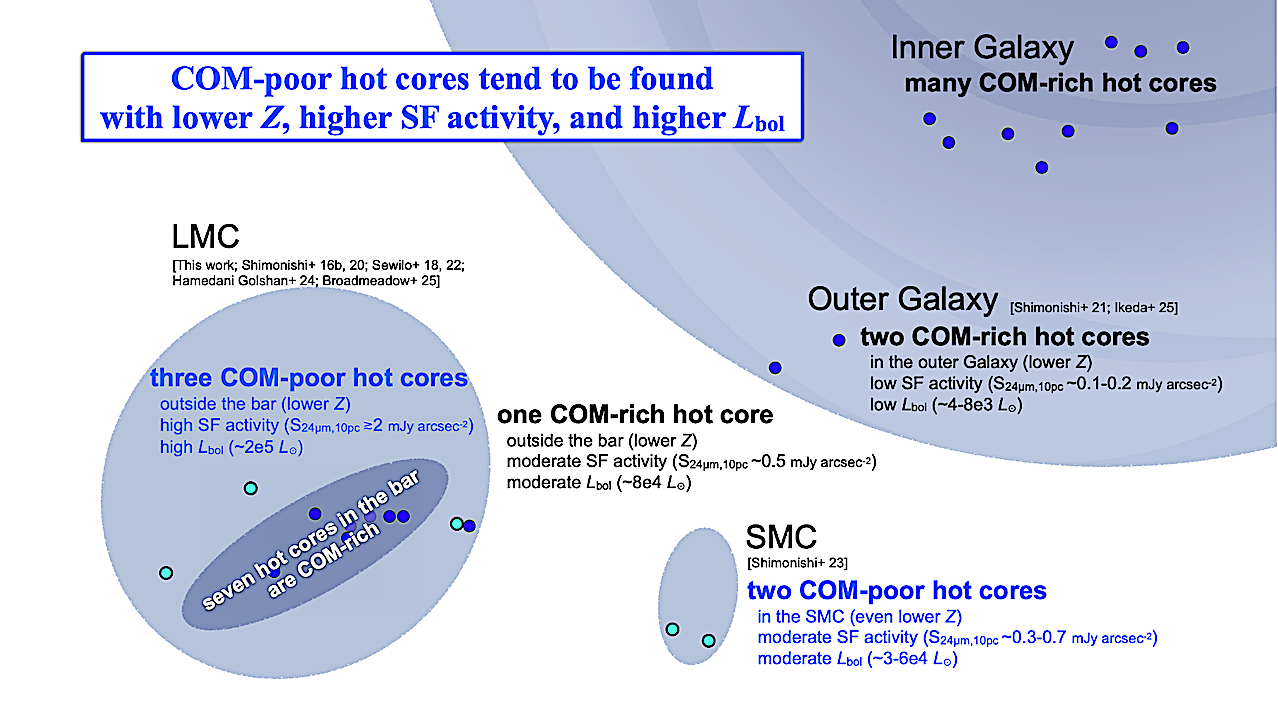
Their survey, dubbed MAGOS (MAGellanic Outflow And Chemistry Survey), identified nine hot cores and one hot-core candidate. The analysis revealed a wide range of molecules, including familiar species like carbon monoxide (CO) and water (H2O), as well as more complex organic molecules like methanol (CH3OH), ethanol (C2H5OH), and dimethyl ether (CH3OCH3). Notably, this is the first detection of dimethyl ether, a molecule larger than methanol, in a hot core outside the LMC's bar region. The bar region is a central, elongated structure within the LMC with slightly different properties.
One of the most intriguing findings was the significant variation in methanol abundance among the hot cores. Some sources were rich in methanol, while others were surprisingly deficient in COMs. Interestingly, the hot cores lacking methanol were all located outside the LMC bar region and were associated with either high luminosity or active star formation in their surroundings. This suggests that a combination of factors, including the LMC's lower metallicity, intense star formation activity in the vicinity, and the high energy output of the protostar itself, may be responsible for suppressing the formation of certain COMs. All hot cores showed stronger emission in the high-excitation SO line compared to non-hot-core sources, suggesting that its strong detection will be useful for identifying hot-core candidates in the LMC.
In contrast to methanol, sulfur dioxide (SO2) was detected in all the hot cores, and its abundance showed a strong correlation with the temperature of the region. This suggests that SO2 formation is less sensitive to the specific environmental conditions that affect methanol production. This research builds on our understanding of interstellar chemistry, complementing existing research on molecular clouds. Understanding the chemical processes involved in star formation is crucial for understanding [science basics](https://www.example.com/science-basics-explainer). It also helps us to appreciate the diversity of star-forming environments in different galaxies.
While this study provides valuable insights, it also raises further questions. Why are some hot cores deficient in certain COMs? What specific chemical pathways are affected by the LMC's lower metallicity? More detailed observations and chemical modeling will be needed to fully unravel the complex interplay of factors that determine the chemical composition of hot cores. Future research could involve comparative studies of hot cores in the Milky Way and other galaxies with varying metallicities. This could provide a more comprehensive picture of how galactic environment influences the chemistry of star formation, potentially informing our understanding of [planetary formation](https://www.example.com/related-field-context) and the origins of life itself.
This study underscores the importance of studying star formation in diverse environments. By examining hot cores in the LMC, astronomers are gaining a better understanding of the chemical processes that shape the birth of stars and the potential for forming complex molecules, regardless of galactic location. The research also contributes to our wider knowledge of [prior research](https://www.example.com/prior-research-background) in astrochemistry, adding to a rich tapestry of scientific exploration.
Editor’s note: This article was independently written by the Scoopliner Editorial Team using publicly available information.