L1 observatory poised to study Sun’s maximum activity phase in 2026
Aditya-L1’s advantage resides in its vantage position and its cutting-edge instrument package. The spacecraft was positioned in a ‘large halo orbit’ around the Earth-Sun Lagrange Point L1 in January 2024, which is around 1.5 million kilometres from Earth and offers a continuous view of the Sun free from obstacles and eclipses.
India’s Aditya-L1 observatory poised to study Sun’s maximum activity phase in 2026
Aditya-L1 mission, launched in 2023, will for the first time study the Sun’s ‘solar maximum,’ a period that happens roughly every 11 years when the Sun’s magnetic poles flip and solar storms spike.
By CNBCTV18
Aditya-L1, India's first dedicated solar observatory, is preparing to observe the Sun at its next expected peak of activity in 2026, which might represent a turning point for solar research.
The mission, launched in 2023, will for the first time study the Sun’s ‘solar maximum,’ a period that happens roughly every 11 years when the Sun’s magnetic poles flip and solar storms spike.
As the Sun transitions from relative stillness to tumultuous activity — a feature of solar maximum — scientists predict a substantial surge in solar storms and the frequency of coronal mass ejections (CMEs). The Sun might emit two to three CMEs every day under normal circumstances, but that number might rise to ten or more by 2026.
CMEs are huge bubbles of fire from the Sun’s corona, which transport charged particles measuring up to one trillion kilograms. Speeds can exceed 3,000 km (1,864 miles) per second. CMEs reach Earth within 15 hours at maximal speed, and can disrupt satellites, electrical grids and communication networks.
Although CMEs rarely directly endanger human life, they do influence life on Earth by generating geomagnetic storms that alter the weather in near space, where there are about 11,000 satellites, including 136 from India.
According to Prof. R Ramesh of the Indian Institute of Astrophysics (IIA), “The most beautiful manifestations of a CME are auroras, which are an obvious indication that charged particles from the Sun are travelling to Earth.”
What sets Aditya-L1 apart
Aditya-L1’s advantage resides in its vantage position and its cutting-edge instrument package. The spacecraft was positioned in a ‘large halo orbit’ around the Earth-Sun Lagrange Point L1 in January 2024, which is around 1.5 million kilometres from Earth and offers a continuous view of the Sun free from obstacles and eclipses.
Its flagship instrument, the Visible Emission Line Coronagraph (VELC), functions like an ‘artificial moon,’ covering the Sun’s dazzling surface while revealing the much-fainter corona — enabling high-precision tracking of CMEs in visible light.
This knowledge allows scientists to assess the intensity, temperature and direction of solar eruptions – data important for projecting future impacts on Earth.
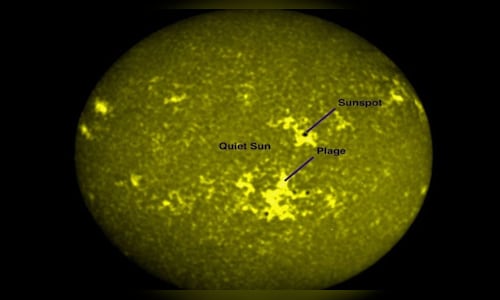
Complementing VELC, equipment such as the Solar Ultraviolet Imaging Telescope (SUIT), with soft- and hard-X ray spectrometers, gives a multidimensional perspective of the Sun’s atmosphere — from the photosphere and chromosphere to the corona — across several wavelengths.
Why it matters for Earth and satellites
CMEs may not pose direct threats to human health — radiation and particles are largely protected by Earth’s atmosphere — but their impact on technology can be catastrophic. When a CME collides with Earth’s magnetic field, it may create geomagnetic storms, potentially interrupting satellite operations, connectivity, GPS systems, and power grids.
A large CME with a mass of around 270 million tons and an initial temperature of about 1.8 million degrees Celsius was captured by scientists utilising Aditya-L1 in November 2025 during its early growth phase.
Though classified as ‘medium-sized,’ this event served as a rehearsal, assisting in calibrating sensors and determining thresholds of solar energy release.
(Edited by : Sudarsanan Mani )
Check out our in-depth Market Coverage, Business News & get real-time Stock Market Updates on CNBC-TV18. Also, Watch our channels CNBC-TV18, CNBC Awaaz and CNBC Bajar Live on-the-go!