Extreme Gravity Reshaping Planetary Forms: A New Understanding of Exoplanet Diversity
हिंदी में सुनें
Listen to this article in Hindi
The James Webb Telescope discovers a bizarre lemon-shaped exoplanet, challenging existing models of planetary formation and atmospheric composition in extreme environments.
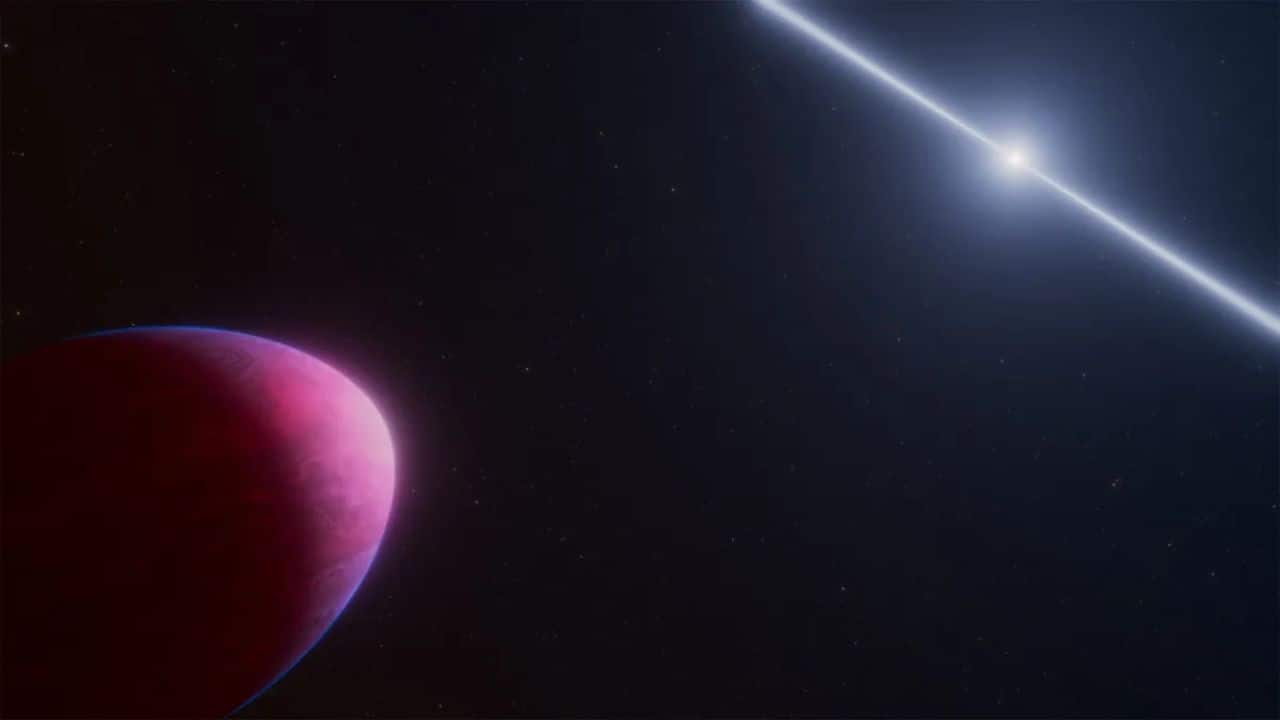
The James Webb Space Telescope has once again expanded our understanding of planetary systems, this time by revealing a planet shaped more like a lemon than the familiar spheres of our solar system. Designated PSR J2322-2650b, this exoplanet, located approximately 2,000 light-years away, orbits a pulsar, a rapidly rotating neutron star. The planet's unusual shape and atmospheric composition are forcing scientists to re-evaluate the processes that govern planetary formation and evolution in extreme conditions.
The most striking feature of PSR J2322-2650b is its distinctly non-spherical shape. This distortion is attributed to the immense gravitational forces exerted by the pulsar it orbits. Pulsars are the remnants of massive stars that have undergone supernova explosions, leaving behind incredibly dense objects with intense gravitational fields and powerful radiation emissions. The planet's close proximity to the pulsar subjects it to a gravitational tug-of-war, stretching it into an elongated, lemon-like form. This observation provides direct evidence of the powerful influence stellar remnants can have on the shapes of orbiting bodies, a factor not typically considered in standard planetary formation models. Understanding gravity is essential in astrophysics; a good [science basics explainer](https://example.com/science-basics) can help digest these concepts.
Beyond its unusual shape, the atmosphere of PSR J2322-2650b presents another puzzle. Webb's infrared sensors detected an atmosphere dominated by helium and carbon compounds, a stark contrast to the gas giants and rocky planets found in our solar system and many other exoplanetary systems studied to date. The presence of these elements suggests an environment where unique chemical processes may be occurring, potentially leading to the formation of exotic cloud structures composed of deep soot or even layers of diamond under immense pressure. This atmospheric composition challenges our current understanding of exoplanet atmospheric chemistry and highlights the diversity of planetary environments that can exist in the universe.
The discovery of PSR J2322-2650b has significant implications for planetary science. It demonstrates that planetary formation and evolution can occur in environments far more extreme than previously thought. The intense radiation and gravitational forces near a pulsar can dramatically alter the shape, composition, and atmospheric properties of planets. This finding necessitates a broadening of our theoretical models to account for these extreme conditions and the diverse range of planetary outcomes they can produce. It also highlights the need for further research into the effects of stellar remnants on orbiting bodies, particularly in binary star systems or regions with high stellar densities. The study of exoplanets is a relatively new field, and understanding [prior research background](https://example.com/prior-research) is crucial.
It's important to note that while PSR J2322-2650b challenges existing models, it doesn't invalidate them entirely. Rather, it expands our understanding by revealing the limitations of current theories when applied to extreme environments. Further research is needed to fully understand the processes that led to the formation of this unusual planet and its atmosphere. Detailed simulations and observations of similar systems will be crucial to refine our models and gain a more complete picture of planetary diversity. The conditions that allow for planets to exist within a [related field context](https://example.com/related-context) such as this are still being explored.
So where does that leave things? the discovery of PSR J2322-2650b represents a significant step forward in our understanding of exoplanets and the diversity of planetary systems. Its unusual shape and atmospheric composition highlight the importance of considering extreme environments when studying planetary formation and evolution. While this single discovery does not rewrite all of planetary science, it provides valuable insights into the complex interplay of gravity, radiation, and chemistry that shapes the destinies of planets throughout the universe. The James Webb Space Telescope continues to be a powerful tool for exploring the cosmos and revealing the unexpected wonders that lie beyond our solar system, continually pushing the boundaries of our knowledge and challenging our assumptions about the nature of planets.
Editor’s note: This article was independently written by the Scoopliner Editorial Team using publicly available information.