James Webb Telescope makes big discovery on planet that has oceans of lava
हिंदी में सुनें
Listen to this article in Hindi
The James Webb Space Telescope detected an atmosphere on exoplanet TOI-561 b, a rocky world with molten lava oceans. Details inside.
In a surprising discovery, the James Webb Space Telescope has detected an atmosphere around a rocky exoplanet named TOI-561 b, a world known for its extreme heat and molten lava oceans.
Despite its harsh conditions, including a surface covered in flowing lava, TOI-561 b possesses an atmosphere that defies conventional expectations. NASA researchers, utilizing the Webb telescope, have characterized this atmosphere as "ultra-hot."
The findings, published in The Astrophysical Journal Letters, shed light on the planet's unusually low density. They also challenge previous assumptions about whether small planets orbiting very close to their stars can maintain an atmosphere.
Planet of Extremes
TOI-561 b is approximately 1.4 times the size of Earth and completes an orbit around its star in under 11 hours. This rapid orbit classifies it as an ultra-short period exoplanet, a relatively rare type of planet.
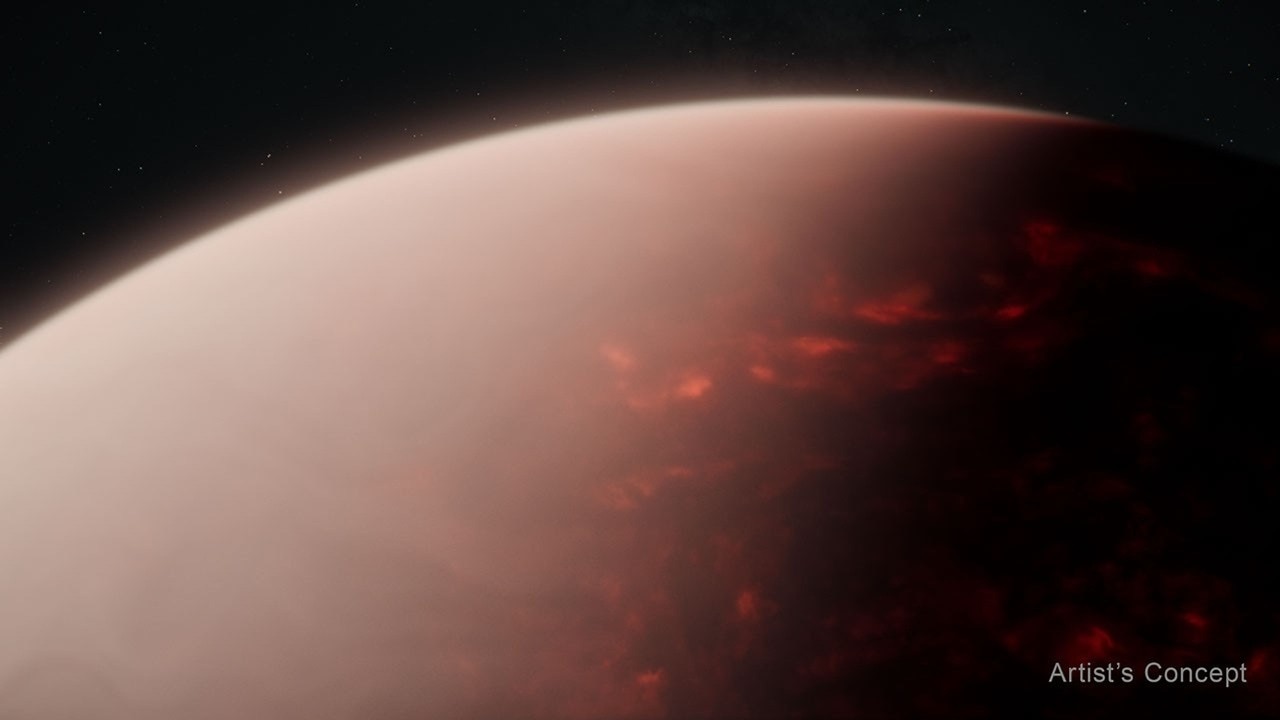
While its host star is only slightly smaller and cooler than our Sun, TOI-561 b orbits incredibly close, at a distance of less than one million miles. This proximity results in extreme temperatures and causes the planet to likely be tidally locked, meaning one side perpetually faces the star.
The dayside temperatures on TOI-561 b are so extreme that they exceed the melting point of rock, leading scientists to believe that vast magma oceans dominate the landscape.
Using Webb's Near-Infrared Spectrograph (NIRSpec), scientists were able to measure the planet's dayside temperature by observing the system's brightness as the planet passed behind its star. Without an atmosphere, the dayside temperature of TOI-561 b was expected to reach nearly 2,700 degrees Celsius. That said, the reality is a bit more complicated. the Webb telescope detected a significantly cooler temperature of approximately 1,800 degrees Celsius.
This temperature difference strongly suggests the presence of an atmosphere capable of redistributing heat. Dr. Anjali Piette, a co-author from the University of Birmingham, suggests that gases like water vapor, or even silicate clouds, could be absorbing or reflecting heat, causing the planet to appear cooler than anticipated.
'Wet Lava Ball'
One of the most remarkable aspects of TOI-561 b is its unusually low density. According to Johanna Teske of Carnegie Science, the lead author of the study, the planet is less dense than what would be expected for an Earth-like world. The planet orbits an ancient, iron-poor star, twice the age of our sun, indicating that it likely formed in a chemically distinct environment early in the Milky Way's history.
Scientists theorize that the planet's atmosphere exists in a state of equilibrium with its magma ocean, where gases released into the atmosphere are subsequently reabsorbed by the molten interior. "It's really like a wet lava ball," explained Tim Lichtenberg from the University of Groningen, a co-author of the study.
These observations are part of Webb's General Observers Program 3860. Researchers are currently analyzing additional data to map temperature variations across the planet and gain a better understanding of the composition of its atmosphere.