James Webb Space Telescope could illuminate dark matter in a way scientists didn't realize
हिंदी में सुनें
Listen to this article in Hindi
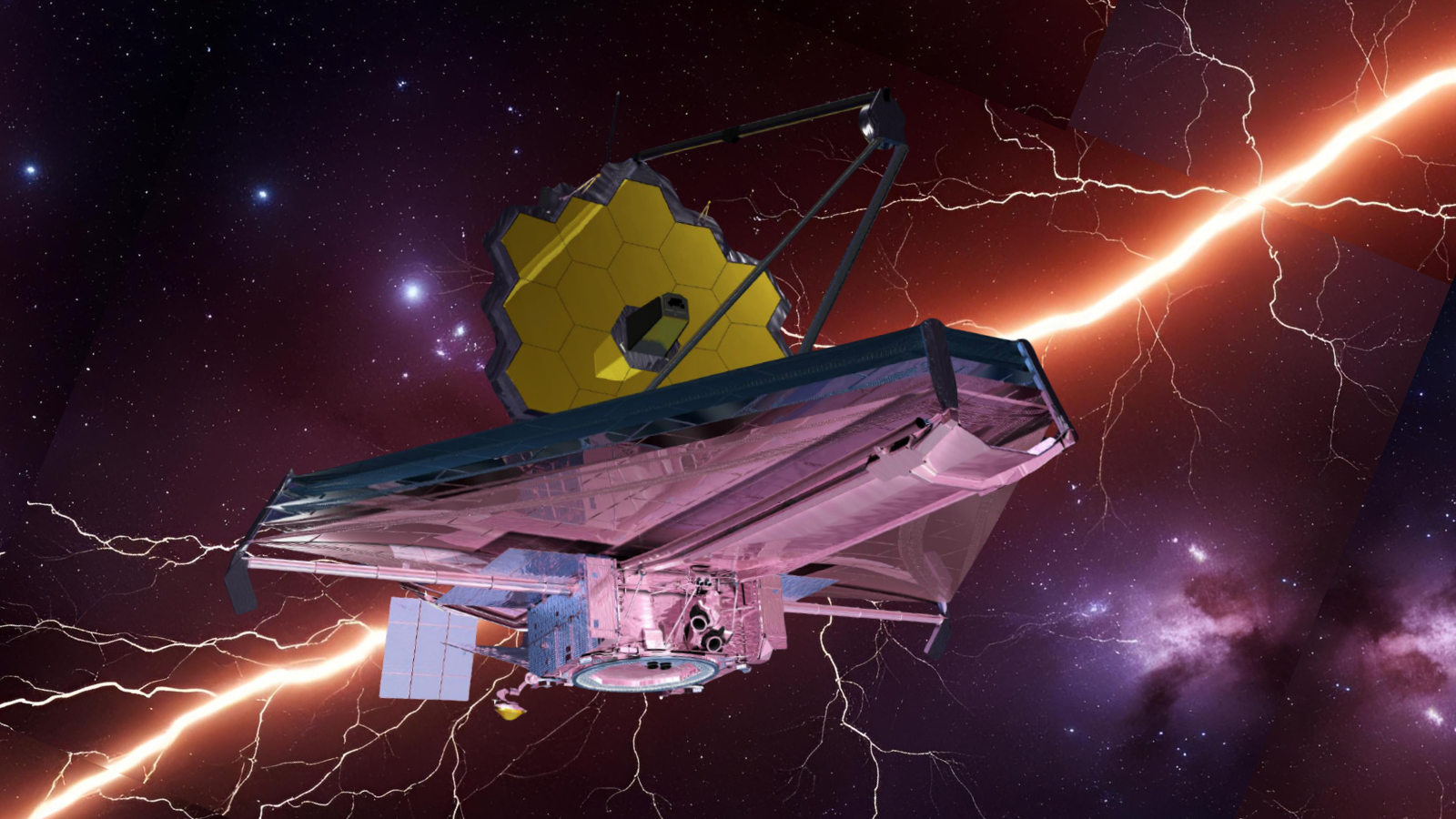
New research suggests the James Webb Space Telescope (JWST) could help reveal the nature of dark matter by studying elongated galaxies.
Since 2022, the James Webb Space Telescope (JWST) has revolutionized our understanding of the cosmos, particularly its earliest periods. That said, the reality is a bit more complicated. the enigmatic nature of dark matter has remained largely untouched by the JWST's observations – until now, according to new findings.
Dark matter is estimated to constitute 85% of the universe's matter. Its resistance to investigation stems from its lack of interaction with electromagnetic radiation (light), or at least, an interaction so weak that direct detection is impossible. This invisibility also indicates that dark matter particles differ from the protons, neutrons, and electrons that compose ordinary matter. While numerous dark matter particle candidates have emerged, all remain theoretical.
Currently, scientists infer the presence of dark matter through its gravitational influence on space, which in turn affects ordinary matter and light. A study published in *Nature Astronomy* proposes that dark matter's gravitational effects might explain the existence of peculiar, elongated young galaxies. Analyzing these shapes could point to the most likely dark matter particle.
According to Rogier Windhorst of Arizona State University, a member of the research team, galaxies in the expanding universe grow from small clumps of dark matter, eventually forming star clusters and larger galaxies through gravity. The JWST's observations suggest that the earliest galaxies might be embedded in filamentary structures. These structures, unlike those expected with cold dark matter, smoothly connect star-forming regions, aligning more with the behavior of ultralight dark matter particles exhibiting quantum behavior.
Simulations of early galaxy formation typically involve cool gas gathering along dark matter filaments, successfully recreating the spheroid galaxies observed today. That said, the reality is a bit more complicated. the JWST has revealed elongated, filamentary galaxies in the early universe that challenge these standard simulations. These galaxies are not easily explained by the conventional model of gas accumulation leading to star formation and galaxy growth.
To address this, Windhorst and his colleagues explored simulations using alternative dark matter types, moving beyond the standard Lambda Cold Dark Matter (LCDM) model. Their research indicated that the wave-like behavior of "fuzzy dark matter," specifically ultralight axion particles, could explain the elongated shapes of early galaxies observed by the JWST.
Álvaro Pozo of the Donostia International Physics Center, the team leader, explained that if ultralight axion particles comprise dark matter, their quantum wave-like nature would prevent the formation of structures smaller than a few light-years for a certain period. This contributes to the smooth, filamentary structures detected by the JWST at vast distances.
The team's models also suggest that faster-moving "warm dark matter" particles, such as sterile neutrinos, could also lead to the formation of early filamentary galaxies. In both scenarios, the smoother filaments arising from these particles allow for the creation of elongated galaxies as gas and stars gradually flow along them.
The JWST will continue its investigation of these unusual early galaxies, while researchers on Earth refine their simulations of the early universe. This combined effort holds the potential to finally unravel the mystery of dark matter.