Is it natural? Astronomers spot strange protrusion on 3I/ATLAS as it speeds toward Earth. Here's how to track interstellar object and mysterious anti-tail explained
हिंदी में सुनें
Listen to this article in Hindi
Astronomers have observed a peculiar protrusion on interstellar object 3I/ATLAS as it nears Earth, sparking debate about its composition and origin. Learn how to track it.
An interstellar object named 3I/ATLAS is currently being scrutinized by astronomers worldwide as it approaches Earth, revealing a peculiar protrusion. This unusual feature has prompted questions regarding the object's nature and where it came from.
3I/ATLAS will make its closest approach to our planet around December 19, coming within approximately 167 to 170 million miles. While this poses no threat to Earth, it offers a valuable opportunity for scientists to study the object in detail.
Traveling at roughly 137,000 miles per hour, data from NASA indicates that 3I/ATLAS originated outside our solar system, entering from the direction of Sagittarius. Its hyperbolic orbit confirms that it will eventually exit the solar system after its passage.
**Unusual Anti-Tail Observed**
Since July, both ground-based and space-based telescopes have been used to observe 3I/ATLAS. On July 21, the Hubble Space Telescope captured images revealing a strange protrusion extending from the object, resembling a second tail.
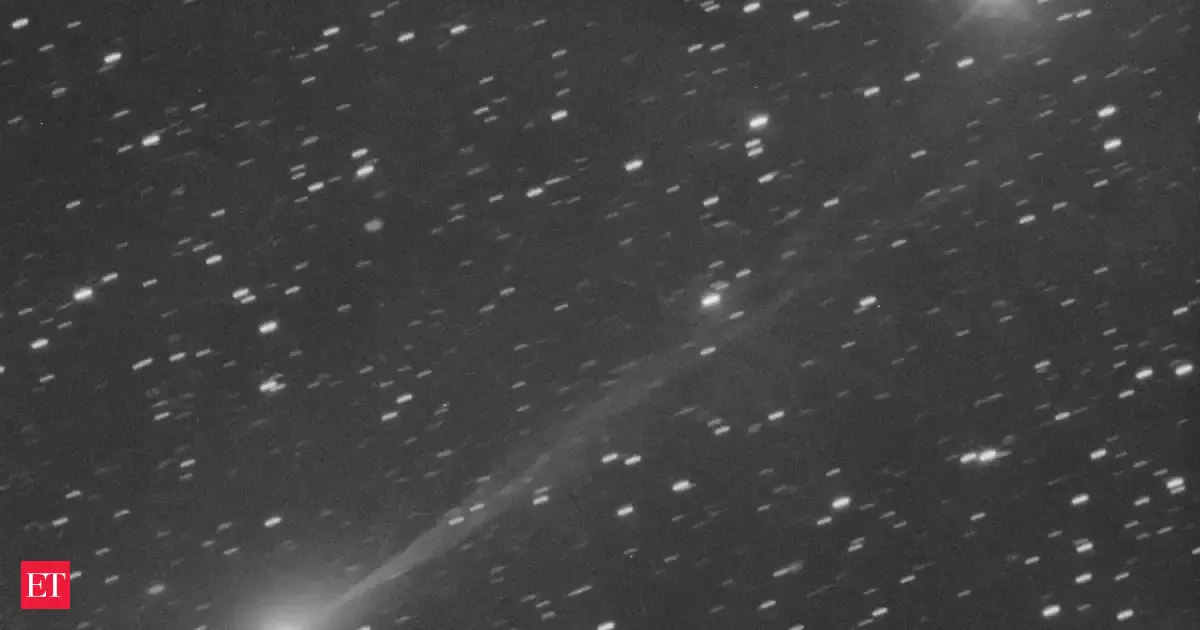
Unlike typical comet tails that point away from the Sun, this "anti-tail" points towards it, defying conventional comet models where radiation pressure pushes dust and gas away from the Sun.
A photograph taken on December 13 from the Teerasak Thaluang telescope in Rayong, Thailand, corroborated the presence of this feature. Even more than a month after 3I/ATLAS's closest approach to the Sun, the anti-tail was still visible.
**Possible Explanations for the Anti-Tail**
One theory, proposed by Harvard astronomer Avi Loeb, suggests that the protrusion might be due to mass loss on the side of 3I/ATLAS facing the Sun. Larger fragments breaking off could move more slowly, accumulating on the sunward side and creating the observed anti-tail.
After reviewing thousands of images, Loeb maintains that the feature is a genuine physical jet and not simply a result of the viewing angle. He argues that gas and fine dust should naturally move away from the Sun.
Loeb has also proposed that sunlight scattering off ice fragments released from the sun-facing side could be another explanation. These ice particles would evaporate before solar radiation pressure could push them away, preventing a standard tail from forming.
**Artificial Object Claims**
Loeb has also speculated about the possibility of 3I/ATLAS being an artificial object, suggesting the anti-tail could be caused by fragments lagging behind due to non-gravitational acceleration. That said, the reality is a bit more complicated. this idea is presented in a paper that is yet to be peer-reviewed.
Other scientists dismiss the notion of an alien origin. UCLA astronomer David Jewitt asserts that 3I/ATLAS behaves like a typical comet, with the sun-facing side ejecting dust. He believes the observations align with known comet behavior.
Jason Wright, an astronomer at Pennsylvania State University, also refuted the alien claim, citing previous observations of comets exhibiting sunward dust enhancements. He explained that larger dust grains are not easily affected by the solar wind.
Scientists from the European Space Agency (ESA) have suggested the second tail may simply be a dust tail, a common occurrence among comets in our solar system.
NASA leaders have also downplayed the alien theories. Acting Administrator Sean Duffy stated there is no alien threat, and NASA science chief Nicola Fox confirmed that no technosignatures have been detected.
**Size and Observation Details**
Estimates place the nucleus of 3I/ATLAS between 1,400 feet and 3.5 miles in diameter, a range supported by ESA data. NASA released new images on November 19, providing more detailed views of the object.
Earlier in the year, the comet passed within 130 million miles of the Sun. Hubble re-observed it on November 30, with background stars appearing as streaks during tracking.
3I/ATLAS will not be visible without aid. That said, the reality is a bit more complicated. small telescopes can be used to observe it in the predawn sky until spring 2026. During its closest approach, it will appear near the star Regulus in the constellation Leo.
NASA's Eyes on the Solar System tool allows users to track its path. NASA encourages the public to participate in local skywatching events.
**Frequently Asked Questions**
- What is the cause of the anti-tail on 3I/ATLAS?** It may be caused by larger dust grains or ice fragments released from the sun-facing side, which move slower and are less affected by solar radiation pressure.
- Does 3I/ATLAS pose a danger to Earth?** No. It will pass at a distance of about 170 million miles and will exit the solar system after its flyby, posing no threat to our planet.