Interstellar Comet 3I/ATLAS to pass Earth on 19 December, here’s why it’s drawing global scientific attention
हिंदी में सुनें
Listen to this article in Hindi
Comet 3I/ATLAS, a rare interstellar object, will make its closest approach to Earth on December 19. Scientists worldwide are eagerly observing it.
On December 19th, an interstellar comet named 3I/ATLAS will pass by Earth, capturing the attention of scientists around the globe. This comet is only the third confirmed object originating from outside our solar system to be observed. Its approach offers a valuable opportunity for researchers to study material from a distant star system.
**What We Know About 3I/ATLAS**
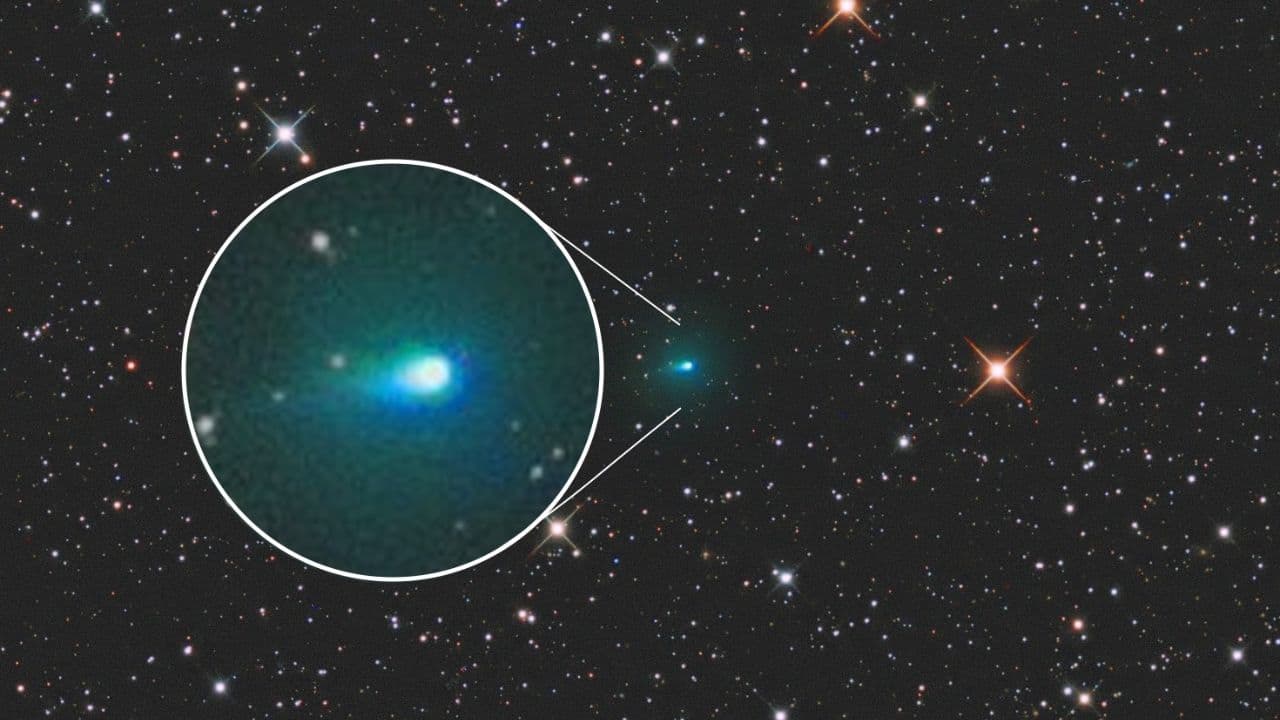
The ATLAS survey first spotted 3I/ATLAS in mid-2025. Observations indicate that it has a bright coma and a noticeable tail. The comet reached its closest point to the Sun in October of this year. Its behavior aligns with that of other interstellar objects. Scientists are particularly interested in its composition, as it may provide insights into the chemical makeup of other star systems.
**When and How Close Will It Get?**
3I/ATLAS will be nearest to Earth on December 19th, at a distance of approximately 167 million miles. While this is considered a close encounter from a scientific perspective, it poses no threat to our planet. NASA's telescopes are expected to provide the most detailed views of this unique celestial visitor. Observers will be able to track the comet's trajectory as it continues its journey past Earth toward Jupiter.
**Why Astronomers Are Excited**
The rarity of interstellar objects, with only two others confirmed previously, makes 3I/ATLAS a significant focus of study. These objects contain matter that did not originate in our solar system. By examining them, scientists can deepen their understanding of galactic formation and chemical processes. This flyby represents a unique chance to observe an interstellar object up close, potentially revealing new information about faraway planetary systems.
**Who Is Involved in the Research?**
Across the world, astronomers are using professional observatories to monitor the comet. Space agencies in both Europe and America are collecting data on its behavior. They are carefully analyzing its light, tail structure, and orbital path. Amateur astronomers are also encouraged to contribute their observations. This collaborative effort will enhance our knowledge of interstellar objects.
**How to Observe 3I/ATLAS**
While 3I/ATLAS is not visible without equipment, those with telescopes can track its progress. Astronomers using mid-sized telescopes may be able to view its bright coma and tail. Optimal viewing times are during local night hours, away from the light pollution of cities. Astrophotography enthusiasts can capture detailed images of the comet's dust and gas features. Astronomy websites provide charts and ephemeris data to help accurately point telescopes.
**What's Next for 3I/ATLAS?**
After its Earth flyby, 3I/ATLAS will continue its journey away from our planet, heading towards Jupiter. As it moves further away, it will become fainter and more difficult to observe. Scientists plan to analyze the data collected to study its material composition. Future interstellar visitors will be compared to this unique example. This flyby highlights our increasing ability to track celestial objects as they travel through space.