Interstellar comet 3I/ATLAS to make its closest approach to Earth: How to track and watch it live
हिंदी में सुनें
Listen to this article in Hindi
Interstellar comet 3I/ATLAS, from beyond our solar system, is making its closest approach to Earth. Here's how to track and view this cosmic visitor.
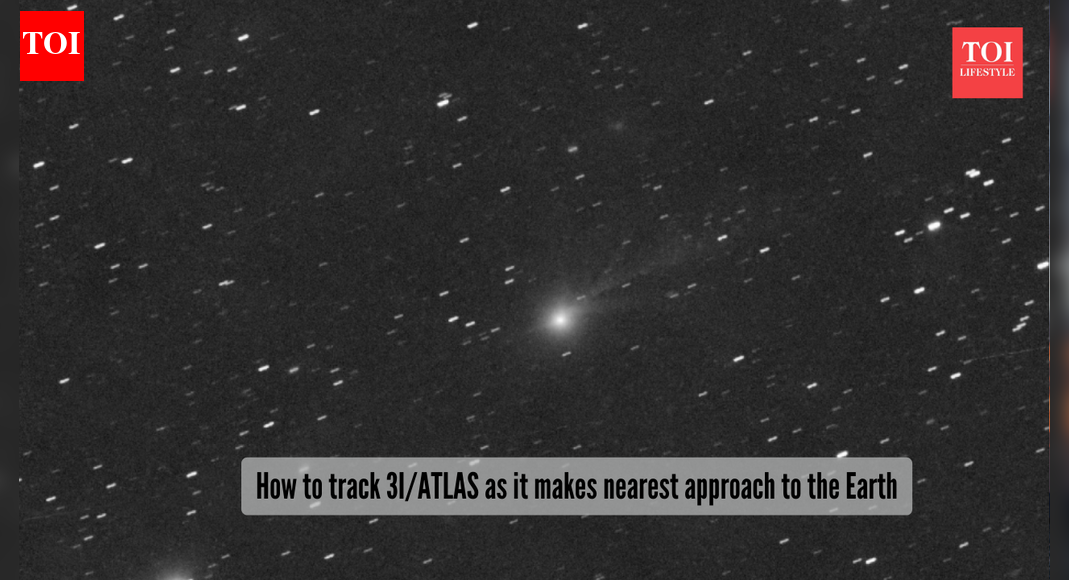
Comet 3I/ATLAS, an interstellar object that originated outside our solar system, has captured the attention of both scientists and the general public. NASA has released detailed images showcasing its active coma and tails, confirming its nature as a comet, despite some theories suggesting otherwise.
The comet is now approaching its closest point to Earth, presenting an opportunity for skywatchers to observe it using telescopes and binoculars. Spotting an interstellar visitor like 3I/ATLAS is a rare event, sparking excitement and speculation. Since its arrival in our solar system, it has been photographed by space telescopes, leading to unverified theories which NASA has addressed.
As 3I/ATLAS makes its nearest pass by our planet, here's how you can track this icy wanderer.
What is 3I/ATLAS?
Discovered in July 2025 by the ATLAS telescope in Chile, 3I/ATLAS is the third confirmed interstellar object to be observed. Originating from beyond our solar system, it's characterized as a comet, featuring an icy nucleus, a coma composed of gas and dust, and distinctive glowing tails, setting it apart from rocky asteroids. The designation '3I' signifies its status as the third interstellar object, following 'Oumuamua (2017) and Borisov (2019). NASA’s Jet Propulsion Laboratory and the Minor Planet Center have confirmed that it comes from the direction of Sagittarius.
NASA's Images of the Comet
On November 19, 2025, NASA shared striking images of 3I/ATLAS, revealing its active coma and tails. The Hubble Space Telescope captured images on November 30 from approximately 178 million miles away, with the comet's motion causing stars to appear streaked in the background. The ESA's JUICE probe, located near Jupiter, also captured images between November 2 and 25, showing a period of increased activity after the comet's closest approach to the Sun.
How to Track 3I/ATLAS
3I/ATLAS will make its closest approach to Earth on December 19, maintaining a safe distance of about 170 million miles. Because it is faint, it cannot be seen without assistance. A small telescope or binoculars are recommended for observation. From now through spring 2026, it can be found in the pre-dawn sky near the constellations Virgo and Leo. Dark locations will provide the best viewing conditions. Live tracking is available through NASA’s Eyes on the Solar System and the Virtual Telescope Project livestream.
Size and Speed
Based on data from Hubble and ESA, the comet's nucleus is estimated to be between 1,400 feet and 3.5 miles in diameter. Upon its discovery, 3I/ATLAS was traveling at approximately 137,000 miles per hour. It accelerated as it approached the Sun, and then decelerated as it moved away. The active release of gas and dust as it warms confirms its cometary nature.
Addressing Alien Probe Theories
Some have speculated that 3I/ATLAS could be an alien spacecraft, a theory that has been discussed, among others, by Harvard scientist Avi Loeb. That said, the reality is a bit more complicated. NASA has refuted this idea, confirming that it is a natural comet. In November 2025, Associate Administrator Nicola Fox stated that no technosignatures have been observed. Observations from Hubble, Webb, and ESA spacecraft indicate that it is composed of ice and rock from another star system, with no evidence of extraterrestrial technology.