Interstellar Comet's Cyanide Revelation: A Cosmic Chemistry Lesson, Not a Threat
हिंदी में सुनें
Listen to this article in Hindi
The discovery of hydrogen cyanide in interstellar comet 3I/ATLAS offers insights into the chemistry of other star systems but poses no danger to Earth.
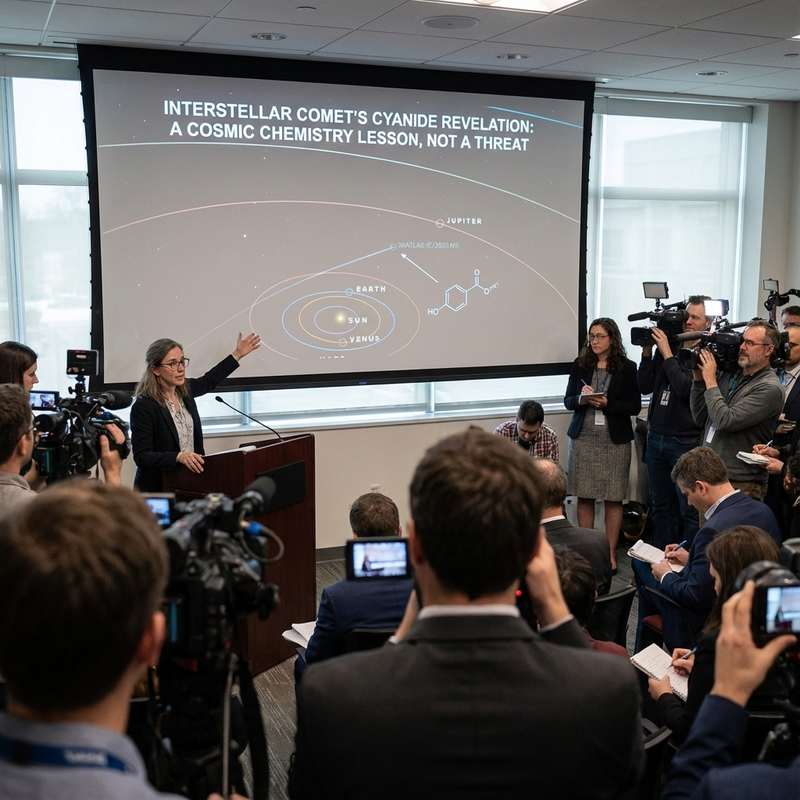
The recent detection of hydrogen cyanide (HCN) in the interstellar comet 3I/ATLAS has sparked scientific interest, offering a unique glimpse into the chemical composition of a celestial object originating from outside our solar system. While the presence of cyanide, a toxic compound, might initially sound alarming, experts emphasize that the comet poses absolutely no threat to Earth. Instead, this discovery provides a valuable opportunity to study the building blocks of planetary systems beyond our own.
Comet 3I/ATLAS, only the second interstellar object observed passing through our solar system (the first being 'Oumuamua'), was discovered in 2019. Its trajectory confirmed its origin beyond the gravitational influence of our Sun. As it approached the Sun, astronomers seized the chance to analyze its composition using spectroscopic techniques. These techniques involve studying the light emitted and absorbed by the comet's coma, the cloud of gas and dust surrounding its nucleus. The resulting spectra revealed the presence of various volatile compounds, including water, carbon monoxide, and hydrogen cyanide.
**Cyanide in Space: A Common, But Misunderstood, Compound**
It's crucial to understand that the detection of cyanide in a comet, while noteworthy, isn't entirely unexpected. Hydrogen cyanide is a relatively common molecule found in various astronomical environments, including comets within our own solar system, nebulae (vast clouds of gas and dust where stars are born), and other interstellar clouds. Its presence indicates the types of chemical reactions occurring in the cold, low-density environments where comets form.
The fear associated with cyanide stems from its toxicity to life. That said, the reality is a bit more complicated. the concentrations detected in 3I/ATLAS, combined with the comet's trajectory, eliminate any possibility of harm to Earth. The comet's closest approach is millions of kilometers away, and even in a hypothetical collision scenario, the amount of cyanide is so minute that it would be rendered harmless. Solar radiation and the vacuum of space would break down these molecules long before they could reach our atmosphere. In essence, the amount of cyanide is akin to a few drops of poison in an ocean – detectable, but inconsequential. It's important to remember that 'toxicity' is always a function of concentration and exposure, concepts often lost in translation when discussing potentially hazardous materials. To understand more about the basics of science, read our [science basics explainer](www.example.com/science-basics).
**A Window into Other Star Systems**
The true significance of this discovery lies in what it reveals about the chemical composition of other star systems. Comets are essentially time capsules, preserving the materials from which planets form. By analyzing the volatile compounds within 3I/ATLAS, scientists gain insights into the conditions and processes prevailing in its parent star system. This allows for comparisons between the chemical building blocks available in different parts of the galaxy. Does the chemical composition of comets vary significantly from one star system to another? Are the ingredients for life as we know it common throughout the galaxy, or unique to our solar system?
Understanding the abundance of volatile compounds like water, carbon monoxide, and hydrogen cyanide is crucial. These molecules play a key role in the formation of planets and can even contribute to the development of atmospheres and oceans. The relative proportions of these compounds can provide clues about the temperature and density of the environment in which the comet formed. The study of interstellar objects like 3I/ATLAS is a relatively new field, and each new discovery adds another piece to the puzzle of planetary system formation. Understanding more about the field of astrobiology can give greater insights into this topic and [related field context](www.example.com/astrobiology).
**Limitations and Future Research**
While the detection of cyanide and other volatiles in 3I/ATLAS is a significant achievement, it's important to acknowledge the limitations of current observations. Spectroscopic analysis provides information about the types of molecules present, but it's more challenging to determine their precise abundances and spatial distribution within the comet. Future observations, potentially using space-based telescopes, could provide more detailed information. It's also important to remember that 3I/ATLAS is just one data point. More interstellar objects need to be studied to draw statistically significant conclusions about the diversity of chemical compositions in other star systems.
**Conclusion: Cosmic Insights, Not Cosmic Threats**
The detection of hydrogen cyanide in interstellar comet 3I/ATLAS is a compelling example of how studying objects from beyond our solar system can expand our understanding of the universe. While the presence of a toxic compound might raise initial concerns, the reality is that this comet poses no threat to Earth. Instead, it serves as a valuable source of information about the chemical composition of other star systems, helping us to piece together the puzzle of planet formation and the potential for life beyond Earth. This is a cosmic chemistry lesson, not a cosmic threat. For a deeper dive into [prior research background](www.example.com/prior-research), check out our previous coverage.
Editor’s note: This article was independently written by the Scoopliner Editorial Team using publicly available information.