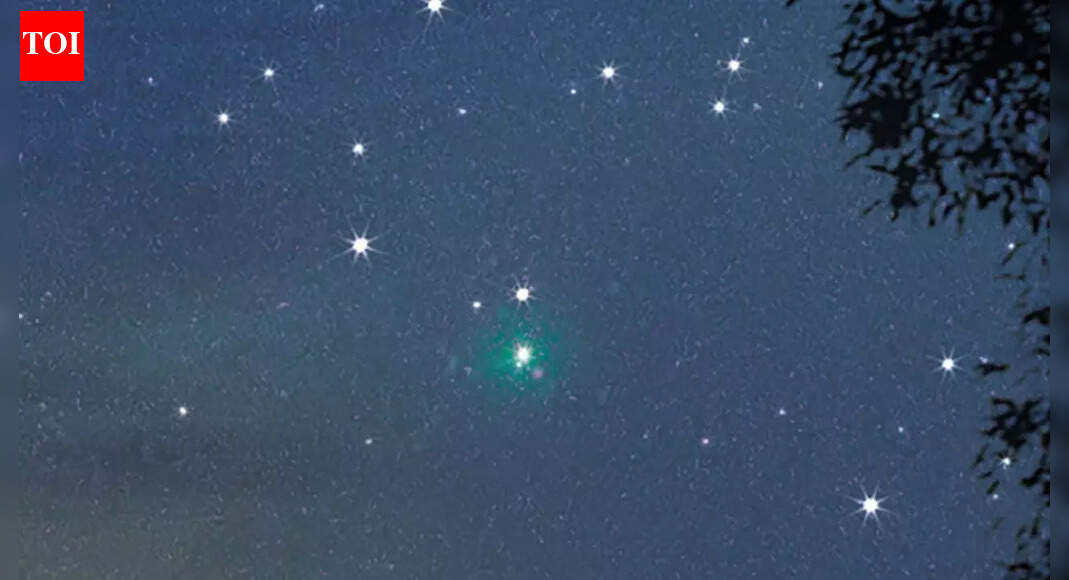
Interstellar comet 3I/ATLAS approaches Earth on 19 December: How to view this rare cosmic event
हिंदी में सुनें
Listen to this article in Hindi
Interstellar comet 3I/ATLAS, discovered in July, will approach Earth on December 19. Learn how to view this rare visitor from another star system.
On December 19th, interstellar comet 3I/ATLAS will make its closest approach to Earth, offering a unique opportunity for scientific observation. Discovered in July by the NASA-funded ATLAS telescopes in Chile, this comet is only the third interstellar object ever confirmed to enter our solar system, following 1I/'Oumuamua in 2017 and 2I/Borisov in 2019.
While 3I/ATLAS will remain at a safe distance of approximately 270 million kilometers (1.8 astronomical units) from Earth, it provides astronomers with another chance to study material from beyond our solar system. As the comet nears the Sun, the dust and gas it releases can be analyzed to glean insights into the evolution of other planetary systems.
Unlike comets originating within our solar system, interstellar comets like 3I/ATLAS follow distinct trajectories and speeds, setting them apart. Studying the composition of this comet offers a glimpse into the makeup of another star system.
**Viewing 3I/ATLAS**
While 3I/ATLAS won't be visible to the naked eye, it can be observed using telescopes and remote space observatories. Recent images from the Hubble Space Telescope and the Jupiter-bound spacecraft JUICE show the comet's bright coma and faint tail. Amateur astronomers can also participate through the Virtual Telescope Project, which will broadcast the event on December 18th at 11:00 pm EST (04:00 GMT on December 19th), weather permitting.
**Scientific Significance**
Researching 3I/ATLAS allows scientists to examine the dust and gases released from its icy nucleus as it heats up near the Sun. This process, called sublimation, produces materials that can reveal the elements composing a celestial body formed in another star system. Analyzing these materials can provide valuable data for interstellar chemistry studies. This encounter is a significant opportunity to observe an interstellar object up close, and the observations will contribute to studies of planet evolution and structure.
**About 3I/ATLAS**
- It is an interstellar comet, originating from outside our solar system.
- Its closest approach to Earth will be on December 19th at a distance of 270 million kilometers.
- It is not visible without telescopes.
- Studying it offers a rare chance to analyze matter from another star system.
- It poses no threat of collision with Earth.