India's Chandrayaan-3 confirms Moon's South Pole is alive. Here's what it found
हिंदी में सुनें
Listen to this article in Hindi
Analysis of Chandrayaan-3 lander data collected between August 23 and September 03, 2023 has produced significant, first-of-its-kind findings about the Moon's south polar region.
India’s Chandrayaan-3 mission has revealed remarkable new details about the Moon’s South Pole, uncovering a surprisingly dynamic and electrically active environment near the surface.
Analysis of data collected by the Vikram lander between August 23 and September 3, 2023, provides the first-ever in situ measurements of the plasma conditions in this region, results that mark a milestone in lunar science.
Plasma, known as the fourth state of matter, is a mixture of charged particles, ions and free electrons, that can conduct electricity and respond to electromagnetic fields.
advertisement
On the Moon, this plasma environment is shaped primarily by the solar wind, a continuous stream of high-energy charged particles from the Sun, and the photoelectric effect, in which sunlight knocks electrons from lunar surface atoms. These processes create a weak but variable lunar ionosphere that constantly interacts with changing electromagnetic conditions.
The Radio Anatomy of Moon Bound Hypersensitive ionosphere and Atmosphere Langmuir Probe (RAMBHA-LP) onboard the Vikram lander measured electron densities at Chandrayaan-3’s landing site, the Shiv Shakti Point, ranging between 380 and 600 electrons per cubic centimeter.
This is significantly higher than what was previously estimated from remote sensing data taken at higher altitudes. Even more striking, the electrons displayed high kinetic temperatures between 3,000 and 8,000 Kelvin, indicating intense energy in the near-surface environment.
The study further found that the plasma varies depending on the Moon’s position in its orbit around Earth. During the lunar daytime, when the Moon faces the Sun, the plasma is mainly influenced by solar wind interactions. However, when the Moon passes through Earth’s magnetotail, an extended region of the planet’s magnetic field, the plasma becomes dominated by particles streaming from Earth itself.
Additionally, Isro’s in-house Lunar Ionospheric Model suggests that molecular ions, possibly from gases such as carbon dioxide and water vapor, also contribute to this charged layer.
Developed by the Space Physics Laboratory at Vikram Sarabhai Space Centre, the RAMBHA-LP instrument’s findings provide crucial “ground truth” data for future lunar missions and long-term human exploration efforts near the Moon’s polar regions.
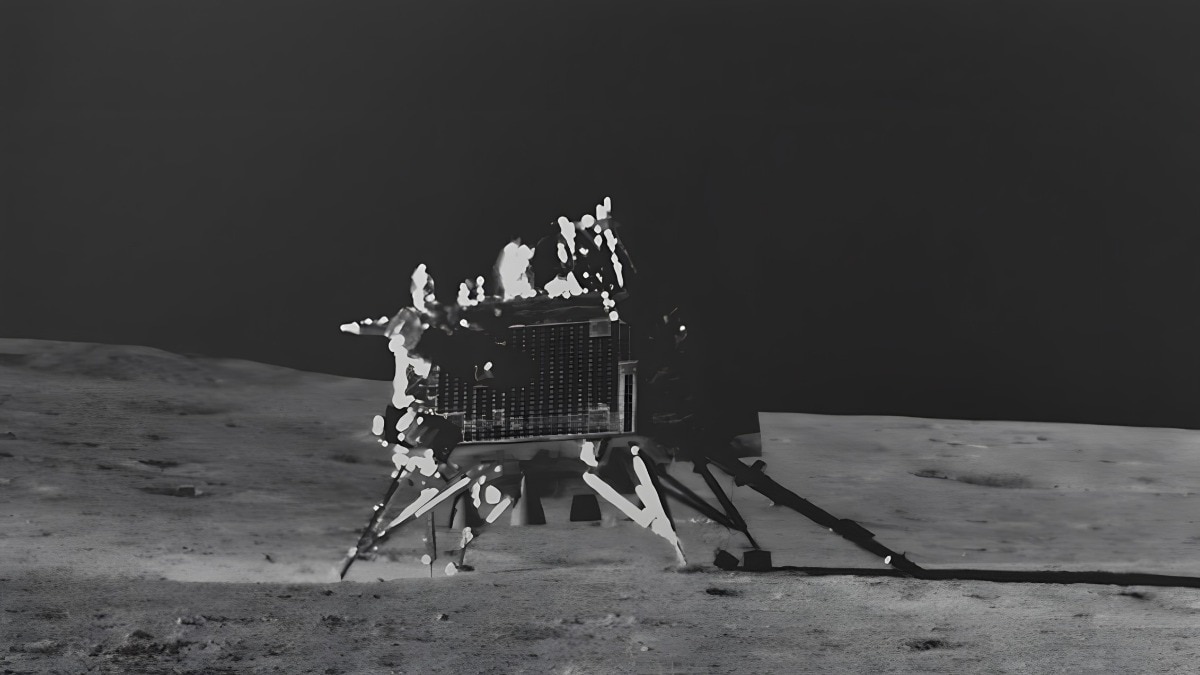
Chandrayaan-3 is India’s third lunar mission, designed to demonstrate a soft landing and rover operations on the Moon’s surface. Its lander, Vikram, successfully touched down near the South Pole in 2023, enabling new scientific measurements of lunar soil, temperature, plasma environment and seismic activity, marking a milestone in India’s space exploration.
- Ends