Indian scientists spot 12-billion-year-old Milky way-like galaxy in Webb images
A new study reports a massive ancient galaxy. It formed when the universe was very young. The universe today is 13.8 billion years old.
Astronomers in India say the early universe still holds surprises, and one ancient galaxy is now forcing scientists to rethink what young cosmic systems could achieve so quickly after the Big Bang.
Early galaxy discovery raises new questions
A new study reports a massive ancient galaxy. It formed when the universe was very young. The universe today is 13.8 billion years old. This galaxy lived only 1.5 billion years in. That means we see it from 12 billion years ago. How did such an ordered system form so early?
Scientists once thought early galaxies were chaotic. They believed those systems looked irregular and messy. But new findings challenge older ideas strongly now. Researchers Rashi Jain and Yogesh Wadadekar used James Webb. Their work appears in Astronomy and Astrophysics. What made this galaxy so unusual and structured?
JWST reveals a mature spiral structure
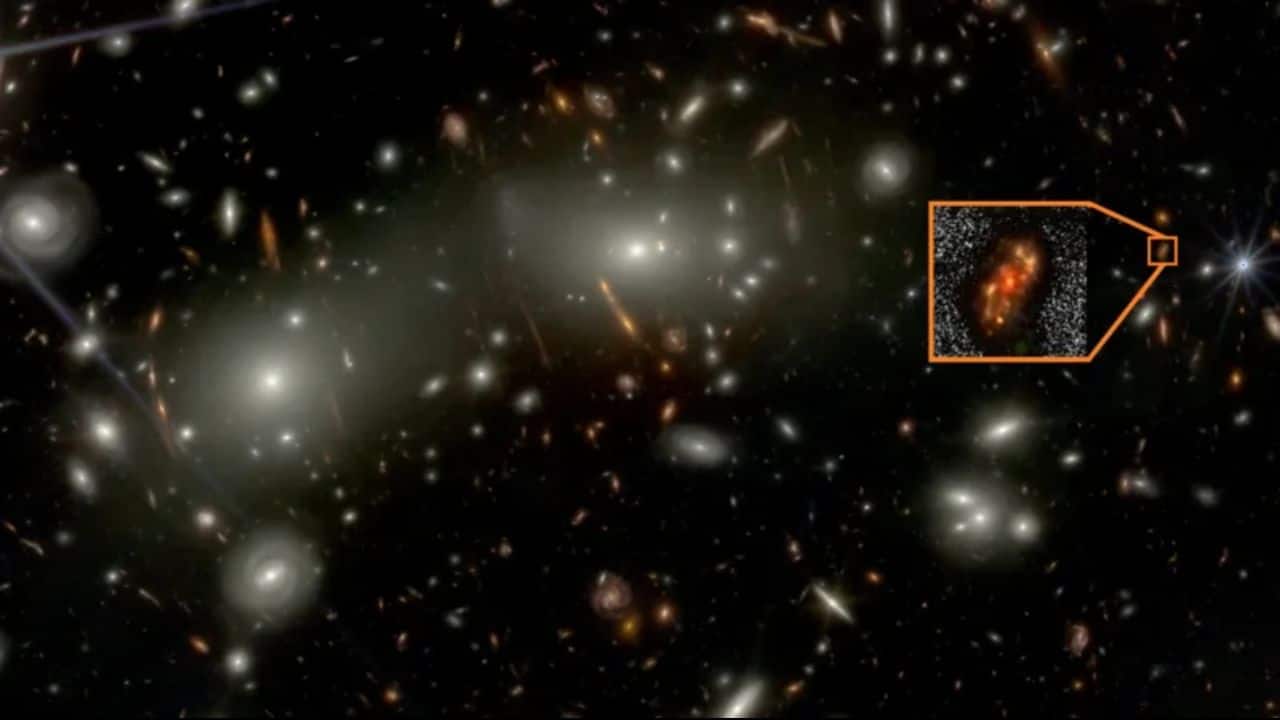
They spotted a fully formed spiral galaxy. It looked like a cosmic pinwheel in detail. They named the galaxy Alaknanda recently. The name comes from a Himalayan river. Prof Wadadekar says it resembles our Milky Way. Why would such order appear at such time?
Ms Jain found it while studying 70,000 objects. Only one object showed a clear spiral shape. The galaxy spans nearly 30,000 light-years across. She noted two balanced arms from the centre. Those arms wrapped around a bright central bulge. She also saw beads-on-a-string star clusters. That pattern appears in many nearby spirals today.
Prof Wadadekar first reacted with disbelief. He said such a galaxy seemed impossible then. This galaxy holds 10 billion solar masses now. It built its disc very quickly by cosmic scales. Could such rapid growth occur so soon after creation?
Astronomers once thought cosmic dawn was turbulent. Early galaxies were expected to be small then. But Alaknanda appears very large and active. It forms stars up to 30 times faster. That rate exceeds the Milky Way’s pace today. Does that suggest early space was more mature?
Researchers seek answers from the ancient past
James Webb has revealed many distant galaxies. Early images often showed unclear red shapes. Later findings revealed more complex structures. Spiral galaxies appeared far earlier than expected. Does this change views on galaxy evolution overall?
Ms Jain says such spirals are rare exceptions. Those exceptions test models of cosmic history. They show structure formed earlier than believed. She says the universe was more creative then. The complexity emerged faster than scientists assumed.
This galaxy sits 12 billion light-years away. Light from it travelled that long to us. Ms Jain says we view only its ancient state. A galaxy’s lifespan is far too long to watch. Astronomers rely on statistical samples for answers. Could follow-up studies reveal how its arms formed?
Prof Wadadekar says people ask about its fate. He tells them to wait another 12 billion years. Researchers plan to request more telescope time soon. They may use Webb or the Alma observatory. They hope to learn how such spirals emerged quickly. They say lessons from early galaxies guide our future.