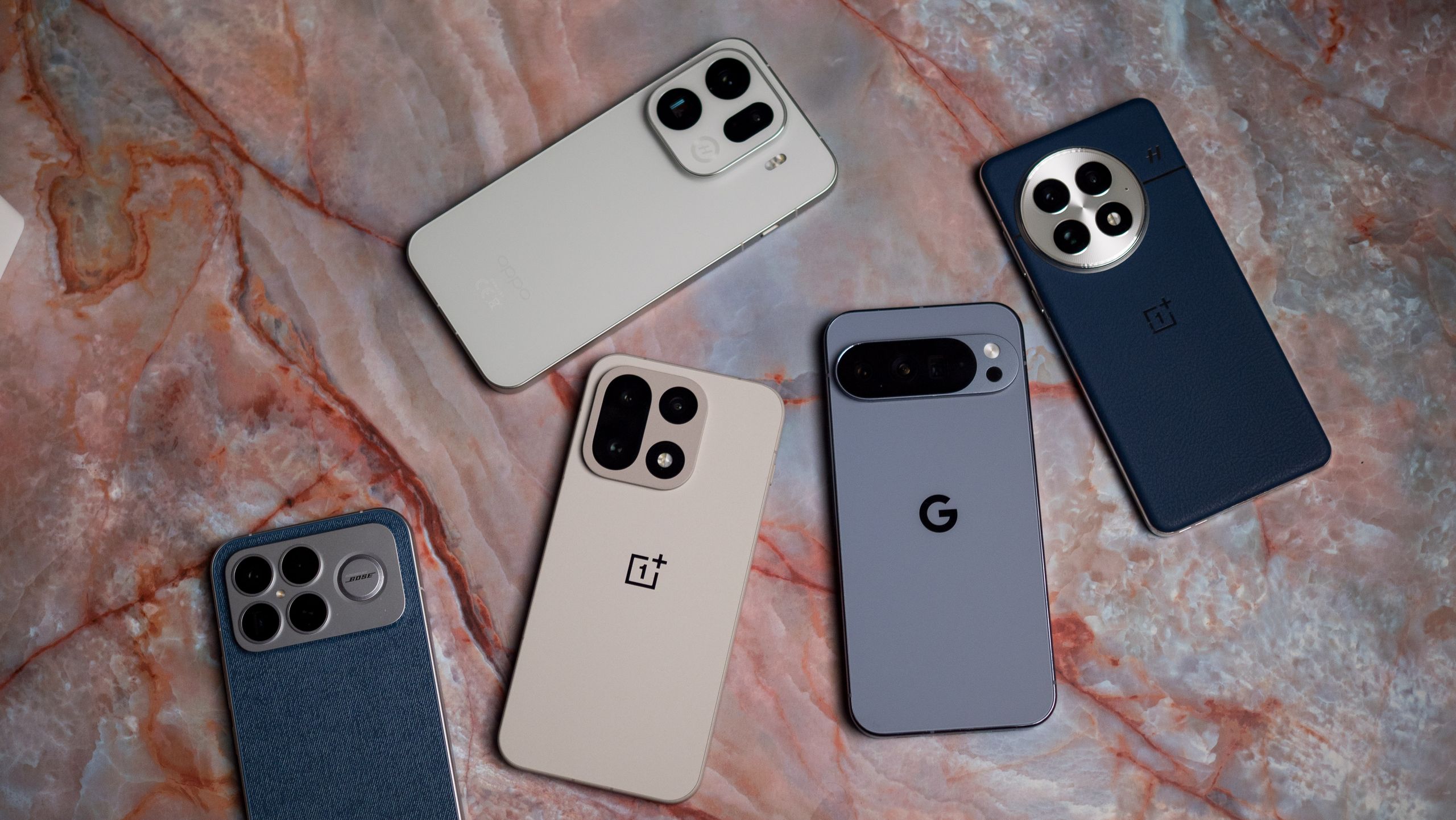
I compared the Snapdragon 8 Elite Gen 5 to the Snapdragon 8 Elite, Tensor G5, and Dimensity 9500
Qualcomm still has a slender edge with the Snapdragon 8 Elite Gen 5, but MediaTek is onto something special with the Dimensity 9500.
It has been a good year for phones, and hardware in general has never been better. Qualcomm is delivering sizeable gains with the Snapdragon 8 Elite Gen 5, MediaTek did the same with the Dimensity 9500, and even Google got its act together with the Tensor G5, finally switching to TSMC's 3nm node — the same as Qualcomm and MediaTek.
I used five devices with the Snapdragon 8 Elite Gen 5 over the course of the last month — the OnePlus 15, POCO F8 Ultra, iQOO 15, Redmagic 11 Pro, and the Realme GT 8 Pro — along with four devices powered by the Dimensity 9500: Vivo X300 Pro, X300 Pro, Find X9 Pro, and Find X9. Finally, I tested key devices in the Pixel 10 family, including the Pixel 10, 10 Pro XL, and Pixel 10 Pro Fold.
I'm not going into too many details about each platform, but as a high-level overview, all chip vendors are using the latest cores and tout heady gains. Obviously, Qualcomm stands out for its use of custom cores on the Snapdragon 8 Elite Gen 5, with the platform featuring a second-gen design with double-digit increase in performance, and there's a similar level of uptick when it comes to gaming.
Having said that, what MediaTek is doing is even more interesting. The vendor is using Arm's latest cores, including the C1 Ultra, C1 Pro, and C1 Premium. The G1 Ultra GPU is terrific as well, and overall, Arm really turned things up a notch this year. On that note, the Tensor G5 is actually good this time. It still doesn't use the latest Arm cores or isn't anywhere as fast as what Qualcomm and MediaTek are offering, but it doesn't feel intentionally hobbled, and that's an achievement in and of itself.
Snapdragon 8 Elite Gen 5 vs. Snapdragon 8 Elite vs. Tensor G5 vs. Dimensity 9500
Let's take a look at how the new platforms hold up in synthetic workloads. I'm using the Redmagic 11 Pro as well as the Redmagic 10S Pro to test Qualcomm, the Vivo X300 Pro to showcase the Dimensity 9500, and the Pixel 10 Pro XL with the Tensor G5.
The Geekbench 6 single-core results show that Qualcomm really has the best single-core design on Android, and this is down to a custom design and increased frequencies, with Qualcomm going up to 4.6GHz while MediaTek doesn't exceed 4.21GHz. As you can see, the difference in negligible in multi-core workloads between the two, but when comparing to last year's silicon, there is still a decent boost.
Similarly, Qualcomm has a lead in 3DMark's Wild Life test, but things are on an equal footing with the ray tracing-based Solar Bay workload. The gains aren't as noticeable from last year either, and the only thing these tests illustrate is just how far behind the Tensor G5 is in this regard. Google says its focus is on AI, and it doesn't want to chase raw numbers, and that bears out in the testing.
Thankfully, it isn't the same in real-world testing. I used the Pixel 10 Pro XL as my daily driver for well over two months, and it is just as fluid as the POCO F8 Ultra or the X300 Pro at a lot of daily tasks. Yes, it doesn't hold up as well at gaming — even though there's much better thermal management — and there is noticeable throttling in extended gaming sessions. Even then, it is better than just about every other Pixel I've used — which I know isn't saying much.
Coming to Qualcomm and MediaTek, there really isn't much of a difference in actual usage. Both have a similar level of efficiency, but if I had to pick a winner, I'd say the Dimensity 9500 has the edge — my Find X9 Pro lasts longer even though it has a similar-sized battery as the OnePlus 15.
Both chipsets do a fantastic job when it comes to gaming, and they handle demanding games well. There is some throttling with extended use, but it doesn't affect the image quality in a noticeable way. The only point of contention is overheating — this affects Qualcomm much more than MediaTek. In my use, I found the Redmagic 11 Pro to get considerably hotter than the X300 Pro in gaming sessions lasting over an hour, and while it didn't get as hot as when I ran synthetic tests, it was still uncomfortable to hold.
The X300 Pro also got hot, but it was never to a point where I couldn't hold the device. The maximum it went up to was 43 degrees Celsius, with the Redmagic 11 Pro crossing 48 degrees, and exceeding 52 degrees when running 3DMark tests.
On the whole, I think MediaTek has the edge this time around. I'm not denying that Qualcomm isn't as good, but intermittent issues with overheating have proven to be annoying, and I don't see that with my X300 Pro or Find X9 Pro.