Planet Formation Under Pressure: Hubble Reveals Turbulent Disk Around Young Star
हिंदी में सुनें
Listen to this article in Hindi
Hubble captures unprecedented images of a turbulent, planet-forming disk dubbed 'Dracula's Chivito,' challenging assumptions about early planetary systems.
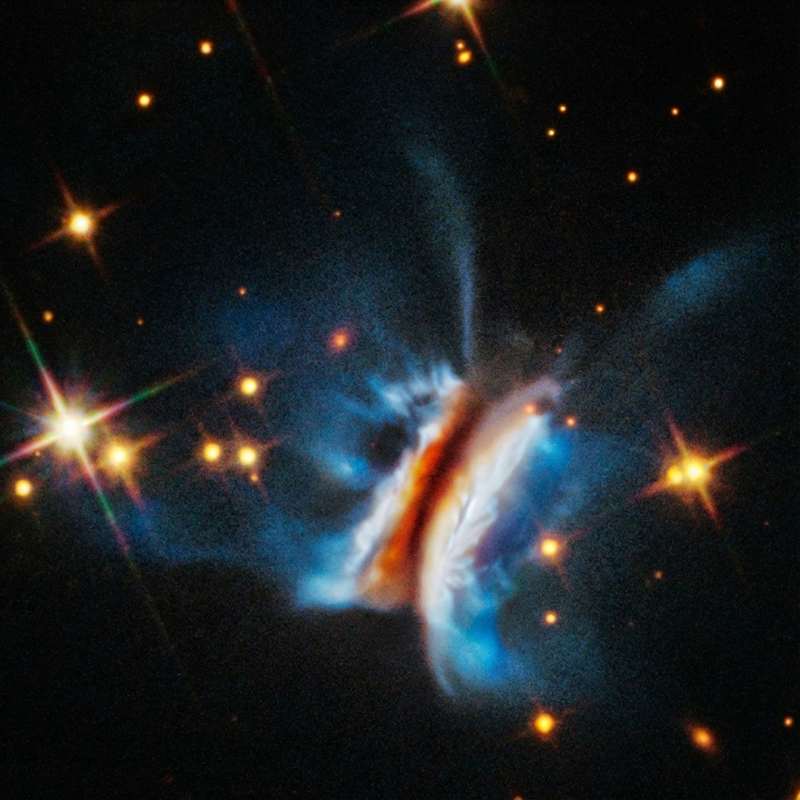
The Hubble Space Telescope has peered into the swirling chaos surrounding a young star, revealing a protoplanetary disk unlike any seen before. Officially designated IRAS 23077+6707, but affectionately nicknamed ‘Dracula’s Chivito,’ this vast disk, located approximately 1,000 light-years away, presents a turbulent environment where planets may be struggling to form. The images, recently released by NASA, provide a unique opportunity to study planet formation under extreme conditions.
Protoplanetary disks are the nurseries of planets. These swirling clouds of gas and dust, orbiting young stars, provide the raw materials and the space for planetary bodies to coalesce. Within these disks, dust grains collide and stick together, gradually growing into larger and larger objects, eventually forming planetesimals, and then, potentially, fully formed planets. Studying these disks is crucial to understanding the diversity of planetary systems we observe throughout the galaxy. (See our [Science basics explainer] for more on how telescopes help us understand the universe.)
What makes Dracula's Chivito particularly interesting is its observed turbulence. Unlike the relatively smooth and orderly disks often depicted in models of planet formation, this disk exhibits significant disturbances. The edge-on view obtained by Hubble allows astronomers to observe a dark central lane, representing the densest region of the disk, flanked by glowing layers of gas and dust. This 'hamburger' appearance, as described by NASA, provides valuable information about the disk's structure and composition. The unexpected level of chaos suggests that the processes of planet formation within Dracula's Chivito may be significantly different from those in more quiescent environments.
One possibility is that the turbulence is caused by interactions with the central star, IRAS 23077+6707. The star's powerful radiation and stellar winds could be disrupting the disk, preventing it from settling into a more stable configuration. Alternatively, the turbulence could be the result of gravitational interactions with other stars in the vicinity or even with nascent planets already forming within the disk. Understanding the source of this turbulence is key to understanding its impact on planet formation.
The discovery of Dracula's Chivito also highlights the limitations of our current understanding of planet formation. While models often assume relatively stable and predictable conditions, the reality, as revealed by Hubble, can be far more complex and chaotic. This suggests that our models need to be refined to account for the diverse range of environments in which planets can form. It also emphasizes the importance of continued observations of protoplanetary disks to gain a more complete picture of the planet formation process. (For related field context, see our article on [exoplanet atmospheres].)
It's important to note that the Hubble observations provide a snapshot in time. The dynamics of protoplanetary disks are constantly evolving, and the turbulence observed in Dracula's Chivito may be a transient phenomenon. Continued monitoring of this disk over time will be necessary to understand its long-term evolution and its ultimate fate. Will planets successfully form within this turbulent environment, or will the chaos ultimately prevent the formation of stable planetary systems? These are questions that astronomers hope to answer through future observations.
The images captured by Hubble, while stunning, do not provide all the answers. Further observations, particularly at different wavelengths of light, will be needed to fully characterize the composition and structure of Dracula's Chivito. Radio telescopes, for example, can probe the distribution of gas within the disk, while infrared telescopes can reveal the temperature and composition of the dust grains. Combining data from multiple telescopes will provide a more complete picture of this intriguing object. (Review [prior research background] on protoplanetary disks.)
So where does that leave things? the discovery of Dracula's Chivito is a significant step forward in our understanding of planet formation. While the turbulent nature of the disk presents challenges to current models, it also provides a unique opportunity to study planet formation under extreme conditions. The observations highlight the diversity and complexity of protoplanetary disks and emphasize the need for continued research in this exciting field. The answers to the questions raised by this discovery will undoubtedly shape our understanding of the origins of planetary systems, including our own, for years to come.
Editor’s note: This article was independently written by the Scoopliner Editorial Team using publicly available information.