Unveiling the Chaos: How a Stellar Nursery's Instability Could Shape Planetary Evolution
हिंदी में सुनें
Listen to this article in Hindi
Hubble's observation of a massive, chaotic protoplanetary disk reveals insights into how unstable environments can influence planetary formation and evolution.
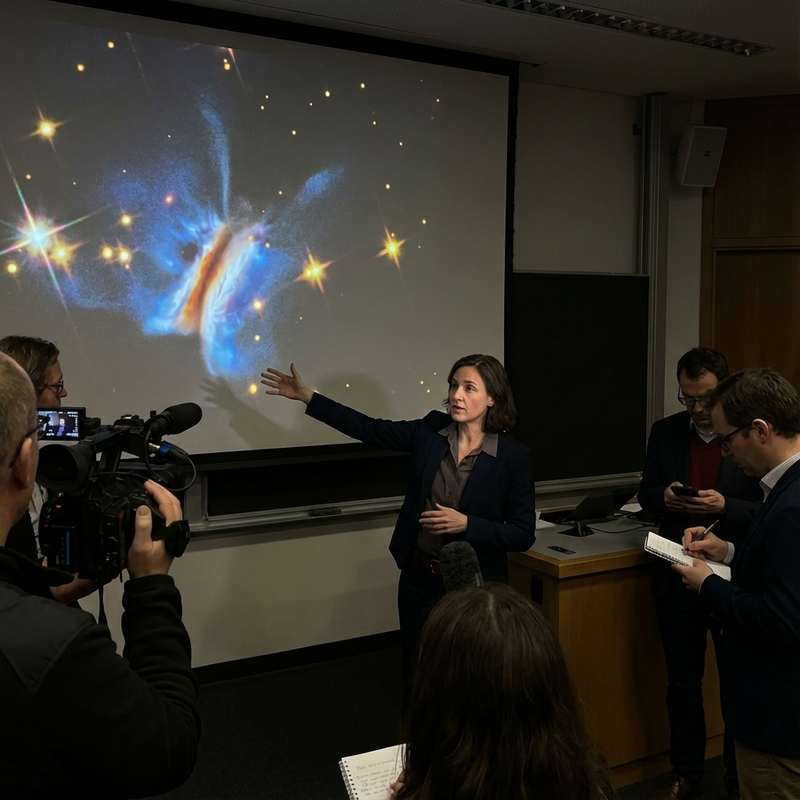
The universe is a dynamic place, and the birthplaces of planets are no exception. Recent observations from the Hubble Space Telescope have revealed an exceptionally large and seemingly chaotic protoplanetary disk, nicknamed “Dracula’s Chivito.” This stellar nursery presents a unique opportunity to study the extreme conditions under which planets can form, challenging some of our established models of planetary system development. Understanding the dynamics within these turbulent disks is crucial for piecing together the diverse range of exoplanets discovered in recent years.
A protoplanetary disk is a swirling mass of gas and dust surrounding a young star. These disks are the raw material from which planets are born. Within these disks, dust grains collide and clump together, gradually growing into larger bodies called planetesimals, and eventually, planets. The standard model of planet formation assumes a relatively orderly process, with material coalescing in a stable, rotating disk. That said, the reality is a bit more complicated. “Dracula’s Chivito” seems to defy this neat picture. Its immense size and observed irregularities suggest a far more turbulent environment.
What makes this particular disk so interesting? Firstly, its sheer size is remarkable. It dwarfs many other observed protoplanetary disks, implying a substantial reservoir of material available for planet formation. Secondly, the disk exhibits significant asymmetries and spiral structures, indicating gravitational instabilities. These instabilities could be triggered by factors such as the disk's mass, its temperature profile, or the presence of unseen companion stars. Such instabilities can lead to the rapid collapse of material, potentially forming massive planets or even brown dwarfs (objects larger than planets but smaller than stars). Understanding the basics of star formation helps contextualize these observations.
The observation of such a chaotic environment raises several questions about the types of planets that might form there. Will they be gas giants flung into highly eccentric orbits? Will rocky planets even be able to coalesce in such a turbulent setting? The answers to these questions could reshape our understanding of planet formation. It's important to note that the term 'chaotic' doesn't necessarily mean 'destructive' for planet formation. In fact, these instabilities may provide a mechanism for rapidly building massive planets, a process that is difficult to explain with standard models. For broader context, exploring related fields like exoplanet research provides further insights.
That said, the reality is a bit more complicated. there are limitations to what we can currently discern about “Dracula’s Chivito.” The Hubble observations provide a snapshot in time. To fully understand the disk's evolution, long-term monitoring is needed. Furthermore, the presence of dust obscures our view of the inner regions of the disk, making it difficult to directly observe the formation of planets close to the star. Future observations, particularly with the James Webb Space Telescope, which can penetrate the dust with its infrared vision, may provide crucial insights. It could reveal the composition of the disk, the presence of forming planets, and the dynamics of the gas and dust.
Another key area of uncertainty lies in the role of the central star itself. The star's activity, such as stellar flares and winds, can significantly influence the protoplanetary disk. These factors can erode the disk, heat the gas, and even disrupt the formation of planets. A more complete picture requires a detailed understanding of the star's properties and its interaction with the surrounding disk. Examining prior research in stellar evolution and the impact on circumstellar disks is useful here.
So where does that leave things? the discovery of “Dracula’s Chivito” provides a compelling glimpse into the diverse and often turbulent environments where planets are born. While this particular disk presents a challenge to our standard models of planet formation, it also offers a unique opportunity to study the complex interplay of forces that shape planetary systems. This doesn't mean our previous understanding is wrong, but rather incomplete. Further observations and theoretical modeling are needed to fully unravel the mysteries of this chaotic stellar nursery and its potential to produce a new generation of planets. The insights gained will undoubtedly deepen our understanding of the origins of planetary systems throughout the galaxy and beyond.
Editor’s note: This article was independently written by the Scoopliner Editorial Team using publicly available information.