Hubble Space Telescope Revisits NGC 4388
हिंदी में सुनें
Listen to this article in Hindi
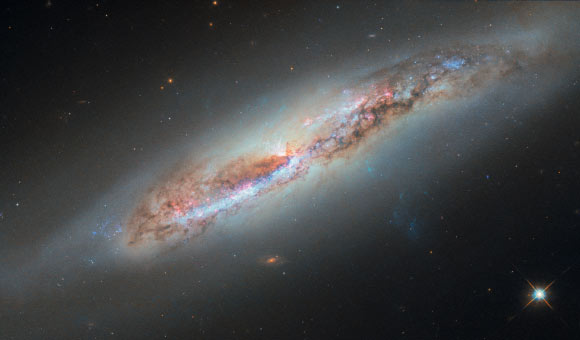
Hubble captures a stunning new image of NGC 4388, an active spiral galaxy in the Virgo Cluster, revealing a plume of gas not seen in previous images.
A new image from the NASA/ESA Hubble Space Telescope showcases the spiral galaxy NGC 4388 in remarkable detail.
Located roughly 59 million light-years away in the constellation Virgo, NGC 4388 was first observed by William Herschel on April 17, 1784. This galaxy, also cataloged as LEDA 40581 and IRAS 12232+1256, spans 120,000 light-years in diameter.
NGC 4388 is one of the brighter galaxies residing within the Virgo Cluster, a massive group containing over 2,000 galaxies. Its classification as an active galaxy stems from its notably energetic nucleus.
The Hubble astronomers noted that NGC 4388's extreme tilt relative to our line of sight provides an almost edge-on view. This perspective highlights a feature not apparent in a 2016 Hubble image: a plume of gas emanating from the galaxy's nucleus, extending from the galactic disk towards the lower-right of the image.
The source and luminosity of this outflow are attributed to the galaxy's journey through the Virgo Cluster. While seemingly empty, the space between galaxies contains a hot gas known as the intracluster medium. As NGC 4388 traverses the cluster, it encounters this medium, which strips gas from the galaxy's disk, creating a trailing effect.
The energy source that ionizes the gas cloud, causing it to glow, remains somewhat uncertain. One theory suggests that energy originates from the galaxy's center, where a supermassive black hole heats surrounding gas into a blazing disk. Radiation from this disk could ionize nearby gas, while shock waves might be responsible for ionizing gas filaments farther away.