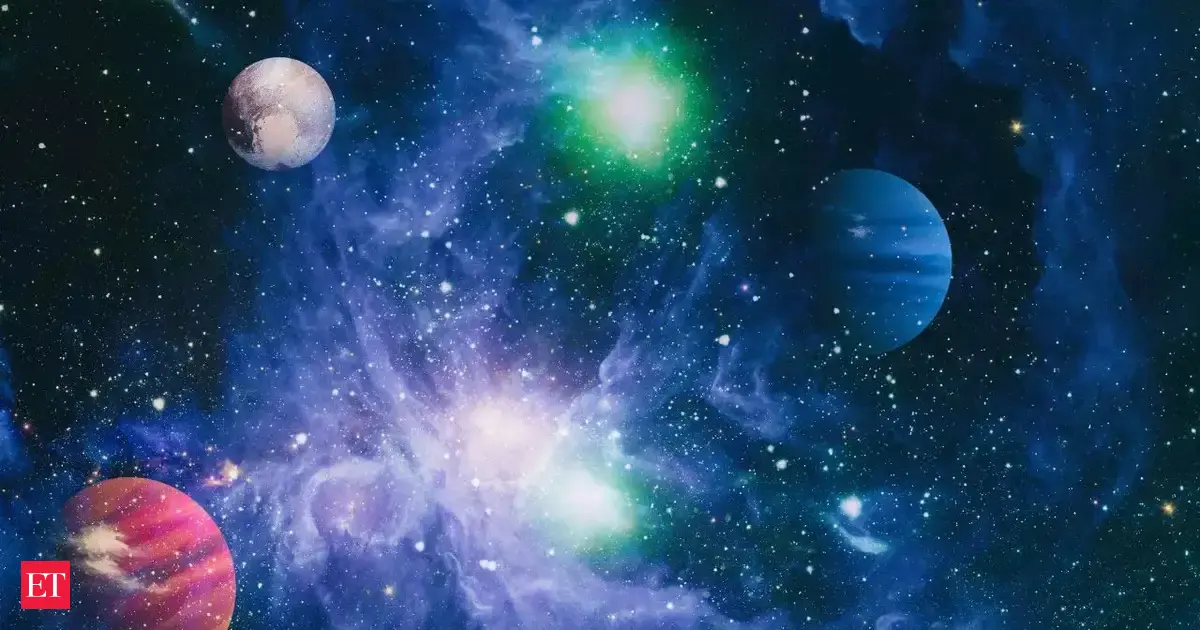
How will the universe end? Scientists explore its possible future
The universe, which originated 14 billion years ago in the Big Bang, remains to evolve. Stars and galaxies form, age, and eventually die, with smaller galaxies combining into larger ones with time. Scientists rely on observations of distant galaxies to forecast future cosmic transformations, though long-term predictions are uncertain. Our Sun is midway through its life, while huge blue stars burn out immediately and red stars persist for trillions of years.
Synopsis
The universe, which originated 14 billion years ago in the Big Bang, remains to evolve. Stars and galaxies form, age, and eventually die, with smaller galaxies combining into larger ones with time. Scientists rely on observations of distant galaxies to forecast future cosmic transformations, though long-term predictions are uncertain. Our Sun is midway through its life, while huge blue stars burn out immediately and red stars persist for trillions of years.
The universe, encompassing all space, time, matter, and energy, originated approximately 14 billion years ago with a quick expansion called the Big Bang. Since that moment, it has evolved continuously. Primarily filled with a diffuse gas of particles, such as protons, neutrons, and electrons, the universe eventually formed stars and galaxies as these materials collapsed under gravity.
How Do Scientists Predict the Universe’s Future?
Astrophysicists examine distant galaxies and stars to know how these systems evolve with time. By evaluating patterns today, they extrapolate potential scenarios for the far future. However, such forecasts have uncertainty. Interpolation, which links known data points, is far more reliable than projecting billions of years ahead.
What Will Happen to Stars?
Our Sun, a medium sized yellow star, has almost five billion years of life remaining. A star’s lifespan relies on its size: massive, hot, blue stars burn out rapidly, while small, cooler, red stars last longer. Some galaxies remain to form new stars, while others have exhausted their star forming gas. When star formation halts, blue stars explode as supernovae within millions of years, and yellow stars gradually shed their outer layers, leaving only red stars that eventually dim. Over trillions of years, even these red stars will vanish, making the universe dark.
How Do Galaxies Evolve?
Galaxies develop by merging with smaller ones, as like building a sandcastle by including bucket after bucket of sand. Within galaxy clusters, hundreds of galaxies gravitate toward a shared center, often colliding and combining into disordered, elliptical galaxies. Spiral galaxies, once orderly disks, eventually transform into these chaotic patterns. Our Milky Way and the neighboring Andromeda galaxy are anticipated to merge in a few billion years, providing future stargazers a spectacular view without actual star collisions.
Live Events
What About the Expansion of the Universe?
The Big Bang initiated a universal expansion that continues today. Gravity from stars, galaxies, gas, and dark matter slows this expansion, and some theories indicate that it might eventually pause. Yet, observations suggest that an unknown repulsive force, dark energy, is speeding up the universe’s growth. “Like raisins in a baking cookie, galaxies will zoom away from each other faster and faster. If this continues into the future, other galaxies might be too far apart to observe from the Milky Way.”
What Is the Likely End State?
Now, the most widely accepted prediction indicates a dark, quiet universe: star formation ceases, galaxies that have old red stars, and galactic clusters combine into massive elliptical galaxies. Accelerated expansion will isolate galaxies, making only the local group visible. This scenario extends into trillions of years, though fresh discoveries could change this vision. Depending on perspective, the universe may never really “end,” but it will get transformed from today.
How Should We Feel About This?
“This scenario sometimes makes me feel wistful, which is a type of sadness,” scientists states, “but then I remember we live at a very exciting time in the story of the universe: right at the start, in an era full of exciting stars and galaxies to observe!”
FAQs:
1. What is the universe?
The universe encompasses all of space, time, matter, and energy. It has stars, galaxies, planets, and all forms of radiation and dark matter.
2. What is a galaxy?
A galaxy is an enormous system of stars, gas, dust, and dark matter bound together by gravity. Examples include the Milky Way and Andromeda.
(You can now subscribe to our Economic Times WhatsApp channel)
(Catch all the US News, UK News, Canada News, International Breaking News Events, and Latest News Updates on The Economic Times.)
Download The Economic Times News App to get Daily International News Updates.
...moreless
(You can now subscribe to our Economic Times WhatsApp channel)
(Catch all the US News, UK News, Canada News, International Breaking News Events, and Latest News Updates on The Economic Times.)
Download The Economic Times News App to get Daily International News Updates.
...moreless
Explore More Stories
1
2
3
)