Chandrayaan-3's Propulsion Module: The Moon's Gravitational Influence Explained
हिंदी में सुनें
Listen to this article in Hindi
Chandrayaan-3's propulsion module experiences an orbital boost due to the Moon's gravity, revealing intriguing dynamics of space travel.
The recent interaction between India's Chandrayaan-3 propulsion module and the Moon highlights the complex dynamics of gravitational influences in space. In November 2025, following a series of maneuvers that began in October 2023, the propulsion module encountered the Moon's gravitational field, resulting in an unexpected alteration of its trajectory. This event underscores the significance of gravitational interactions in space missions and the potential for unplanned changes in orbital paths.
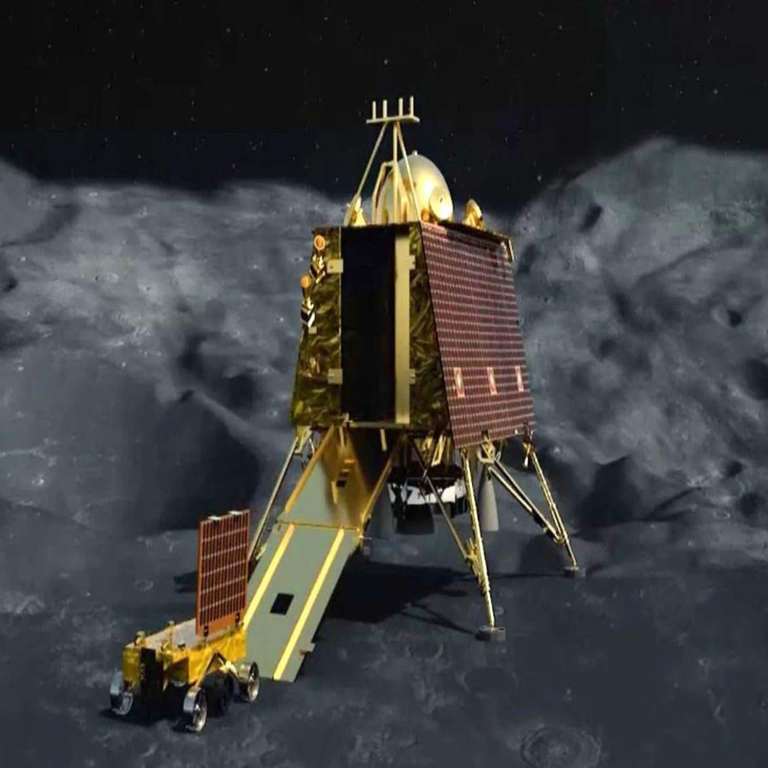
Chandrayaan-3, launched by the Indian Space Research Organisation (ISRO), successfully landed near the lunar south pole on August 23, 2023. After fulfilling its primary objectives, ISRO aimed to repurpose the propulsion module for additional tasks, given that it retained over 100 kg of propellant. Initial plans involved positioning the module into an Earth-bound orbit to gather data and conduct observations.
In October 2023, engineers executed a series of maneuvers to boost the propulsion module's speed and facilitate a Trans-Earth Injection (TEI) burn. This action placed the module into an elliptical orbit around Earth, reaching an apogee of approximately 380,000 km. That said, the reality is a bit more complicated. this trajectory eventually brought the module back into the Moon's sphere of influence, where it encountered the Moon's gravity once more in early November 2025.
During two close flybys on November 6 and November 11, the propulsion module experienced significant gravitational effects that altered its trajectory. According to astronomer Jonathan McDowell, the Moon's gravitational pull changed the module's orbit from a previously established elliptical path of about 125,000 x 305,000 km to a more elongated orbit with estimates ranging from 365,000 x 983,000 km to 409,000 x 727,000 km, as confirmed by ISRO.
These changes illustrate the potent influence of celestial bodies on spacecraft trajectories, emphasizing the need for ongoing research into orbital mechanics. The encounter also highlights the potential for gravitational assists, a strategy often used in space exploration to enhance spacecraft speed and adjust trajectories without additional fuel consumption.
That said, the reality is a bit more complicated. it is important to note that while the gravitational interaction was beneficial in this instance, it is not always predictable or controllable. The dynamics of such interactions can lead to unforeseen consequences, including potential risks to spacecraft if orbits become erratic or if encounters with other celestial bodies are miscalculated.
In summary, the unexpected boost of Chandrayaan-3's propulsion module due to the Moon's gravity serves as an informative case study in the complexities of space travel. It demonstrates both the potential benefits and the inherent uncertainties associated with gravitational influences in orbital mechanics, highlighting areas for further investigation and understanding in the field of space exploration.
As we continue to explore the Moon and beyond, these findings remind us of the intricate dance of gravitational forces that shape the paths of our spacecraft. The ongoing study of such phenomena is crucial for the planning and execution of future missions.
Editor's note: This article was independently written by the Scoopliner Editorial Team using publicly available information.