How Earth’s Atmosphere Reached the Moon
हिंदी में सुनें
Listen to this article in Hindi
Scientists may have solved the mystery of how particles from Earth's atmosphere, including water, ended up on the Moon. New research explains the process.
A scientific puzzle hidden in lunar soil, first detected during the Apollo missions, has intrigued researchers for years: the presence of Earth-borne particles, including water. Now, a potential explanation has emerged regarding their journey to the Moon.
Initial analysis of lunar dust samples, or regolith, recovered by the Apollo missions revealed traces of elements like water, carbon dioxide, helium, argon, and surprisingly, nitrogen. While solar winds might account for some of these elements, the elevated levels of nitrogen and other substances presented a challenge. The question remained: how did atmospheric particles from Earth make their way to the lunar surface?
In 2005, a team from the University of Tokyo proposed that these particles escaped Earth's atmosphere billions of years ago, a phenomenon they attributed to our planet's weaker magnetic field at the time. That said, the reality is a bit more complicated. subsequent investigations of iron-rich rocks in Greenland indicated that Earth's magnetic field was just as robust 3.7 billion years ago as it is today, casting doubt on the earlier hypothesis.
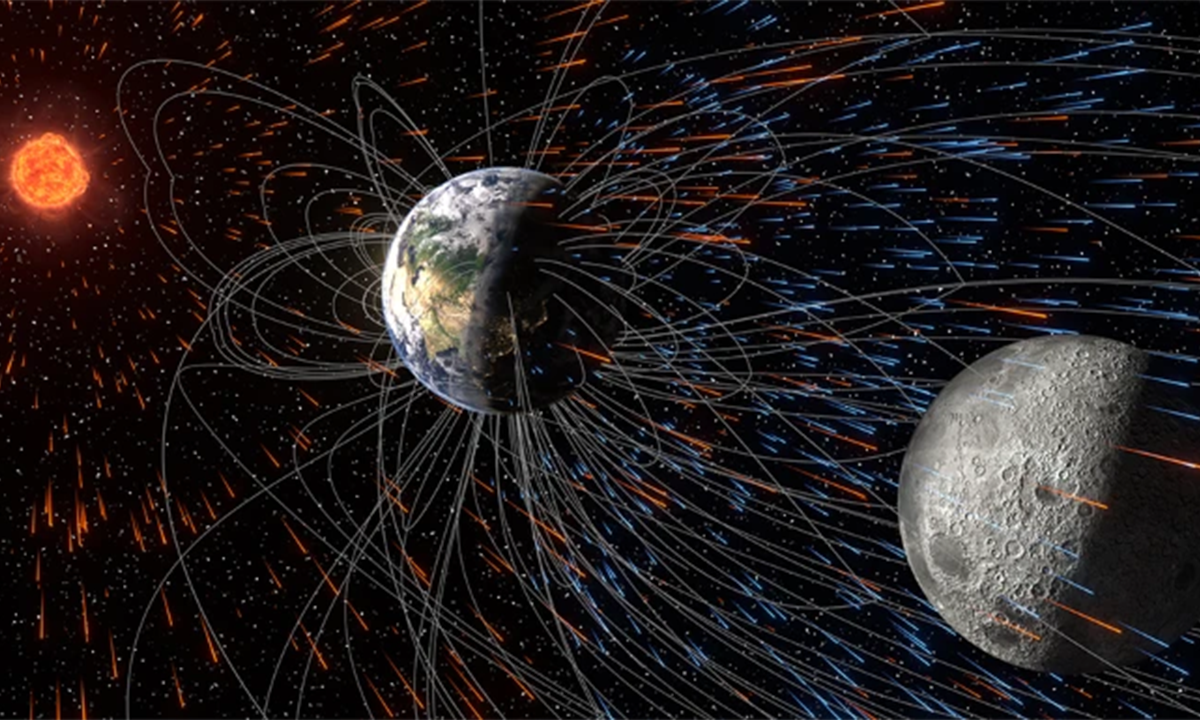
New research from the University of Rochester, published in *Nature Communications Earth and Environment*, offers a compelling alternative. Scientists combined data from regolith samples, solar wind measurements, and knowledge of Earth's magnetic field to create computer simulations. These simulations tested two scenarios: an "early Earth" model with a weak magnetic field and strong solar wind, and a "modern Earth" model characterized by a strong magnetic field and weak solar wind.
The simulations revealed that the "modern Earth" scenario aligned more closely with the particle composition of lunar regolith. The explanation? Earth's magnetic field, after charged particles were dislodged by solar wind, acted as a conduit, effectively transporting them to the Moon.
This discovery has significant implications. First, the continuous transfer of particles between Earth and the Moon suggests that lunar regolith might hold a record of Earth's early atmosphere. Second, the presence of water and other life-supporting elements on the Moon could facilitate future lunar colonization efforts.
According to Shubhonkar Paramanick, an astrophysics graduate student at the University of Rochester and co-author of the study, this research could also improve our understanding of atmospheric escape on planets such as Mars. Paramanick noted that Mars, which currently lacks a global magnetic field but possessed one in the past along with a denser atmosphere, could offer insights into how planetary evolution and atmospheric escape influence habitability.